

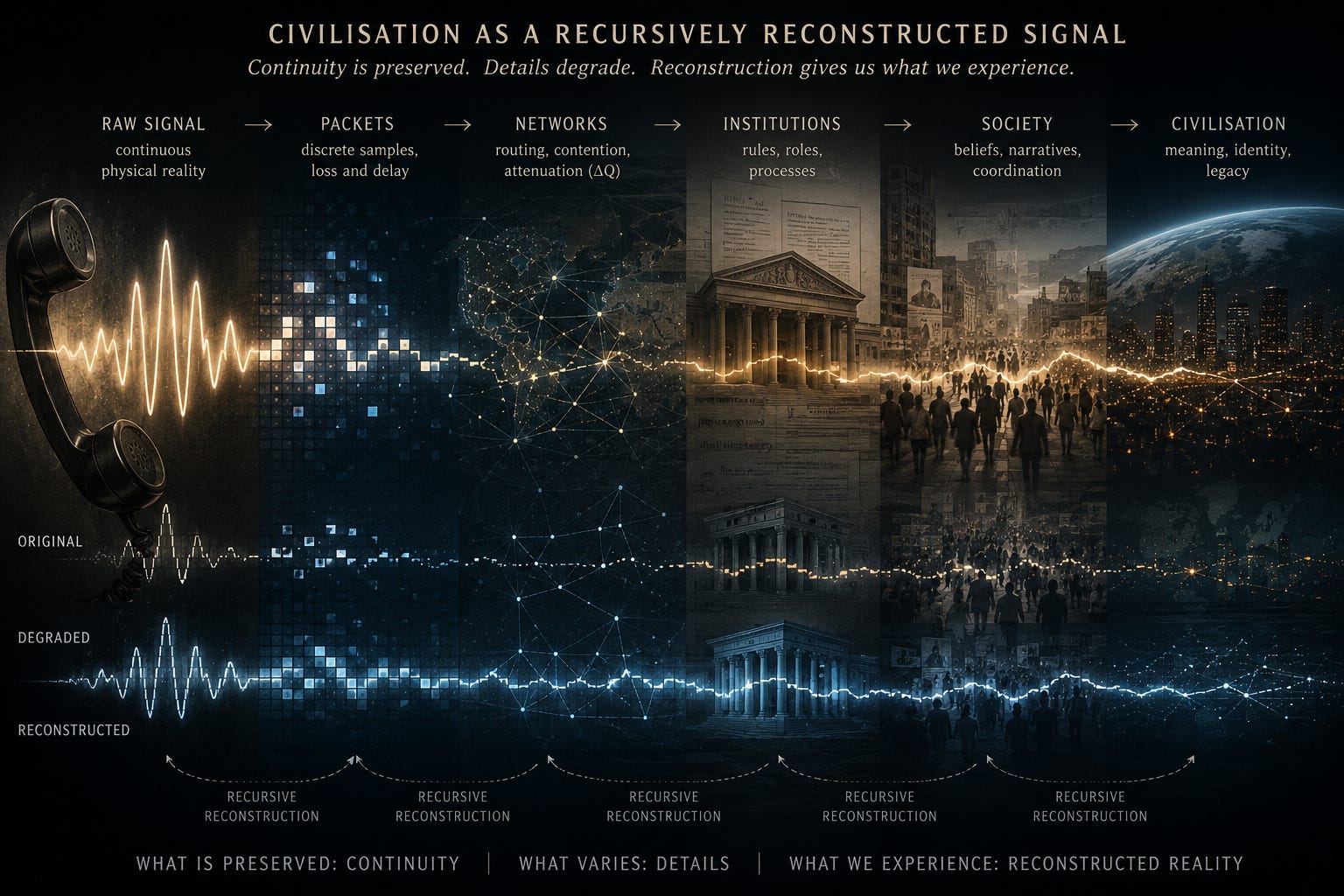
If you had told me in 2024 that being criminally prosecuted by a ghost court for the non-crime of “parking near people who parked badly” would eventually lead me toward a general theory of governance under load — and straight back to the same deep coordination problems I had worked on in telecoms a decade earlier — I would never have believed you.
The big “aha!” is that the real world is made of distributed structures with finite resources carrying potentially unbounded loads at any instant — more than they can service in the moment. Once you see that, imperfect outcomes stop looking like a malfunction and start looking like a fundamental property of reality.
Bureaucratic systems do not initially fail because they are evil or broken, but because finite coordination structures must degrade somehow under load. The default condition is contention and compromise — not malice. The pathology begins when systems hide, deny, or unlawfully redistribute the resulting degradation.
More specifically, people want truth, justice, and fairness to emerge cleanly from administrative bodies, but that ignores the fact that such systems cannot service every possible demand simultaneously. Under load, outcomes are delayed, fragmented, partially processed, distorted, or lost altogether.
They degrade in structurally the same way that packet networks do.
The real surprise, however, is not that ideas from distributed computing, packet-network performance, and network architecture can be applied to other domains. Engineers always suspected the principles transferred elsewhere; that was common coffee-break conversation.
What has really opened my eyes is the reverse direction: the wider civilisational picture turns out to reveal something profound about the Internet and distributed systems themselves.
What follows is pitched at the level of a general audience that is technically aware and scientifically literate at an ordinary high-school level. You do not need to be a packet-data nerd or mathematics professor to follow it. Some parts may stretch you a little, but that is the nature of trying to say something both profound and potentially new.
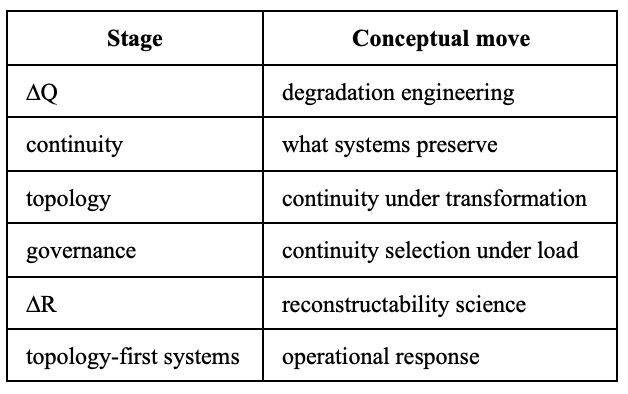
Here is the journey I want to take you on, if you will let me.
First, I will recap how I encountered a group of engineers who fundamentally reframed what a network actually is: a system whose quality inevitably attenuates under load. From that insight emerged a new science of degradation called ∆Q.
Then we will revisit what data networks really do. Contrary to popular intuition, they do not simply “transmit data”. They allow us to reconstruct events and experiences at a distance. That distinction turns out to matter enormously.
From there, we can look at the different layers at which reconstruction occurs, and ask what is being preserved or kept continuous at each one. Science, at its heart, is about invariants: the things that remain stable while other things vary. Energy, momentum, and charge are classic examples — quantities governed by laws that preserve certain continuities across transformation.
The question here is: what is the invariant in distributed reconstructive systems?
Once we have that machinery in place, we can shift from networking to governance. Courts, bureaucracies, institutions, media systems, and administrative bodies face the same fundamental problem as packet networks: finite coordination structures operating under load.
These decision-making systems conserve something as their invariant — typically institutional continuity — while varying something else — usually reconstructability.
This reveals reconstructability as the deeper general problem of which ‘quality’ is merely a special case — and civilisation itself as a reconstructive system operating under load.
That, in turn, lets us reinterpret ∆Q as a special case of a broader category: ∆R, the degradation of techno-social reconstructive systems.
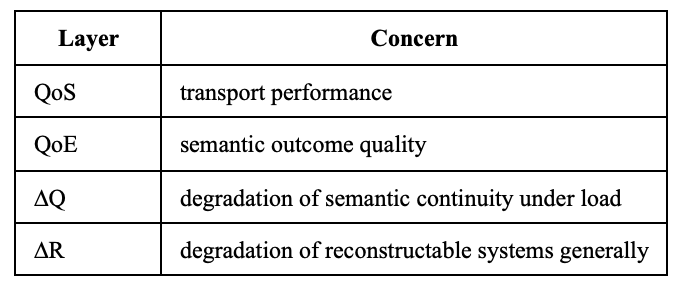
At that point, the fun really begins. We can borrow some surprisingly intuitive ideas from geometry and topology — concepts about paths, continuity, connectivity, boundaries, and structure — and apply them both to the general ∆R world and to the special-case ∆Q domain of packet networking.
Finally, we can return to the Internet itself with fresh eyes, and state the deeper insight about what networking architectures are actually doing. This includes a brief digression into related ideas such as Recursive InterNetwork Architecture (RINA), which now appear in a rather different light.
In the end, this all resolves into a single overarching problem domain: civilisation scaling.
These systems — networks, governments, institutions, even AI-mediated societies — share a common and deeply counter-intuitive property. Many people instinctively resist the conclusion because it cuts against modern assumptions about fairness, optimisation, and abstraction.
My conclusion is simple, even if the implications are not: there is a new science of reconstructable systems emerging, and it underpins almost everything in organisational and administrative life.
What we need now is an Institute for Scalable Civilisation — a kind of Bell Labs for governance, coordination, semantics, and reconstructability — to take ownership of it.
This probably isn’t your typical Substack post. As a small tip, if you set the margins to “none”, it prints quite nicely without truncating the text. You may even want a paper copy to work through at a slower pace.
Either way, I hope you enjoy the intellectual ride.
I blundered into telecoms in the early 2000s after working in IT throughout the 1990s. I had zero qualifications in networking, which turned out to be an advantage, as it allowed me to ask dumb questions without embarrassment. To me it was only “familiar technology” in the sense that it was digital and needed electricity. Beyond that, it was opaque.
So I became determined to understand what made it all tick, and — more importantly — what underlying principles simplified it enough that I didn’t have to fill my head with endless new detail. A theme running through everything that follows is my willingness to expend unbounded effort in pursuit of laziness. Finding the core simplicity is how you escape unnecessary mental and manual labour.
My first attempt to find the foundations led me to the “stupid network” movement: a loose collection of renegades pushing back against the complexity, cost, and over-engineering of the telecoms world. They correctly recognised the revolutionary potential of the Internet — and specifically the TCP/IP protocol stack — to democratise access to information, knowledge, and human connection.
In doing so, however, they privileged one particular outcome above all others: universal association between largely unmediated data nodes. Other properties — notably performance guarantees, security, identity, and economic sustainability — were treated as secondary concerns, or problems to be solved later.
The engineering requirements did not disappear; they merely relocated — and became harder to satisfy.
So my hunt for the fundamentals continued, and eventually I encountered a small team of UK computer scientists who had developed — originally in the context of military systems — new techniques for assuring the performance of distributed control systems under hostile conditions.
The military is in the business of blowing things up, and people die when systems fail. Destruction is the limiting case of non-reconstructability. Whether explicitly recognised or not, military systems engineering had therefore become a practical science of reconstructability under hostile conditions.
As a result, military engineers are naturally inclined to focus as much on how systems fail as on how they work. The challenge is translating those insights into the civilian world, where money is typically made by solving marketing and commercial problems rather than safety-critical engineering ones.
The enabling paradigm shift that allowed this team to control performance under overload — when almost nobody else could — was a reframing at the most fundamental level. In the ideal case, a network allows the perfect and instantaneous replication of information, enabling the perfect reconstruction of sensor signals, control instructions, and ultimately human experiences at a distance.
Real networks, however, degrade both the replication process itself — introducing delay, loss, jitter, and bit-level errors — and the reconstructed outcome. A glitchy voice call, frozen video stream, interminable download, or delayed control signal are all expressions of the same underlying problem: reconstructability under constraint, with contention being one form of resource limit.
This turned out to be the key insight: quality, taken as a whole, only ever attenuates. Its specific manifestations — loss, delay, jitter, bit-errors, and so on — can be traded off against one another, individually raised or lowered, but the underlying degradation itself cannot be magicked away.
Once degradation at one layer could be related cleanly to degradation at another, the entire stack of problems under load became mathematically tractable in a new way. Transport degradation, application degradation, and human outcome degradation could all be mapped onto one another as different expressions of the same underlying phenomenon.
It wasn’t enough to reason about these systems in an abstract or qualitative way; engineering is ultimately about quantified safety margins. A probabilistic algebra was therefore developed — the ∆Q calculus — which allowed the permissible “budget” for quality attenuation to be expressed mathematically and related directly to the acceptable rate of application failure.
Does this load fit into this supply, and if not, how much demand has to be discarded?
(You may already have spotted where the civilisation-scaling argument is heading.)
One might imagine this was already a solved problem, given that such reasoning is routine in most mature engineering disciplines. But broadband networking emerged during an era of extraordinary optimism about abundance and scale. “Fit for purpose” quietly gave way to “more bandwidth”. If the user experience degraded, that became a sales opportunity for a bigger pipe — whether or not it actually solved the underlying quality problem.
As a result, commercial and investment incentives drifted away from genuine engineering and toward the management of perception, marketing, and growth narratives.
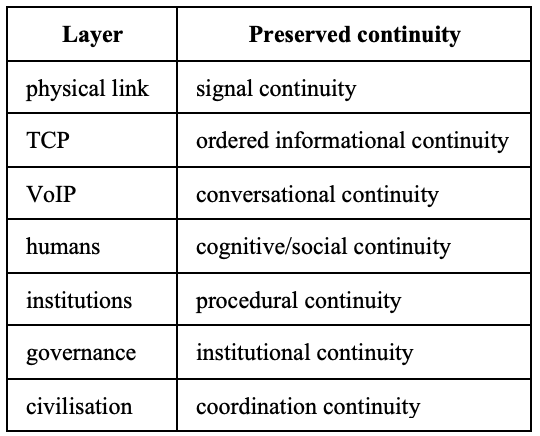
If we unpack how the Internet actually works, we find a stack of reconstruction technologies that are rarely described in those terms:
At the lowest level, multiple fibres or radio channels can be bonded together and presented as a single virtual link.
Individual links may use error-correction schemes to reconstruct a “clean” data stream despite transmission faults.
Protocols such as TCP/IP use control loops to detect missing packets and retransmit them so that information can be reconstructed in the correct order.
Applications like VoIP then use codecs to reconstruct the human voice in ways aligned with human cognition and perception.
The reconstruction process does not stop there — and this will later turn out to be a figural insight. The stack does not end with the machine. Humans themselves become part of the control loop: “Could you repeat that?”, “The line dropped out”, or “I think you froze for a second” are all higher-level reconstructive mechanisms used to recover continuity when lower layers fail to preserve it perfectly.
The illusion a telephone presents us with is the transmission of a voice from afar, as though it were somehow squeezed into the wire itself and burst back out of the speaker at the other end. That is only the final surface reconstruction imposed by our brains.
In reality, telecoms networks do not truly “transmit data” in the way we casually imagine. Transmission is largely metaphor. What networks actually do is recursively copy, correct, reorder, and reconstruct.
The truth is telecoms networks simulate continuity — and nothing else.
We pretend distant locations behave as though they were not apart. Nobody needs a phone bill to speak to someone in the same room; the atmosphere itself performs the reconstruction from mouth to ear.
When you email a spreadsheet as an attachment, a similar illusion occurs. It appears as though a copy of the document somehow “moves” together with the covering note. Nothing of the sort really happens. The underlying objects are recursively dismantled into layers, copied, transformed, and recursively reconstructed at the destination.
Every successful interaction is reconstruction.
Every failure is degraded reconstructability.
Crucially, reconstructability is never absolute. It is always observer-relative — defined with respect to some interpretive layer, participant, or continuity domain capable of treating certain variations as irrelevant while preserving others as meaningful:
A VoIP codec does not reconstruct the exact original waveform; it reconstructs a version sufficient for human conversational continuity.
A court order reconstructs institutionally recognised authority continuity, not metaphysical justice.
A spreadsheet attachment preserves semantic utility for its recipient, even if opened in a different application with a different internal representation.
Civilisation itself preserves social coordination continuity for observers embedded inside it. The observer is therefore an active participant in the reconstructive stack, not a passive external judge.
This invites two distinct schools of thought.
One focuses on the geometry of physical separation as the primary reality — and what work is needed to overcome it.
The other focuses on the illusion of continuity as the primary reality — and what degradation is tolerable to sustain that illusion.
That distinction turns out to be transformational.
Every spinning top given to a child as a toy has been different — even if they came off the same production line. At a minimum, there are microscopic variations in surface roughness, weight distribution, or the straightness of the plunger used to spin it. Despite that variability, we can still say meaningful things about all spinning tops: how they stay upright, how they wobble, and how they eventually fall over.
Science is the body of knowledge that allows us to abstract common properties of the world despite its endless variability.
In another sense, every spinning top given to a child is identical. They all conform to the same underlying model of design and operation: a uniformly rounded body, a point at the bottom, and a twisted spindle that converts downward force into rotation. Two tops sitting on the same shop shelf are physically distinct. But they are functionally continuous. One can be substituted for the other, as though they were connected at a deeper level.
Science is therefore concerned with two intertwined problems: variation between instances, and continuity across them.
The same pattern now appears everywhere we look:
TCP does not preserve the exact in-sequence physical journey of each packet; it preserves the continuity of ordered information despite loss and reordering underneath.
A voice call does not preserve the original sound waves leaving someone’s mouth; it preserves enough perceptual continuity for conversation to remain intelligible.
Two spinning tops are never materially identical, yet they preserve the same functional continuity of operation.
In each case, the underlying geometry varies while some deeper continuity relation is preserved. Each system succeeds not because nothing changes, but because the right things remain invariant despite the change.
The world keeps going because continuity is continually reconstructed. A prized child’s toy is lost or broken; the child cries; another of the same model replaces it. The physical instance has changed, but the deeper continuity relation survives.
That this continuity is an endlessly reconstructed illusion — much like continuity between scenes in a film — does not make it any less real than the geometric continuity of owning the same heirloom watch throughout your life.
The real “aha!” comes one layer higher still. The phone call already contained multiple nested continuities: signal continuity, packet continuity, conversational continuity, and cognitive continuity.
But the stack does not stop at the human being holding the phone.
The call itself is embedded inside larger continuities that are also being continuously reconstructed despite degradation: relationships, organisations, markets, institutions, and societies.
The same reconstructive pattern keeps recurring at progressively larger scales.
Hence…
Civilisation is the continual reconstruction of continuity under constraint.
What we observed earlier with ∆Q was a switch from geometrical thinking about telecoms networks in overload, to a continuity-first view. What keeps going when the going gets tough? It started from the premise that total continuity is unattainable; degradation is normal; and there are choices over how to deal with it.
Those choices keep some things the same — i.e. invariant.
The same choices allow other things to change — i.e. variant.
The crucial question in any reconstructive system is therefore:
what continuity relation is being preserved while everything else changes?
Because every system, whether consciously or not, preserves some forms of continuity while allowing others to degrade. Even pathological systems preserve continuity somewhere — institutional survival, ideological coherence, market pricing, procedural momentum, or simply the continuity of confusion itself.
When I was working in telecoms, my career transitioned through three governance regimes, with three different continuity goals, and three different implied invariants. In a sense, outside that limited community, the details don’t matter. What is relevant here is that these governance paradigms existed, but were only partially articulated.
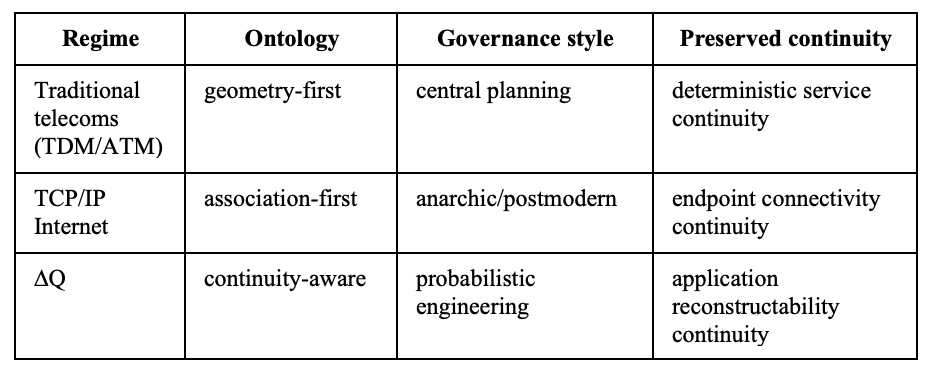
I thought I was dealing primarily with a science and engineering problem — the “technical stack” — but in reality I was confronting competing geometrical and continuity-first modes of thought operating at the human, institutional, and civilisational layers.

What I didn’t understand at the time was that the ∆Q concepts could not be absorbed at the governance layer by institutions bound to geometric thinking and paradigms. Their continuity goals, chosen invariants, and reconstruction strategies were incompatible with the science on offer.
The science wasn’t wrong. The scaling problem was real. The surrounding governance paradigms simply could not absorb the implications.
So when I began to confront and investigate the “ghost court” issue — i.e. the non-reconstructability of continuity to statutory authority — this wasn’t my first encounter with the pattern. It has taken two years of work, but I now see I was dealing with exactly the same meta-pattern of geometric automation hitting continuity scaling constraints.
Then I looked around me at others struggling with authority and complaining about degradation — plus the overbearing desire of systems for their own continuity above all other considerations. The truth slowly dawned on me: at the deeper structural level, it was all the same thing. Injustice from courts. Unresponsive utility complaints. Despotic HR departments.
Each is a reconstructive system seeking to maintain some form of continuity via an invariant under resource constraint.
Quality attenuation is merely a special case of reconstructability attenuation.
This is not an analogy between networking and governance. It is the recurrence of the same reconstructive constraints in different domains.
I had arrived back at exactly the same technical-governance interface problem I had struggled with a decade earlier. The “throw more resources at it” mindset simply does not work in the general case — and, truthfully, it never really worked in the supposedly simpler special case of broadband networking either.
The toolchain I had learned in distributed-computing performance engineering turned out to have more natural application to organisational governance than to online gaming. And the bureaucracy is caught between the exact same two unhealthy polarities as the telecoms industry has oscillated between: fixed promises and unbounded cost, and fixed cost with unbounded degradation.

The answer is always the same, because finite distributed systems leave no real alternative: pick your continuity goal, identify the degradation invariant that results, and let the degradation vary in the rest. It isn’t ideology, it is simply the performance engineering of society as a distributed runtime facing continual reconstruction of continuity under resource constraints.
Just like the Internet.
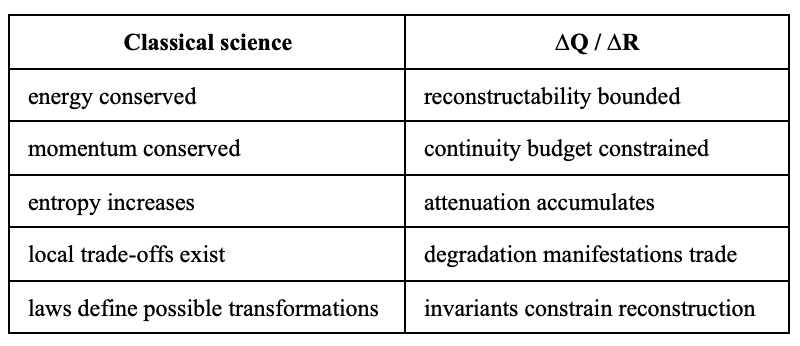
Packet networking turned out to be one particularly mature special case of a much deeper reconstructive systems problem.
∆Q was only the technical subset
of the “full stack” human civilisation
scalability engineering problem, ∆R.
I have been using the word “continuity” a lot, because I have been avoiding a somewhat less familiar term, albeit a useful one.
Everyone reading this, however, is familiar with woodworking, and knows what a wood plane is, and how it shaves down a block of wood. But that is all it does — it adjusts the geometry. (As an aside, “lumber attenuation” is conserved — once you take it off, it is not going back on again!)
Meanwhile, a drill can be used to change geometry too — by making a depression that goes part-way into a piece of wood, like where you insert those Ikea dowel rods when assembling furniture. But a drill can do something a plane cannot do at all: it can form a hole.
So when we break through to the other side, that is no longer merely a change in geometry. The continuity structure itself has changed. We have entered the realm of topology.

Now, I have to admit that my analysis classes while enduring a mathematics degree were where I started to mentally check out and wonder whether abstractions about abstractions were really my thing. The grade I got reflects my indifference to topology at the time. Even now, I can only spell ‘manifold’, not rigorously define a topological space.
But it has all turned out to be rather useful, if somewhat belatedly, I have to confess.
Because topology is fundamentally the study of continuity and connectedness under transformation.
Take two key-rings as a simple example. The surface of each ring is continuous with itself. If we loop them together, they become connected — yet they still do not form one single continuous surface. Their continuity relations have structure.
And crucially, those continuity relations survive many kinds of transformation. It does not matter if you paint the rings, sell them to a friend, stretch them slightly, or scorch the metal with a flame. The geometry changes; the topology does not.
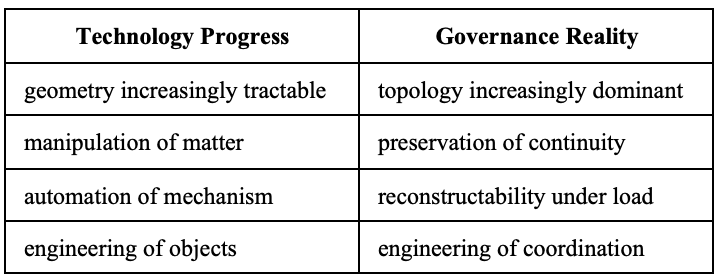
We can see this geometry/topology governance split play out in our telecoms example:
The traditional telecoms model attempted to collapse geometry and topology into the same thing: continuity enforced through fixed geometry in space and time.
The Internet introduced a different model, preserving continuity of reachability by abstracting away the underlying geometry, which could now vary dynamically over time, albeit at the expense of other forms of continuity.
The ∆Q approach makes those continuity trade-offs explicit as first-class objects, so they can be reasoned about, engineered, and balanced against one another.
In other words, the world naturally evolves from geometry-first solutions toward topology-first ones under load. Our problems become progressively more topological — continuity and reconstructability under stress — and progressively less geometric — the physical mechanisms that merely “do the work”.
But every new geometrical capability also creates new transformations, new abstractions, new coordination pathways, and new demands for continuity reconstruction. As our power over mechanisms increases, the burden of preserving meaningful continuity grows with it.
Meanwhile, topological governance problems stubbornly remain.
The point is this: as society grows ever more complex, decisions tend to become harder as data grows more diffuse, the scale of inputs wider, and the scope increasingly global. Chains of authority grow longer, more abstract, and increasingly impersonal.
The problems afflicting society increasingly revolve around grounding decisions in factual evidence and demonstrable authority — i.e. reconstructable paths that trace back to reality.
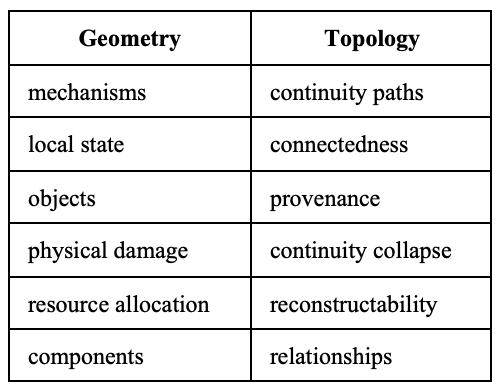
Over time, these increasingly become topological problems — boundaries, connectedness, provenance, and continuity pathways — rather than geometrical ones like mechanisms, location, or individual actors.
Reconstructability is stressed.
The stress this imposes pushes institutions toward continuity-first doctrines that rise above demonstrable facts and provable provenance.
Reconstructability erodes.
The public complain more loudly, so “failure load” grows.
The system trends toward reconstructability collapse.
The exact same thing happens in distributed systems under overload. A shell hits a tank; systems record errors; they attempt to communicate distress; the remaining capacity can no longer sustain both operational control and management continuity. The tank ceases to be operable — not primarily because of the shell strike itself, a geometrical violation, but because continuity control collapses: a topological failure.
The Contention Management technology associated with ∆Q — it being mathematics rather than mechanisms — enables things like classes of service on the Internet with managed upper and lower quality boundaries. Within a finite overall budget of quality attenuation, different forms of continuity can be preferentially preserved under load.
Not everything can always fit, but the resulting order of failure becomes more predictable, controllable, and less damaging.
This is essentially a topological solution, creating new kinds of connectedness and pathways. There is always a geometrical element with the scheduling of packets from queues, but that is a means, not the ends. In the absence of such enablers, alternative topological solutions are required for imbalances of supply and demand for reconstructability — more dedicated networks, traffic segregation, demand offload strategies, and other forms of continuity management.
It is easy to become obsessed with the network mechanisms themselves as geometrical objects, and they are indeed fascinating. I also studied geometry as part of my degree, with equal difficulty staying engaged as topology, and it is not a lesser discipline. Just the nature of reality tends to bias towards topology problems at greater scale and under increasing load.
What I failed to grasp at the time I was active in telecoms was that I was already operating in the realm of topology.
The “stack” of technologies that allows a voice call over the Internet is really a topological space defined by continuity operators, each in turn using geometrical technologies to continuously perform the reconstructive act.
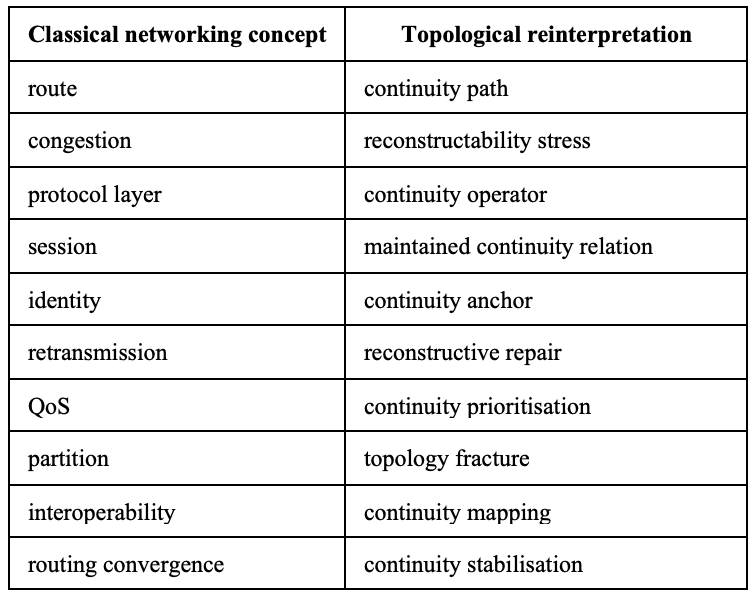
Seen through this lens, many familiar networking concepts reveal themselves as fundamentally topological rather than geometrical:
Routing is really the management of continuity pathways under changing constraints.
Identity anchors continuity across transformation.
Retransmission repairs broken continuity.
Congestion reflects reconstructability stress under competing continuity demands.
Even protocol layering becomes a hierarchy of continuity operators preserving different invariants at different scales.
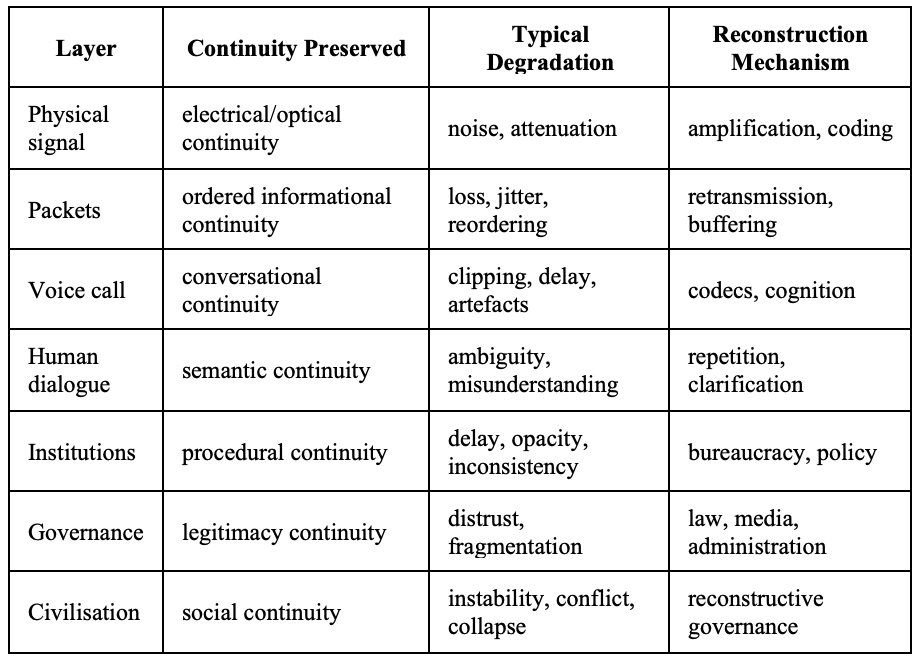
Now I can reinterpret the problems I was involved in solving under the correct category.
I thought I had escaped both topology and geometry, but both came back to haunt me!
This same divide can be seen in breakthrough ideas like Recursive InterNetwork Architecture (RINA). As the name suggests, it identifies a foundational natural structure for inter-process communication — an “attractor” toward which networking designs ultimately trend, much as modern aircraft designs converge under aerodynamic constraints.
Certain optimisation pressures naturally narrow the space of viable solutions.
In many ways, RINA is already reaching toward a topology-first understanding of networking. It recognises that networking is fundamentally recursive and relational rather than a collection of fixed geometrical mechanisms. But it still articulates the problem primarily in terms of processes, interfaces, and distributed facilities.
In other words, RINA operationally discovers topology without fully recognising it philosophically.
Even here, the deeper invariant is still continuity and reconstructability under transformation and degradation. RINA escapes much of the legacy geometrical architecture, but not entirely the underlying geometrical worldview surrounding it.
The opportunity lies in topology-first solutions, because socio-technical problems — such as the automation of justice systems — cannot ultimately be separated from techno-social ones, such as the social adoption of architectures like RINA over TCP/IP.
Continuity problems naturally spill across the artificial boundaries between technology, institutions, and culture.
Until people place the problem in the correct category, the solution remains effectively unbuyable.
This all sounds lovely and very erudite, but if this is true, why is civilisation not already organised around it?
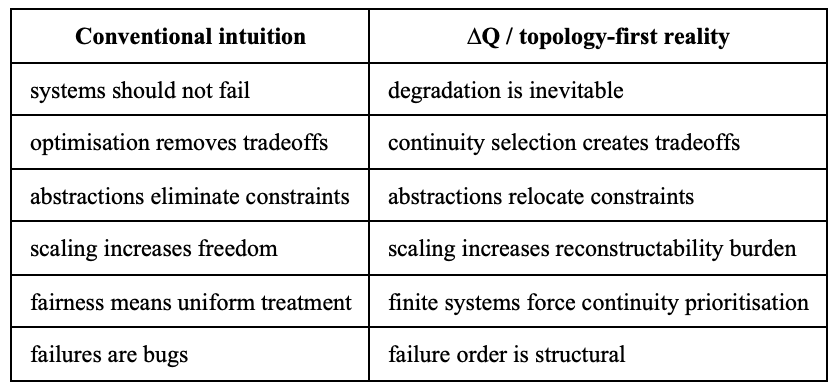
What we are talking about here is a conceptual advance with a level of dislocation comparable to Claude Shannon’s information theory, Alan Turing’s theory of computability, or Kurt Gödel’s Incompleteness Theorem. In other words, a foundational rearranging of the mental deckchairs.
Unlike those domains, however, this one lacks an easily articulated “enemy” to overcome.
Take Shannon as an example. He effectively invented the “bit” — at least as an abstract unit of information that could be related to an imperfect underlying substrate. The opponent was “noise”, which simultaneously imposed a hard limit on what could be achieved in principle while also defining the frontier up to which innovation was possible.
Better mechanisms could be invented, engineered, optimised, and sold — all within the finite boundaries Shannon’s work illuminated.
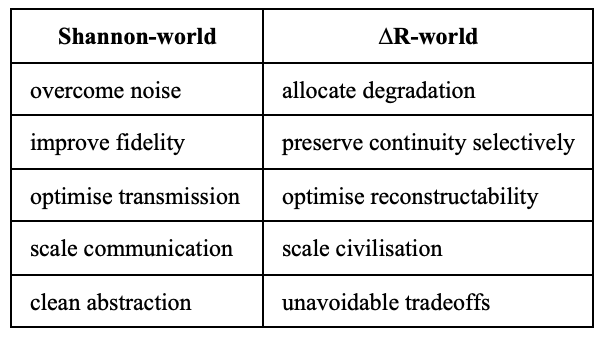
We do not have a neat equivalent to “noise”, only long phrases that make you reach for a dictionary — or perhaps a dram — like “finite reconstructability under competing continuity demands”.
It is closer to a tongue-twister than a marketing slogan.
But unfortunately, that appears to be how reality itself works: probabilistic, distributed, occluded, resource-constrained, and degraded.
All civilisation can really do is decide where the degradation lands.
Or, more bluntly: who gets hit with the shit.
People do not want to buy “more choices over how bad it is for whom”. They want the fantasy that every reconstruction demand can be satisfied everywhere, immediately, and at negligible cost.
This was essentially the cornucopian promise embedded in much of the Internet revolution: infinite scalability through abstraction, where constraints would supposedly dissolve into software and bandwidth.
But the underlying reconstructability problem never went away. Reliability engineering still costs real money, real energy, real coordination, and real governance.
The constraints were not eliminated. They were merely displaced, deferred, hidden, or redistributed.
The inversion that made ∆Q tractable was psychologically uncomfortable from the outset: it gave primacy to failure. Traditional engineering often begins with ideal operation and then treats faults as exceptions. ∆Q instead starts from overload, degradation, contention, and collapse — and asks what continuity can still be preserved despite them.
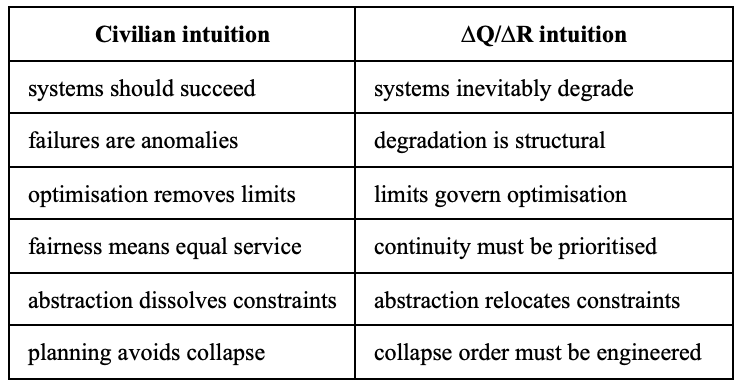
That mindset is entirely natural in military environments. Armies already assume destruction, interruption, hostile interference, uncertainty, and loss of capacity. A ship with damaged communications, a radar system under jamming, or a missile defence network under saturation attack are not considered abnormal edge-cases; they are the operational reality the system is expected to survive.
Failure is not denied. It is engineered around.
Civilian societies, however, tend to find this framing deeply unpalatable. People do not want to hear that fairness, responsiveness, legitimacy, and continuity are all bounded by finite reconstructability under load. They want the promise that every demand can always be satisfied, immediately, universally, and at low cost. Yet once systems scale sufficiently, that fantasy collapses.
The real problem becomes managing degradation in ways that remain survivable, predictable, and socially tolerable.
In a very real sense, “military is the only way”, because engineered collapse is the starting point rather than the exception. Systems are assumed to degrade, fragment, overload, and fail under pressure; the question is what continuity can still be reconstructed despite that reality.
The scalability of civilisation is therefore constrained as much by psychological and cultural limits as by any underlying technical or physical ones. People instinctively resist topology-first thinking because it forces acknowledgement that not every continuity demand can be satisfied simultaneously, indefinitely, and at low cost.
From a scientific perspective, the transition from ∆Q to ∆R is ultimately unavoidable. The reconstructability problem does not disappear merely because societies refuse to recognise it.
Survival, however, remains optional.
The ΩΛ∆∑ Canon is my first attempt at operationalising parts of this broader ∆R worldview, extending ∆Q-type thinking into a practical diagnostic runtime for reconstructive governance under load.
My conclusion is simple, even if the implications are not: there is a new science of reconstructable systems emerging, and it underpins almost everything in organisational and administrative life.
It cannot be owned by networking alone, nor by law, political science, AI, economics, media theory, or philosophy. The problem lives between these domains, because civilisation itself now lives between them.
What we need is an Institute for Scalable Civilisation — a kind of Bell Labs for governance, coordination, semantics, and reconstructability — to take ownership of the problem.
Existing academic, industrial, and think-tank initiatives remain too locked into geometric modes of thought. The foundational ideas behind ∆Q and RINA — as precursors of something larger — continue to evolve, but remain fragmented, niche, and culturally difficult to absorb.
The development of a genuine “full stack” ∆R runtime for a scalabile civilisation is far beyond the scope of any existing discipline or institution operating in isolation.
We already did this once before to solve our telecoms network geometry problem.
Now we need to do it again for our civilisation topology problem.
The operational structure of reality demands it.