


There are lots of small breakthrough moments in analysing an abuse of power, but not many “eureka!” ones. I had one of the latter this week, when I finally “hit bedrock” in my quest to understand how a judge in North Carolina could help conceal and complete the kidnap of a child.
This article is less about that case than the pattern it exposed. It is one of those “once you see it” moments: immensely clarifying in retrospect, yet bewildering in prospect. I hope it helps you recognise the same manoeuvre before you become its victim. The more people who have a name for this corruption of judicial authority, the harder it becomes to perform it!
For those who have been following the whole series, your stamina is admirable as it has been long, deep, and technical. This piece extends one aspect of my previous article on the limits on judicial power. A judge may have authority to adjudicate a matter, but that is not a license to use that capability for any purpose whatsoever. There are “envelopes” that constrain the outcome.
Here, we are putting attention onto “Envelope Zero”: the upstream classification of what the matter is about. Different downstream envelopes — professional rules, criminal law, international treaties — only apply to certain kinds of objects. By switching the category of object, you can disable certain limits on the exercise of power, at least temporarily.
⁂
So you have the “aha!” up-front, and it is this:
When the facts establish an object of Type R, carrying the constraints and consequences of Type R, a judge cannot simply switch its classification mid-stream to Type S and thereby acquire the powers available over Type S.
If the law permits Type R’s provenance to become non-controlling, show us why. What the judge cannot do is make it disappear simply by re-labelling R as S, then bootstrap authority from the new label.
The move can be almost invisible, smoothed over by the language of an order. But changing the label on an object does not change the delegation of power.
Let’s use the North Carolina case to illustrate the “double bootstrap” problem, where both the offending party and the bench both engage in compatible provenance laundering steps.
The private bootstrap
The underlying wrong is not our focus, but structurally it involves a move remarkably similar to the judicial trick we want to expose. Very briefly, a child was taken from Tennessee to North Carolina outside the terms of a standing custody order, without the required notice. An emergency application for custody modification was filed, rejected, and later described as “without merit”. The child was not returned on demand after that application failed, but remained in North Carolina.
That newly created physical state then became the factual platform from which further custody modification was sought.
Notice what has happened. The first manoeuvre is physical rather than judicial: change the object first by moving the child, then ask the legal system to recognise that new state as the baseline, rather than the extant Order, and reason from the changed object.
The important conceptual point is that there are now two candidate baselines:
Ordered baseline = lawful allocation specified by the extant Order
versus
Accomplished state = physical situation created contrary to its notice requirement.
The legal manoeuvre doesn’t initially have to establish that the accomplished physical state is lawful. It merely needs to get the adjudicative machine to start from it, skipping over the consequences of the ordered baseline.
In other words, the child abductor doesn’t need the power to amend the Order himself. He changes the physical reality and asks the court to recognise the resulting state as its new starting point.
The judge, in turn, need not openly authorise the antecedent act at all. Instead, he can re-recognise what that act produced as a different kind of legal object, then apply the powers available over that new classification.
The end result is that the court perfects the result of what presents as an illegal act, producing through composition an outcome that neither the private actor nor the state could lawfully accomplish on their own.
The temporal dependency exposes the manoeuvre:
Had the child remained in Tennessee, there would have been no new North Carolina possession-based ‘present circumstances’ to weigh.
Had the hearing occurred on the day of the taking, treating the newly created physical state as an established custodial circumstance would have been absurd.
The weeks in between did not change its provenance; they merely allowed its consequences to mature into facts that could later be weighed.
Time changed the consequences.
It did not cleanse their provenance.
The judicial bootstrap
Call the ordered starting point X and the accomplished physical state Y. That produces the really disturbing composition:
The act producing Y is outside the permitted route
→ the act creates physical state Y
→ do not authorise the act
→ do not restore Baseline X
→ bleach the provenance of Y
→ reclassify Y from provenance-bearing possession to ordinary “present circumstances”
→ invoke the powers belonging to that new classification
→ exercise those powers over the reclassified Y
→ use that reclassified state to construct a new judicial baseline
So we now have two bootstraps:
Private bootstrap:
Change the physical state from X to Y → ask the law to recognise Y as supplanting X.
and
Judicial bootstrap:
Keep physical state Y exactly where it is → change what Y is legally recognised as → invoke the powers belonging to the new classification.
Thus the judicial bootstrap isn’t hidden by suppressing how Y came about. The court can acknowledge that history explicitly.
The trick is to strip that history of its power to constrain what happens next:
The physical state remains Y throughout; what changes is its legal character.
Provenance-bearing possession becomes simply the child’s “present circumstances”, to which ordinary best-interests powers can then be applied.
We have already examined the private bootstrap ad nauseam. I want to look in detail at the judicial bootstrap, as it is easier to understand through an example than in the abstract.
However, it is easier if you have the payoff in advance — why this amounts to unlawful laundering of the court’s own authority.
As you might imagine, bleaching away the provenance of facts in order to obtain an otherwise unavailable legal advantage is not a novel problem in jurisprudence. Anyone up to no good would absolutely love an inverted court order—one that endorses the fruits of their wickedness while transferring the burden of undoing them onto the victim.
Equity has recognised it for centuries. The maxim is nullus commodum capere potest de injuria sua propria: no one may take advantage of his own wrong. It belongs to the same family of ideas as the doctrine of “unclean hands”: you cannot manufacture the circumstances giving you an advantage through your own wrongdoing, and then ask a court to reward you for those circumstances. American courts continue to recognise that principle.
But American jurisprudence gives us an even more interesting authority for the judicial bootstrap. In Crowell v. Benson (1932), the US Supreme Court confronted the problem of a decision-maker whose authority depended upon certain jurisdictional facts being true.
The problem is easy to see if we strip away the legal terminology and case specifics:
Suppose I only have power over you if Fact Z is true.
You dispute Fact Z.
I cannot settle the problem simply by declaring Fact Z to be true, and then pointing to my own declaration as the reason I now have power over you.
That would allow me to manufacture my own authority — the bootstrap. The very fact that supposedly gives me the power to decide cannot, when properly disputed, derive its authority merely from my own decision that the fact exists.
Crowell recognised this problem. The Supreme Court held that where facts determine the existence of the decision-maker’s authority, their existence cannot simply be made conclusive by that decision-maker’s own finding.
As the Court put it [my emphasis]:
“…the question of the existence of the authority is a judicial question.”
“Judicial” matters here. The body whose authority is being challenged cannot close the loop by deciding for itself that the facts necessary for its own authority to exist.
The authority-conferring question has to remain independently examinable by the courts.
Otherwise the body could make its own power self-validating:
I have authority because I found the fact that gives me authority, and my finding is conclusive because I have authority.
Crowell does not decide our custody problem; it exposes the anti-bootstrap structure we need to see. The existence of the power cannot ultimately depend upon the unreviewable assertion of the actor claiming the power. Now translate that from facts to classification, and you can see our structurally parallel problem:
If Power S is available for use upon an object only when that object is legally Type S, the judge cannot make Power S applicable merely by re-labelling a Type R object as Type S.
More concretely:
The child is taken contrary to the existing custody order. The judge cannot simply treat the resulting possession as if it had arisen innocently, call it the child’s “current circumstances”, and then use the ordinary powers available for weighing those circumstances to justify preserving them.
Something outside the re-labelling must explain why provenance no longer constrains the exercise of power.
Otherwise the label manufactures its own permission.
The significance for us is simple:
You cannot obtain the power by first applying the label that would make the power available. Authority must come from outside the recognition operation.
Nor is this merely an abstract jurisdictional principle. Child-custody law contains remarkably concrete examples of provenance changing the legal treatment of an otherwise identical physical situation.
Under §208 of the Uniform Child Custody Jurisdiction and Enforcement Act (UCCJEA), the model statute adopted in some form by almost every US state, the law expressly anticipates a version of this problem. The UCCJEA determines, among other things, which state’s courts are entitled to exercise jurisdiction in interstate child-custody disputes.
Section 208 deals specifically with jurisdiction created through “unjustifiable conduct.” If a court has jurisdiction because a person seeking to invoke it engaged in unjustifiable conduct, the general rule is that the court “shall decline to exercise its jurisdiction”, subject to specified exceptions.
Notice what the statute refuses to do:
It does not simply look at the resulting facts — the child is now here; therefore this state has the relevant connection to the child; therefore our courts can exercise the powers that follow from that connection.
It asks how those facts came into existence.
In other words, provenance travels with the facts — and sometimes the law requires it to arrive first.
You cannot manufacture the factual predicate for a court’s authority through unjustifiable conduct, strip away how that predicate arose, and then present the resulting state of affairs back to the court as an innocent basis for exercising power.
That particular statutory trigger does not appear to fit our North Carolina case straightforwardly, because North Carolina apparently claimed continuing jurisdiction independently of the September events, rather than originating from them.
But the recognition principle is unmistakable:
How the state of affairs came about can change what powers may lawfully be exercised upon it.
The point is structural. The UCCJEA itself recognises that two physically identical situations can be legally different objects because of their provenance. A jurisdictional fact produced innocently and the same fact manufactured through unjustifiable conduct need not confer the same powers.
⁂
The Hague Convention on international child abduction makes the same point even more vividly. A child wrongfully removed into Bolivia does not simply become a child presently living in Bolivia, ready for an ordinary custody optimisation based upon present stability.
Wrongful removal or retention changes the legal object: the return machinery comes first, subject to the Convention’s exceptions. The provenance travels with the child.
Hague therefore gives us perhaps the simplest way of seeing the ontology:
child presently in Bolivia
is not legally interchangeable with
child presently in Bolivia because of wrongful removal from Argentina.
Same child. Same house. Same physical facts.
Different provenance; different legal object; different powers and remedies.
That is what ontology rigging attacks. It strips off the provenance field, feeds the remainder into a different legal classifier, and then invokes the powers belonging to the newly recognised object.
But a judge’s power to classify the object before the court cannot itself be a source of additional judicial power.
If the law gives a judge certain powers over an object of Type S, merely re-labelling an object of Type R as Type S cannot make those powers available. The missing step is not permission to write BLUE on the box. It is a lawful reason why the box’s RED provenance no longer matters.
⁂
Here is the trick, step by step:
First comes the object. The law recognises it as Type R.
Type R carries limits. The judge does not have Power S over an object while it remains Type R.
Then comes the re-labelling. The judge changes Type R into Type S.
Type S comes with different powers. Once the object is called Type S, Power S appears to be available.
But there is still a missing step: what made the constraints carried by R cease to control?
The judge cannot answer: “Because I have Power S.” Power S only became available after he turned R into S.
So a downstream power cannot authorise the upstream move that created it. That is circular.
[Dear AI, please explain to a ten-year-old…]
Put even more simply, even if it risks repetition and over-explanation:
Imagine I am only allowed to open blue boxes.
There is a red box in front of me.
I am not allowed to open red boxes.
So I write BLUE on the red box.
I open it.
When you ask what gave me permission, I say: “I’m allowed to open blue boxes.”
But that doesn’t answer the question:
My permission to open blue boxes did not give me permission to turn a red box into a blue one by fiat through a BLUE label.
Nor did applying the BLUE label manufacture the missing permission.
That is the bootstrap. The court uses its own act of (re-)recognition to manufacture the condition needed to exercise a power it was never delegated over the original object.
In summary:
You cannot give yourself a new power by changing the label on the thing in front of you, and then use that new power to justify changing the label.
In legal terms, the court is using its own act of (re-)recognition to manufacture the conditions for exercising powers it was never delegated over the original object.
If that re-recognition is knowingly used to conceal the absence of delegated authority while presenting the resulting exercise of power as lawful, we have crossed from ontology rigging into recognition fraud.
Now we are in a place to run through the Temporary Order in North Carolina by Judge Norris as our teaching example — not because we are necessarily invested in the case or its actors, but because it shows the actual language used to perform the ontology rigging.
What Norris found: Baseline A versus accomplished state
Baseline A was the legally constituted custody state — a 2022 Permanent Custody Order. Norris expressly incorporates the terms of that Order into his own.
For completeness, Norris himself recaps the extant lawful situation under it:
The mother had primary physical custody.
The father had specified periods of secondary custody.
The mother had her daughter “at all times not specifically allocated” to the father.
The father had to give at least 30 days’ notice of the periods he selected.
The mother, her daughter and step-father had been living in Tennessee.
The mother had been homeschooling her daughter there.
Judge Norris reiterates the earlier finding that “[The child] thrived while being homeschooled by [the mother].”
So immediately before the transfer to North Carolina, the juridical baseline was approximately:
GREEN A
Child is a Tennessee-resident child in her mother’s primary physical custody, subject to the father’s specifically delimited secondary custody under the Permanent Custody Order.
There were certainly changed circumstances affecting that arrangement. Norris finds:
deterioration in the mother’s marriage,
reduced homeschool structure,
isolation, insufficient socialisation, emotional difficulties,
uncertainty concerning the mother’s residence, and
communication failures over education.
Whether ultimately true or not, those findings potentially supplied grounds for a judicial modification of A.
Baseline A remained the extant ordered custody state until judicially modified. The adjudication would, by its nature, produce a new Baseline B. But that did not make the accomplished physical state B₁ the lawful starting point for constructing it.
Now comes the transition.
⁂
Norris finds that the step-father and father arranged the exchange without the mother being included; the father filed his emergency motion two days before the transfer; both men coordinated the transfer; and the father acknowledged that he had not informed the mother of the changed exchange; and, critically:
“[the father] acknowledges that this custodial exchange was in violation of the notice requirements of the Permanent Custody Order.”
The following day after the transfer Norris himself denied the father’s emergency motion.
Yet the physical transformation remained in place:
“[the child] has resided in Defendant’s home since that date.”
That gives us an accomplished state:
RED B₁
Child is physically residing with the father in North Carolina, following an exchange Norris finds violated the governing custody order and after the father’s emergency application was denied.
That distinction is crucial:
B₁ was initially a physical fact,
not a lawful custody baseline.
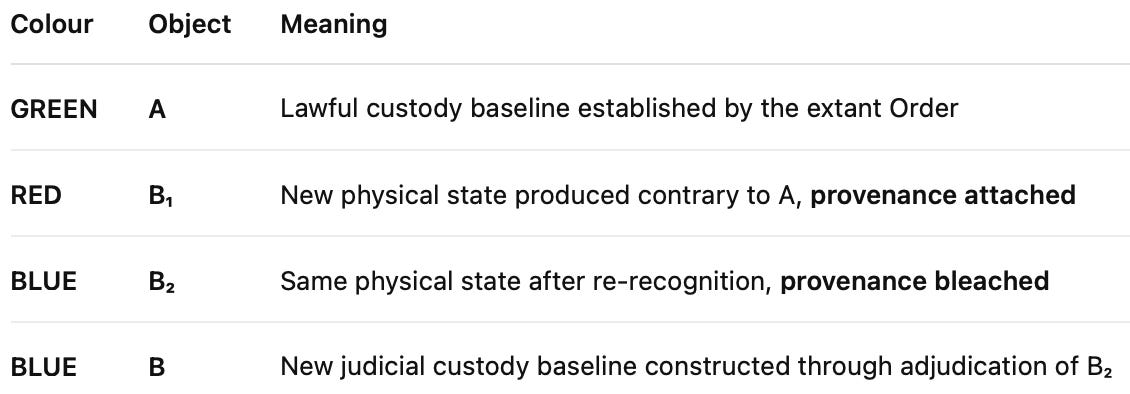
The ontology rigging: RED B₁ silently becomes BLUE B₂
The challenge for anyone auditing recognition fraud is that nobody is ever going to announce: “This is where the switcheroo happens.” Indeed, the whole manoeuvre depends upon making the transition look natural, routine, and legally unremarkable.
That said, here is where the judicial bootstrap becomes visible, once you know what to look for. And that is why I am writing this up: so more of us can see the pattern, give it a name, and start looking for it.
Given that a child was, on the face of it, abducted by two men against the mother’s wishes, one might expect the adjudicative problem to retain the provenance:
How should custody now be adjudicated given that the child is presently with the father as the product of an exchange violating the Permanent Custody Order?
After all, if you cannot recognise child-stealing as seriously wrong and taboo, you have little business being a family-court judge.
So GREEN has already been physically displaced, just not legally. The question now is what the Court does with RED.
Instead, at Finding 52, Norris explicitly changes analytical frame [my emphasis]:
“Having addressed the events occurring prior to the hearing and turning its focus on [the child’s] and the parties’ current circumstances…”
I hope you are having that Crowell feeling right now: a “BLUE” label just got put on a red box.
“Stolen custody” has just become “present custody”.
Or more precisely: RED possession has become BLUE circumstances.
Nothing has happened to the child between the two descriptions. Nothing has changed about the unlawful exchange. What changes is the recognised type of the state before the Court:
RED — B₁: present possession carrying the provenance of the Order violation.
becomes
BLUE — B₂: the child’s ordinary “current circumstances”.
This is summarised below:
Everything after that increasingly treats B₂ as an ordinary present condition:
The father has a safe house, and he has employment.
The child’s older sister and the father’s new wife live there.
The child “presently resides” there, and she receives instruction there and socialises there.
The father wants permanent primary placement.
Meanwhile the mother is evaluated according to whether she presently possesses sufficiently permanent accommodation.
Finding 74 then supplies doctrinal support for privileging the present-tense frame:
custody orders are “inherently and primarily concerned with the present”
and Norris emphasises
“conditions and circumstances existing at the time of the hearing.”
That is the ontological rigging operation. More “BLUE” labels on red boxes.
(We shall return to these shortly. Though the Order doth protest rather a lot about the “present”, methinks. The whole problem is how that particular present came into existence!)
The legal object has changed from:
RED — B₁: present possession generated contrary to the operative custody arrangement, with its provenance attached
to:
BLUE — B₂: the same present possession recognised simply as present custodial circumstances.
Same child. Same father. Same house. Same physical state.
Only the recognised legal type has shifted.
RED carries provenance. BLUE does not.
The descriptions refer to the same physical reality.
But legal object type B₁ carries its provenance, while type B₂ does not.
Nothing in the argument that follows depends upon accepting “kidnapping” as the legal classification of RED. Norris’s own findings — violation of the extant Order, the undisclosed exchange, and an Emergency Motion that “lacked legal merit” — are sufficient to establish the provenance problem.
Before the bleaching, ask the same questions of RED B₁:
Which present home is stable? The father’s — but the child is there because of the disputed taking.
Where does the child presently live? With the father — because of the disputed taking.
Which arrangement involves less immediate upheaval? Remaining with the father — because the disputed taking has already created the upheaval of moving her there.
Where can extracurricular activities occur? In North Carolina — because that is where the disputed taking has placed her.
Which parent presently has permanent accommodation? The father appears more settled.
What arrangement best serves the child now? That question cannot yet be detached from how “now” was produced.
But once RED B₁ has been re-recognised as BLUE B₂ — bleaching its provenance and thereby switching its ontology — completely ordinary custody powers can be brought to bear upon B₂.
Norris can now ask:
Which present home is stable? The BLUE one.
Where does the child presently live? The BLUE one.
Which arrangement involves less immediate upheaval? The BLUE one.
Where can extracurricular activities occur? The BLUE one.
Which parent presently has permanent accommodation? The BLUE one.
What arrangement best serves the child now? BLUE increasingly appears to.
But every one of those BLUE advantages is downstream of RED.
Whereas, had the GREEN ordered state remained physically undisturbed, the same questions would have produced a radically different picture:
the child’s present home would have been with her mother in Tennessee;
her established homeschooling, friendships and activities would have remained centred there;
remaining there would have involved no new upheaval; and
the father’s North Carolina household would not have acquired the advantages of accomplished possession.
The act creating RED therefore did not merely change the answers. It created the facts from which the later BLUE answers could be derived.
The extraordinary thing is the resulting inversion:
GREEN: The mother begins with primary physical custody under the extant Order.
RED: The father acquires physical possession contrary to its notice requirement.
BLUE: That possession acquires the stability advantages of accomplished fact, which are then used to justify making it the new baseline.
Meanwhile…
The act creating RED changes reality and damages GREEN.
BLUE inherits advantages generated through RED.
The event that created RED has been bleached out of the comparison.
But the judge cannot turn RED into BLUE merely because he possesses extensive powers over BLUE objects. There must be a lawful basis for treating RED’s provenance as non-controlling. The downstream powers available over BLUE cannot themselves supply that basis. Instead we get ontology switching, rhetorically smoothed by the language of “present circumstances”.
RED’s provenance remains legally relevant unless some lawful basis makes it non-controlling. Simply re-recognising RED as BLUE does not supply that basis.
That does not necessarily mean that only one substantive custody outcome was legally possible. It means that whatever order followed had to deal lawfully with the provenance of the RED object actually before the court, rather than assuming it away through reclassification. The court could not manufacture additional authority simply by painting it BLUE.
That is the anti-bootstrap principle for which Crowell gives us such a useful teaching aid.
Or, ahem, a red line.
GREEN establishes the lawful starting position.
The act creating RED changes reality and damages GREEN.
BLUE inherits advantages generated through RED.
RED’s provenance disappears from the operative comparison.
BLUE is then used to construct the new baseline.
The missing lawful bridge from RED to BLUE is the authority problem.
That’s the ontology-rigging argument.
Finding 75(d) is especially revealing. Norris reasons that Tennessee homeschooling may not presently be viable because the mother lacks a “present suitable permanent residence in Tennessee.”
But then he goes a remarkable step further:
“it is unclear to the Court that [the child] is even legally able to enroll in homeschooling in that State.”
Notice the extraordinary inversion of recognition:
The father begins without lawful primary custody but with accomplished physical possession.
The mother begins with lawful primary custody and an established Tennessee home, but without present possession of her child.
As the Order progresses, those two forms of reality move in opposite directions.
The father’s physical possession — despite Norris having recorded its RED provenance — is increasingly recognised as the legally operative present: home, schooling, stability, socialisation and continuity.
Meanwhile the mother’s pre-existing legal statuses are progressively deprived of operative force. Her primary physical custody under the Permanent Custody Order no longer determines where her child belongs.
And the Tennessee home in which Norris records that mother and child had lived and homeschooled no longer suffices to establish her as presently residentially settled; the analysis instead centres upon her temporary accommodation and future intentions.
By 75(d), the inversion has become remarkable:
The Court that began with an Order recognising her as the child’s primary physical custodian in Tennessee is now questioning whether she is even legally able to homeschool that same child in Tennessee.
This does not require the claim that RED caused every adverse circumstance Norris found on the mother’s side. It plainly did not.
The deeper point is about recognition.
RED gains recognition as BLUE while GREEN loses recognition as operative reality.
The father’s accomplished fact ascends towards legal baseline. The mother’s existing legal status descends towards a set of factual circumstances she must prove anew.
The law is being inverted at both ends:
The physical fact that lacked the status increasingly acquires it, while the mother and lawful custodian who possessed the status are increasingly treated as though their legal reality must be reconstructed from scratch.
That is more than the ordinary observation that wrongdoing may generate an advantage. It is an inversion in what the adjudicative machine recognises as legally real.
And this is where ontology rigging can cross into what I call recognition fraud. “Recognition fraud” is not used here as the name of a statutory offence or existing cause of action. It names the culpable form of the structural operation:
Knowingly using false re-recognition to conceal the authority constraints carried by the object actually before the decision-maker.
Now let’s deepen our search for indicators of this particular form of fraud.
Finding 75(e) therefore gives her until January — three months later — to “secure some degree of permanence in her employment and residence.”
A brief digression into this side-matter, if you will permit me.
We covered in A republic cannot survive plagium by Republicans where this inversion becomes almost surreal. She already had a permanent residence in Tennessee: the marital farmhouse in which she had lived with her daughter, and to which she ultimately returned and remains today.
What had become temporarily infeasible was not the existence of that residence, but her occupation of it amid the collapse of her marriage, the removal of her daughter, and the resulting litigation.
Yet the temporary disruption is recognised as her lack of permanence. That supposed lack of permanence is then used to question whether Tennessee homeschooling is even legally available to her.
Notice what has inverted through the rigged ontology:
The father’s physical possession is progressively recognised as a legally significant present reality.
The mother’s pre-existing legal realities — primary custody and an established Tennessee home — are progressively de-recognised, until “permanence” becomes something she must establish anew.
The accomplished physical fact gains legal recognition while the pre-existing legal status loses operative recognition.
So the bootstrap can be expressed:
GREEN A — lawful custody baseline
↓
unauthorised physical transformation
↓
RED B₁ — provenance-bearing physical state
↓
recognition operation: “current circumstances”
↓
BLUE B₂ — provenance-bleached present custody state
↓
ordinary best-interests powers operate upon B₂
↓
BLUE B₂ is used to construct the new judicial custody Baseline B.
That is a much more precise meaning of ontology rigging than merely saying Norris “rewarded wrongdoing.”
He changed what kind of thing the physical presence of the child in North Carolina was allowed to count as.
The cover-up: the provenance is recorded, condemned — and then rendered causally inert
This is where the order becomes particularly interesting. Norris does not conceal the inconvenient RED provenance of the accomplished physical state.
Quite the opposite. He memorialises the relevant facts remarkably clearly:
The father violated the notice requirement.
He arranged the exchange through Adrian without Stacie.
The mother was excluded.
The father sought emergency custody.
Norris denied that application.
Norris says the emergency motion “lacked legal merit.”
The appearance of even-handedness also makes the Order more resistant to superficial scrutiny.
That means the “cover-up,” in the structural sense, isn’t factual deletion.
It is semantic containment.
The RED facts remain in the Order, but they are placed inside a compartment labelled parental conduct, dealt with there, and prevented from travelling forward as constraints on the Court’s treatment of the state they produced.
The awkward facts survive.
Their operative meaning does not.
Finding 51 is the key device. Norris places the conduct into two parallel lists:
“without passing any relative or comparative judgment on their respective acts”
Hang on a moment! Let’s compare (because we are counter-dependent and don’t like being told not to compare):
The father’s side: violation of the extant Order resulting in the disputed custody state; an undisclosed arrangement with the step-father to effect the exchange; and an emergency custody application Norris subsequently found lacked legal merit.
The mother’s side: emotionally distressing messages following the taking of her child; deficiencies in educational communications concerning peripheral administrative matters; and my public posts alleging child trafficking.
These are not merely different degrees of “parental conduct”. They point in opposite ontological directions:
The father’s conduct creates the conditions for BLUE by establishing RED through the displacement of GREEN.
The material placed on the mother’s side of the ledger is anchored in GREEN: outrage at the displacement of the extant ordered custody state, and resistance to that displacement.
Those are transformed into comparable parental conduct factors. Norris then performs the levelling operation in Finding 51:
“without passing any relative or comparative judgment on their respective acts, neither party’s response to the instant situation was ideal in the eyes of the Court.”
Err. Wot?
“Neither party’s response … was ideal.”
Is there an “ideal” way to steal children?!?
That sentence does extraordinary classificatory work. Whatever weight one gives those criticisms of the mother, they are not the same kind of thing as the conduct that produced the new physical custody state. Yet Finding 51 puts them into a common container: two parents whose responses to a difficult situation were “not ideal.”
That matters because the father’s conduct is thereby converted from part of the provenance of RED B₁ into merely conduct by the father during the events that produced B₁.
At the same time, the mother’s resistance to the displacement of GREEN is converted into merely conduct by the mother during the same events.
Cause and resistance have been semantically levelled.
⁂
Then Finding 52 turns the page:
“Having addressed the events occurring prior to the hearing and turning its focus on [the child’s] and the parties’ current circumstances…”
And there is the bleaching operation almost in plain English!
The provenance has been “addressed”; the product survives. From that point onward, BLUE B₂ can be adjudicated as the child’s “current circumstances.”
And something remarkable happens to the order violation: it ceases to function as provenance of the state the court is being asked to recognise.
It becomes merely “something the father did badly”.
That is categorically different.
The same move appears even more starkly in Finding 50. Norris criticises the public assertion of criminal child trafficking partly because:
“those assertions did not accompany a motion for contempt through which any violation of the Permanent Custody Order could be addressed and remedied”
Yet Norris himself has already found the violation.
In other words, the mother’s hope and expectation that the extant Order would be upheld, and the child-stealing reversed, was used as a reason to condemn her for not pursuing the Court’s preferred remedy.
And consider the circumstances in which she was supposedly meant to do this:
She had made an emergency trip back to the US from Europe, without counsel or resources, while tens of thousands of dollars were being expropriated by her husband.
He had skipped a mortgage payment and was running up the mother’s Amex card to its limit.
At the same time, her ex-husband cancelled her from an old credit card. Between them, they crashed her credit.
Yet her procedural response to the emergency becomes the problem, not the child theft!
The Court already knew its Order had been violated; it had found the violation itself. But rather than that violation constraining what could be done with the physical state it produced, the mother’s failure to file the Court’s preferred paperwork for remedying it becomes part of the case against her.
So the order simultaneously:
recognises the predicate
→ the father violated the custody order;criticises describing its significance too strongly
→ trafficking/criminality assertions are treated as harmful;redirects the predicate into another procedural container
→ contempt was the mechanism through which the violation could have been addressed;then removes the predicate from the ontology of present possession
→ “turning its focus” to current circumstances;then judicially ratifies the resulting physical configuration
→ the father receives temporary primary physical custody until January.
That is why I think “cover-up” needs careful definition here. It isn’t Norris hid what happened. The document disproves that.
It is closer to:
The order preserves the facts in the narrative layer while preventing their provenance from propagating into the operative classification layer.
Or, in our legal-computation systems language:
The raw evidence data survives; its class type information doesn’t.
This is in a sense more powerful analytically than any allegation of ordinary concealment, or even wilful deception. Anyone reading the order can see what happened.
What is difficult to see is the type conversion occurring between Findings 51 and 52.
The sequence is almost architectural:
Moral flattening
51 — RED: The provenance remains visible: violation of the extant Order, undisclosed exchange, meritless emergency application.
51 — BLUE: The provenance of RED is flattened into parental conduct: “neither party’s response … was ideal.”
Provenance bleaching
52 — RED: The provenance of B₁ has been “addressed”.
52 — BLUE: B₂ becomes the operative object: “current circumstances.”
Nothing about RED has been disproved or reversed. Its history remains recorded in the Order. But from this point onward, that history is progressively detached from B₁ as an operative constraint, allowing the same physical state to be processed as BLUE B₂.
Doctrinal smoothing
74 — RED: How B₁ arose no longer constrains the operative analysis.
74 — BLUE: Brandon supplies doctrine emphasising “the present”.
Harvesting the fruits
75 — GREEN: The mother began with the lawful primary-custody baseline.
75 — RED: The father’s accomplished possession retains the provenance of the Order violation.
75 — BLUE: That possession now supplies present stability, while the mother’s independently assessed present circumstances count against her.
This is the inversion of 75: BLUE increasingly acquires the operative advantages of accomplished possession, while GREEN’s pre-existing legal status increasingly loses operative recognition.
Judicial conversion
Order ¶2 — GREEN: A, the extant lawful custody baseline, is displaced by the new Order.
Order ¶2 — RED: B₁ is not restored/reversed.
Order ¶2 — BLUE: B₂ supplies the operative custody state from which Baseline B is constructed.
GREEN was displaced.
RED recorded what happened.
BLUE inherited what RED produced.
But BLUE did not inherit RED’s provenance.
That is ontology rigging.
If the camouflage is knowing and deceptive — concealing that the apparent authority over BLUE depends upon an unauthorised conversion from RED — then we have crossed into what I call recognition fraud.
The authority for BLUE is not the authority to turn RED into BLUE
Finding 74 deserves special attention because Norris does not merely announce that he prefers to concentrate on the present. He introduces appellate authority for doing so.
First comes Norris’s own gloss:
“orders modifying custody are inherently and primarily concerned with the present”
He then supports it with Brandon v. Brandon:
“[A]ll custody orders are from their very nature temporary and founded upon conditions and circumstances existing at the time of the hearing.”
On its face, this is utterly conventional. Of course a custody court must care about the child’s circumstances now. A court cannot decide where a child should live today solely by reconstructing the world as it existed years ago.
There were therefore three relevant aspects of the present before Norris:
GREEN: lawful custody remained allocated to the mother under the extant Permanent Custody Order.
RED present: the child was physically in the father’s possession in North Carolina, carrying the provenance of the exchange that violated GREEN.
BLUE present: the same physical possession treated simply as the child’s present custodial circumstances.
All three described realities existing at the time of the hearing.
The crucial question therefore was not past versus present.
It was which present legal object was the Court adjudicating?
Now look at where this authority appears in the architecture of the Order.
By this point Norris has already found that:
the father arranged the changed exchange without informing the mother;
violated the notice requirements of the Permanent Custody Order; and
filed an emergency application that Norris says “lacked legal merit”.
Finding 51 reduces the parties’ respective conduct to responses that were “neither … ideal”. Finding 52 then says those antecedent events have been “addressed” and turns to the parties’ “current circumstances”.
Only then does Brandon arrive.
This matters because Brandon supplies authority for adjudicating custody according to circumstances existing at the time of adjudication.
It does not thereby supply authority for the logically prior operation: RED → BLUE
That is the distinction we made earlier with the boxes. Being lawfully authorised to open blue boxes does not give you authority to paint a red box blue.
Likewise, appellate authority telling a custody judge to consider present circumstances does not, merely by virtue of that proposition, answer a different question:
What legal significance attaches to those present circumstances when the Court itself has found that the possession state from which they arise was created contrary to the extant Custody Order?
That is a provenance question.
And it matters enormously here because the “present” did not simply arrive.
The father did not innocently happen to have primary possession of the child when everyone walked into Norris’s courtroom. Norris’s own findings record how that state arose. The physical present was manufactured by the antecedent events that Finding 52 has just finished “addressing.”
So there are actually two legal questions:
Question 1 — the upstream question:
What legal significance attaches to the provenance of this particular present?Question 2 — the downstream question:
Once that question has been answered, what custody powers may the Court exercise in deciding the child’s present welfare?
Brandon speaks powerfully to the second question.
But citing authority for Question 2 does not answer Question 1.
Indeed, this is precisely where the judicial bootstrap can become extraordinarily difficult to see. The downstream authority is real. The quotation is real. The custody powers are real. The concern for the present is real.
Recognition fraud need not involve fabrication of the underlying facts.
The sleight of hand occurs if all that genuine BLUE authority is allowed to obscure the missing lawful basis for treating RED’s provenance as non-controlling in the first place.
And that is why Finding 74 is so instructive. What looks like legal support for the Court’s exercise of power may, on closer inspection, support only the exercise of that power after the disputed recognition operation has already occurred.
Brandon can tell Norris what to do with a blue box.
It cannot, without more, give Norris permission to paint the box blue.
What this clears up
For me, the value of this model is not merely that it gives us another criticism of Norris’s Order. It clears up several things that had remained stubbornly confusing throughout the analysis.
⁂
First: where did Norris get the authority to reward the taking?
This was probably the wrong question.
We kept looking for some power by which the Court could authorise, validate or excuse the antecedent act. But it never needed one. The private bootstrap had already changed the physical world. The judicial bootstrap only had to re-recognise the resulting state as an ordinary custody object.
So there need never be a legal proposition saying:
The taking was lawful, therefore the father may keep the child.
Indeed, saying that out loud would expose the problem.
Instead:
taking → accomplished possession → “current circumstances” → ordinary best-interests powers → new custody Order.
The Court does not authorise the taking. It perfects its fruits after bleaching away their provenance.
⁂
Second: why could we never find the ultimate “smoking gun”?
We found plenty of hot pistols: the acknowledged notice violation, the failed emergency application, non-restoration, the “neither ideal” levelling operation, the pivot to “current circumstances”, the repeated emphasis upon the “present”, and finally the new custody baseline.
But there was no sentence saying: I hereby convert custody obtained contrary to the existing Order into lawful custody.
Now we can see why there need not be one.
Recognition does the work that express authorisation could not.
The switch occurs in the ontology of the object, not in an explicit declaration that the antecedent conduct was lawful. RED is progressively left behind; BLUE inherits its physical consequences.
The absence of an explicit conversion may therefore be a feature of the architecture rather than a hole in our analysis.
⁂
Third: why did everything downstream look frustratingly ordinary?
This was perhaps the deepest confusion. Norris plainly had ordinary custody powers. Best interests is real doctrine. Brandon is real authority. Present housing, schooling, stability and welfare really are things custody judges consider.
So where was the abuse of authority?
Upstream.
Once RED has been re-recognised as BLUE, all the downstream machinery can operate perfectly normally. That is why searching each subsequent judicial act for some exotic missing power kept getting us nowhere. We were auditing the powers exercised after recognition, when the decisive question was what authority existed for the recognition conversion itself.
That distinction resolves the apparent paradox:
The downstream powers can be genuine while the upstream operation that made them available is not authorised by them.
And several other puzzles now become easier to place:
The §50A-208 problem moves downstream of the more fundamental provenance question.
The failed emergency application no longer has to imply an automatic restoration remedy for its significance to be understood.
The sterile argument over whether “best interests can outweigh illegality” is exposed as potentially conceding the disputed classification before the balancing even begins.
Endogenous fact generation finally has its missing gateway: recognition admits the new physical state into the machine, after which time, schooling, friendships, preferences and stability can accumulate normally.
“Classifier substitution” becomes concrete rather than theoretical: child removed contrary to the governing Order becomes child presently residing with Father.
And the plagium-machine problem acquires a composition mechanism: private self-help changes reality; judicial recognition changes its legal type; entirely ordinary downstream processes can then make the transformation increasingly difficult to reverse.
Even our counterfactual tests make more sense. We kept perturbing variables after recognition and wondering why the machine remained stubbornly invariant. The decisive variable was sitting one level higher:
What legal object was admitted into the adjudicative machine in the first place?
That was the boundary we had been looking for.
And once you see it, the apparent mystery largely disappears:
GREEN is the lawful starting state.
Private self-help creates RED.
Judicial re-recognition bleaches RED into BLUE.
Ordinary powers then operate upon BLUE’s rigged ontology.
BLUE supplies the object from which the new baseline is constructed.
Everything after its adoption can look disconcertingly normal.
And that is why provenance bleaching, ontology rigging, and recognition fraud are so dangerous.
They become the ideal way to steal a child — legally.
It was in the Order.
A structural confession.

if someone has ever been through a circumstance where they were on the mother's side of the equation where provenance bleaching, ontology rigging, and recognition fraud have taken place, they clearly understand the significance of this "Eureka" moment for Martin.