


As I write, it is the late morning of 24th August, 2026. Everything I am seeing indicates that we may be at “go time” for major changes in the world. Hence I am writing not merely about a paradigm change, but potentially during one.
What happens when a constitutional Restoration is officially recognised? What happens to past cases deeply entangled with its prior non-recognition? And how do we make sense of either while occupying the liminal space between them?
Hence the longer pieces: I want to explore these questions fully, while I can, and before events themselves pollute the analysis.
This series of articles tracks a most curious family-law case in North Carolina, where I was dragged in as both observer and victim. Seen in isolation, it is just another example of families behaving badly and courts being lax towards morality. But it does not present itself as “just another messed-up custody battle”. Quite the opposite. What makes it singular is that it imported classifications located in national security into a family court to defeat what, on the face of it, was deserved accountability for criminal acts.
The framing of the series is plagium, the Roman term for child-stealing. We understand murder, torture and enslavement to be wrong without requiring a legislative body to announce it so. Indeed, should a common-law offence such as unlawful killing be de-recognised as a crime under positive law, it would not be the abolition of murder; it would simply be the legislature renouncing its own claim to be a legitimate law-making body.
In the first article, A republic cannot survive plagium by Republicans, we did a deep dive into one “smoking gun” of one instance of plagium: that facts about property and residence had no effect on the outcome. The mother’s rights were made contingent on a future housing scenario that was provably already true. The significance is not merely “bad judging”, but that something else appears to be operating as the governing authority of the adjudication, not just ordinary law.
In the second article, When the off-ramps are all blocked, we explored another eleven anomalies, all of which pointed in the same direction of a pre-determined outcome. These formed a “ratchet effect”, whereby the fruits of plagium were fed back into the court to justify it. The article ended with a question: by what authority does any tribunal functionally act as an extension of an allegedly criminal act, without any countervailing justification, and harden the proceeds of crime into personal gain?
We then took an interlude, via Constitutional Cluedo, to step back from this one case and look more widely at the constitutional and moral limits on courts:
What happens when the court itself becomes the “murder weapon” against motherhood?
How do we make sense of a situation where the form of adjudication is preserved, but its function is a constitutional assault on an innocent party?
How to account for a court enabling a harm—plagium—that has been seen as reprehensible since ancient times and alien to the purpose of law?
In this final article, I return to the North Carolina courtroom, and in particular the second hearing under Judge Ray. There is a second “smoking gun” in this case: how the “QAnon” classifier was treated in this specific instance. This creates a second “epistemic witness” that something other than a pure best-interests-of-the-child determination was going on.
In a loose but ancient sense, two witnesses are enough to establish a matter: the principle runs through Biblical law, appears in the Constitution’s exceptional two-witness requirement for treason, and survives in modified form in the traditional law of perjury.
So if conventional child custody is an insufficient explanation for the outcome, the question is: what is? There must be an envelope that constrains law so that it does not become a “plagium machine”, otherwise at some point it ceases recognisably to be law.
What envelope contains the court?
The term “smoking gun” comes laden with cultural meaning, and is often over-used to describe any form of contradiction or defect in a base of evidence. While there are many causes for concern in this case, there are, in my own analysis, exactly two that fit a narrow definition of what a “smoking gun” is.
There are four features that all have to appear simultaneously:
Internality — the contradiction arises from within the adjudication itself, not from disagreement imposed from outside.
Perturbation — something the adjudication treats as material is changed, removed, disproved or directly confronted.
Output invariance — despite that change, the recognition does not change. A materially different input preserves the same state.
Discriminatory power — the failure to update distinguishes between competing explanations of what the adjudication was actually recognising.
In short: the governance system changes an input it claims is material, yet preserves the output. The failure to recompute exposes the pre-installed recogniser.
That is a much higher bar than finding an error, inconsistency, dubious factual finding, procedural defect, or even evidence of wrongdoing. Those may tell us that something went wrong.
A smoking gun tells us something more interesting:
What was the system really responding to, if changing its stated reason made no difference?
Our “permanent residence” example in Part One counts as a smoking gun for factual perturbation. No matter what the evidence, the outcome is the same:
The court treats the mother’s lack of permanent residence as material.
The mother testifies that she already has a permanent residence, supported by concrete facts, and directly challenges the false presumption.
The supposedly missing condition is therefore present, and not rebutted.
The final order nevertheless says “When Plaintiff Mother establishes a permanent residence…”
The fact changes. The recognition does not.
Thus the question becomes:
Under what authority do the load-bearing facts not matter?
Which brings us to our second “smoking gun”.
In the first hearing under Judge Norris, considerable time and energy was expended on the mother’s relationship with me, and the purported danger of “QAnon”. I had never met the child, and when the mother came to visit me, I had no intention of travelling to America. No evidence was offered that I posed any personal danger to the child; quite the opposite.
Yet the classifier took on a life of its own.
The resulting order imposed no consequence upon the father for plagium, yet shackled the mother with punitive constraints despite finding her a fit parent. The reasonable inference is that the classifier was doing real legal work, even if never announced as such.
Association with “QAnon” (via myself) altered her standing before the law.
The second hearing, to replace the temporary order with a permanent one, covered familiar ground. Opposing counsel began to do the same character assassination of myself:
“Mr. Geddes is a prominent figure within the United States within the QAnon community.”
“His public statements could encourage others to target me.”
“There have been multiple domestic violence acts committed on U.S. soil by individuals who associate themselves with QAnon.”
Judge Ray intervened, and called both attorneys into chambers.
We were told the intervention after. He stated:
“I don’t want that QAnon shit in my courtroom.”
The hearing proceeded onto other matters.
Let’s ponder for a moment what that could mean.
There is strong evidence in the transcript that Ray was not simply treating Norris’s adjudication as something he personally endorsed.
Early in the hearing, while discussing the state of affairs he had inherited, Ray said:
“Whether you agree with Judge Norris’ order or not, where we are now is the child—now, and I get temporary orders are interlocutory…”
The wording matters. Ray expressly acknowledges that Norris’s order is something one might reasonably disagree with, and that it was interlocutory rather than final. Yet his attention immediately moves to “where we are now”—the physical state produced during the months in which that temporary order had operated.
(Keep in mind that there had been no judicial authority for the father’s continued retention of the child between the denial of his emergency motion and the first hearing. Yet everything that followed was computed from the physical state created during that interval. No legal bridge was ever identified that converted the original retention into an authorised baseline.)
He also showed some scepticism about the relevance of the wider narrative that had dominated the previous hearing. When my presence in the courtroom was raised, Ray responded:
“For the record, I’m just not sure what that ties into this—”
And elsewhere, when the mother began explaining the history of her relationship with the father, Ray stopped her:
“Let’s not get into too much about why you left [your first husband]. It’s not relevant as to the motion to modify.”
But perhaps the clearest indication comes much later, when Ray is discussing what restrictions he might impose under his own custody order. He tells the mother:
“I’ll tell everybody. I don’t know what I’m going to do yet custody-wise, but whoever’s visitation, if you do have visitation, I’m not going to tie your hands as tightly as Judge Norris did. Okay?”
That is unusually explicit. Ray was not merely applying a different judicial style in some abstract sense. He had identified Norris’s treatment of the mother as excessively restrictive and said, on the record, that he would not reproduce it.
So this was a judge consciously distinguishing his own adjudication from Norris’s—not merely replaying it.
Then look at what happened when the “QAnon” classifier itself was tested.
The father admitted that he did not know me personally, had spent no meaningful time with me, and had not spoken to me even in court. Asked what connected me personally to the supposedly dangerous group he was describing, his answer eventually collapsed into this:
“Do I know that he is associated with a wild or violent group? No. Again, my assessment is not about Mr. Geddes, it’s just about the community.”
Then came perhaps the most revealing exchange, when the father was asked if he had read my work:
“No, I have not read his book.”
(It’s a great book — buy your copy here!)
The evidential problem could hardly have been made clearer. The purported danger was not individualised to me. The father did not know me. He could not connect me personally to violence. He had not even read the book whose subject matter supposedly helped establish my dangerousness.
By his own admission, his assessment was not about me at all.
It was about the QAnon classifier.
Ray therefore had an unusually valuable opportunity. He was watching, in real time, the evidential foundations of the same QAnon classifier that had played such a conspicuous role before Norris fall apart under examination.
And then he stopped it. Understandably so! “QAnon” is nonsense in a child-custody case.
Until it isn’t.
Because if the classifier determines the recognition of the parties—who is dangerous, who is credible, who requires restraint, and who receives the ordinary presumption of innocence—then it is no longer extraneous political nonsense.
It is doing adjudicative work.
And if removing the classifier does not undo the recognition it produced, we have our second smoking gun.
Then everyone returned to court, and the hearing proceeded to discuss Apple AirTags instead.
And on we went.
That is what makes the episode so consequential:
Ray had recognised that Norris’s order was contestable.
He had recognised that some of the surrounding material was irrelevant and potentially prejudicial.
He had before him the father’s admission that the supposed danger attached to me was not based upon personal knowledge of me at all.
And when the classifier itself threatened once again to consume the proceeding, Ray removed it from his courtroom.
But he did not remove what it had already done.
The temporary custodial state, derived from the “QAnon” smear, remained the starting point. The months accumulated beneath Norris’s order remained facts about “where we are now.” The child’s resulting preference, schooling, friendships and adjustment remained available as evidence. The burden remained on the mother. And the central custodial conversion survived.
Smoking Gun One: The fact changes; the recognition does not.
Smoking Gun Two: The classifier is removed; the recognition does not.
Everything else is a near-miss, a mechanism, or a supporting defect. There is always some fallback explanation available, even if hopelessly unsupported. The smoking guns are different: binary, direct, and determinative.
Together, they establish that “custody law” is not a sufficient explanation for the outcome.
They do not yet tell us what is sufficient.
That is what the envelope is for.
When I started writing this series, I had in mind a Part Three that would test the custody case against a hierarchy of possible wider authorities under which the court might actually have been operating.
Perhaps Judge Ray, being new to the bench, was still in “advocate mode” and had not yet internalised the role of the judge. Maybe the court was simply more interested in preserving its own dignity than vacating a prior order in a political “hot potato” case. Perhaps there was outside influence of some kind.
For each hypothesis, the task would be the same:
What remains unexplained? What is the least “dark and wild” explanation that accounts for the observable facts?
A little secret of being a writer is that you aim to please your audience while, at the same time, they are irrelevant. Much of the benefit comes from forcing yourself to articulate what is going on inside your own head—to find words for the structure of an injustice you can already feel.
So the real advance for me turned out to be the interlude, Constitutional Cluedo, and restoring plagium to its rightful antecedent place.
Stop asking whether it is legal to steal children. Any system of law that endorses child-stealing has surrendered its claim to impose coercive authority upon anyone. The task is instead to find the bigger box—the containing envelope—in which plagium is correctly recognised, and therefore removed from the set of legitimate judicial outcomes.
That changes this Part Three completely.
We are no longer asking which explanation best accounts for the court.
We are asking which envelope contains it.
If we take the narrowest view, and stay wholly within the “child custody case” envelope, then American courts are, it seems, in principle capable of endorsing child-stealing. Each step in the conversion is an ordinarily available function of a custody court, even where its exercise may be mistaken, negligent, unconstitutional, or worse.
According to my own research, there is, at present, no Supreme Court ruling expressly holding that otherwise lawful exercises of judicial power become unconstitutional when composed into a “plagium machine”.
That needs careful qualification. It does not mean that any particular adjudication is lawful, or would survive appeal. It does not mean that constitutional rights were not abridged. It does not mean that criminal acts could not have been committed under colour of law. It does not mean that delegated authority was not exceeded. It does not mean that international obligations were not breached.
It means something narrower, and more disturbing:
Ordinary American custody doctrine contains no obvious circuit-breaker that necessarily prevents the consequences of child-stealing from being converted, step by individually permissible step, into legally recognised custody.
Procedurally and practically, therefore, a court can complete the conversion—and the ordinary custody envelope may provide no internal means of recognising what the machine has become.
Just with one proviso.
It has to do so without leaving any smoking guns that it is doing something other than adjudicating a child-custody case.
And we have two.
Ah.
So we have to widen our view. Stop asking “what went wrong?” inside the ordinary-family-law envelope, and instead ask which envelope properly contains the matter at all.
There is a necessary symmetry here, because at least two recognition attacks appear to have poisoned everything downstream:
First, the facts of residence were not recognised. That supplied the maternal instability narrative.
Second, the standing of the mother was mis-recognised. She became the burdened, suspect parent—creating space for the father’s standing to rise from criminal suspect to concerned parent.
Once those recognitions are wrong, everything downstream can still look perfectly judicial while computing from a false ontology. The remedy, therefore, may not lie in correction within family law. It may require counter-recognition from a wider scope of sovereign authority.
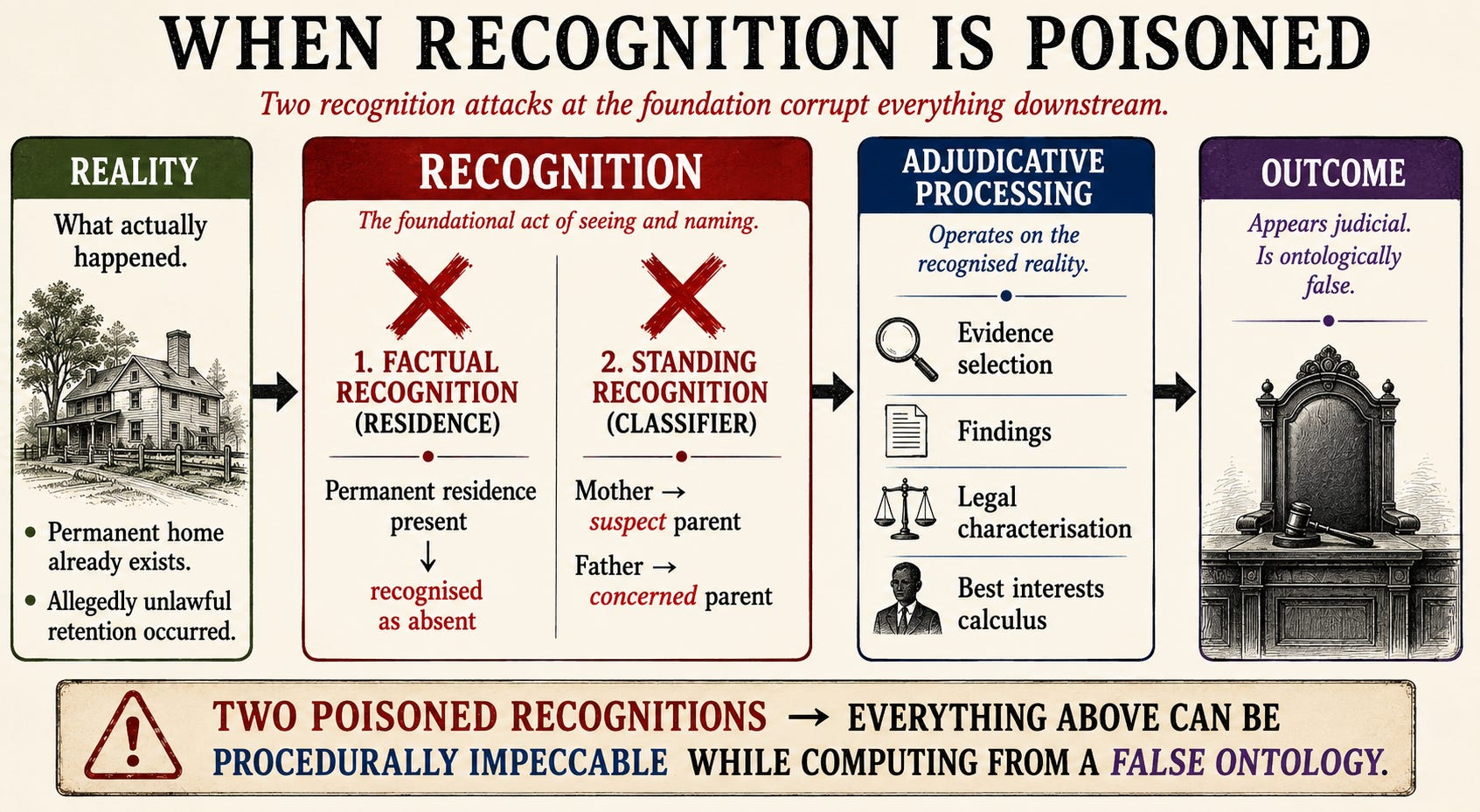
Which is where we turn next: to the recognition stack, and in particular, to the architecture of delegated authority.
A family court may, as a practical matter, be capable of aiding child-stealing and normalising its consequences. But what contains the family court? What external limits prevent that plagium conversion from becoming legitimate merely because a judge has perfected it?
Who judges the judges?
That is not a rhetorical question. It is an architectural one.
A family court is not sovereign. A judge does not possess an inherent authority to do whatever can be expressed in the grammatical form of an order. Judicial power is conferred, bounded and constrained.
So if the ordinary family-law envelope contains no internal circuit-breaker against the plagium machine, we have to move outward through the recognition stack and ask where that circuit-breaker actually resides.
Who granted the authority? What were the limits of the grant? What other authorities constrain its exercise? And who possesses the authority to counter-recognise an act that the court itself has recognised wrongly?
That is the architecture we need to map.
The answer is not a single hierarchy. Different bodies of law intersect the family court in different ways, so before looking for a larger containing authority we need to separate four questions that ordinary custody adjudication tends to collapse into one.
Provenance — what entered the machine?
Primary custody existed. The child was taken early and without the required notice. An emergency motion was denied. The new physical state nevertheless persisted.
What was the legal character of that state before the court recognised it? And if it was criminal in nature, what duties did that place upon Judges Norris and Ray?
Authority — what could the machine lawfully do?
The temporary order recognised the new physical state. Time generated preference, schooling, friendships and stability. Those fruits were then used to make the state permanent.
Where did the court obtain authority to perfect allegedly criminal child-taking into lawful custody—to act functionally as the completion mechanism of the crime?
Constraint — what contains the court?
Both judges were exercising delegated power, not sovereign power of their own.
What constitutional, criminal, structural and international limits prevent that delegated power from being used as an instrument of plagium? At what point does the judicial form cease to legitimate the judicial function?
Counter-recognition — who judges the judges?
The custody court recognised the sequence as an ordinary modification proceeding.
What wider authority can counter-recognise the same sequence as something else: restore the erased provenance, recognise the alleged crime and any resulting rights deprivation, and impose consequences upon those who converted it into lawful custody?
Those are four different questions.
And “best interests of the child” cannot answer all four.
It could take a week-long seminar to map every possible answer. We need not do that here. Instead, we will test four progressively wider envelopes against those questions:
State constitutional and delegated judicial authority — what power did North Carolina actually confer upon its family court, and does that grant extend to perfecting the fruits of an alleged crime?
Federal constitutional law and Deprivation of Rights Under Color of Law (DORUCOL) — when does misuse of state judicial power cross the boundary from erroneous adjudication into intentional deprivation of federal rights?
International and higher-order recognition — what legal character remains visible when we stop allowing North Carolina family-law vocabulary to define the entire object?
Military authority — the unresolved hypothesis raised by the apparent enemy classifier: if “QAnon” belonged to a national-security ontology rather than a child-welfare one, what authority brought that recognition into a civilian courtroom, and what was it doing there?
These envelopes are not four rungs on a jurisdictional ladder. They are four different places from which the same object can be recognised.
We will take them in that order, moving outward from the authority the family court unquestionably possessed towards the increasingly difficult question of what, if anything, was actually containing it.
State constitutional and delegated judicial authority
The crux of the state envelope is stronger than “did the judges apply custody law correctly?”
It is:
North Carolina created the District Court, prescribed its powers, and vested it with judicial power. Did that grant include power to use adjudication functionally to complete conduct that North Carolina’s own criminal law forbids?
North Carolina’s Constitution is unusually useful here. Article IV vests the State’s judicial power in the General Court of Justice, while §12 says the General Assembly prescribes the “jurisdiction and powers” of District Courts. It also expressly distinguishes civil actions for private rights and wrongs from criminal actions brought to punish public offences.
So the first question is what “judicial power” means at its boundary. Having subject-matter jurisdiction over custody does not necessarily answer whether every conceivable use of that jurisdiction is an authorised exercise of judicial power. And this is where ordinary North Carolina criminal law belongs upstream of §241/§242 (Federal DORUCOL), not underneath them.
North Carolina itself criminalises child abduction.
State law provides that a person who, “without legal justification or defense,” abducts or induces a minor to leave someone lawfully entitled to custody commits a Class F felony. Whether that statute actually fits these facts, including any applicable parental defences or interpretations, requires element-by-element analysis; we should not simply assume it does.
But analytically, suppose the antecedent conduct does satisfy a North Carolina criminal offence.
Then you get the beautiful structural collision:
The same sovereign speaks twice.
Through its criminal law, North Carolina says:
this conduct is forbidden.
Through its judicial delegation, North Carolina says:
these courts may exercise judicial power over custody.
The question is whether the second grant can coherently be construed to include perfecting the prohibited act that the first rule condemns. That is the state-law version of the plagium problem; you do not even need DORUCOL yet.
There are other state criminal-law channels around the process too. North Carolina separately criminalises perjury and subornation of perjury, for example, and has an entire statutory architecture around obstruction of justice. These do not automatically apply to anybody here; they establish the larger point:
A civil custody courtroom is not a criminal-law-free zone.
Calling the proceeding civil does not repeal the criminal law governing conduct before or during it.
Indeed, the North Carolina Constitution itself preserves the distinction: civil actions address private rights and wrongs; criminal actions address public offences. A custody judge adjudicating the former therefore does not thereby acquire authority to erase the latter.
The family-law envelope does not contain the criminal law. Both are contained by the constitutional order of the State.
The deeper state-law question is whether, by shielding a public-law wrong through private-law conversion, the court makes a counter-transition of its own: from adjudicating a private dispute into participating in the completion of a public offence.
A custody court has authority to resolve private rights concerning a child. It does not follow that it has authority to take the fruits of criminal conduct, strip them of their provenance, and perfect them into private rights for the actor who generated them.
If that operation remains “judicial power”, then the problem stays largely inside the ordinary doctrines of error, appeal and immunity.
If it does not, the problem changes category.
The question is no longer whether the court decided a custody case badly, but whether the purported custody adjudication became the mechanism through which an antecedent public wrong was completed.
Federal constitutional law and DORUCOL
The state-law problem asks whether judicial power ever included the authority to perform this operation. Federal law asks a different and more dangerous question:
At what point does the exercise of state judicial power become an intentional deprivation of federally protected rights under colour of law?
This is where our case becomes uncomfortable, because many of the necessary ingredients are already visible:
State action? Obviously. These were judicial orders backed by the coercive authority of the State.
Rights? Potentially several: parental liberty, procedural due process, speech and association, travel, and the right not to have state power applied discriminatorily.
Deprivation? Again, plainly something was taken. A fit mother went from primary physical custody to secondary custody, geographically constrained contact and reduced decision-making authority.
Causation through official power? Direct. The private taking could create possession; it could not create lawful custody.
Knowledge? This is where the two smoking guns become important. Norris had the provenance before him. Ray inherited the temporary order, expressly acknowledged its interlocutory character, recognised that Norris had “tied [the mother’s] hands” unusually tightly, watched the evidential basis of the “QAnon” classifier collapse, and then removed that classifier from his courtroom. The case therefore becomes increasingly difficult to describe as one in which the relevant problems were simply invisible to the decision-makers.
Intent? Care is required here. Intentional adjudication is not the same thing as criminal intent. A judge deliberately signing an order later found unconstitutional has not thereby committed a federal crime.
And that brings us to the final line.
Under 18 U.S.C. §242, the federal question is not merely whether someone acting under colour of law deprived another person of a constitutional right.
For criminal liability, the deprivation must be willful.
The Supreme Court’s Screws formulation makes that a demanding boundary: the official must act with the specific purpose of depriving a person of a federal right made definite by the Constitution or laws of the United States. United States v. Lanier adds the fair-warning requirement: the unlawfulness must be sufficiently clear.
That is the box we cannot tick merely from an anomalous custody judgment.
But notice how narrow the remaining question has become:
We are no longer asking whether state power was used. It was.
We are no longer asking whether the mother suffered a profound deprivation through that power. She did.
We are no longer asking whether constitutionally protected interests were implicated. They plainly were.
We are no longer asking whether the judges had notice of the facts that make the operation troubling. The record supplies substantial evidence that they did.
The remaining federal question is whether the evidence crosses the line:
from knowingly performing the adjudicative acts
into willfully using state power to accomplish a deprivation of a right sufficiently definite to support criminal liability.
That is a very different question from “was the custody order wrong?”
And judicial immunity does not answer it. Judicial immunity is principally a doctrine protecting judges from certain civil damages claims; it is not a licence to commit federal crimes. If the elements of a federal criminal offence are independently established, putting on a robe does not erase them.
This is the DORUCOL boundary:
Does the judicial act remain an adjudication that happens to be unlawful, or does the evidence establish that adjudication itself was intentionally being used as the instrument of the unlawful deprivation?
On the evidence we have, most of the architecture needed to ask that question is already present.
The unresolved box is willfulness.
Which brings us straight back to Constitutional Cluedo.
We readily distinguish accidental killing from murder, because murder already names a culpable kind of killing. The same is true of rape and torture: the words do not merely describe physical outcomes; they identify acts whose character already incorporates agency, violation and wrongful purpose.
Plagium works the same way.
A child can become separated from a parent accidentally. Custody can change through mistake. A judge can issue an erroneous order. But once we recognise the composed operation as child-stealing—the deliberate conversion of another’s protected relationship into somebody else’s possession or advantage—the innocent description has already begun to collapse.
That is why Constitutional Cluedo matters here.
Recognition precedes mens rea analysis.
Call the object a custody modification, and willfulness appears as some additional criminal ingredient that must somehow be discovered behind the adjudication.
Recognise the object as plagium, and the question reverses:
What would non-willful plagium even look like?
That does not automatically satisfy the technical willfulness requirement of §242. The federal offence still requires proof of its own mens rea and of deprivation of a sufficiently definite federal right. But it radically changes where the evidential problem lies.
The question is no longer merely “can we find evidence of willfulness?”
It becomes:
“What evidence permits us to recognise this composed operation as innocent adjudication rather than intentional participation in plagium?”
Not every mistaken custody order is child-stealing. Not every unconstitutional order is a federal crime. A judge can misunderstand evidence, misapply precedent, make an irrational credibility finding, or even violate a constitutional right without possessing the specific criminal intent required by DORUCOL.
But that is precisely why recognition comes first.
If we recognise the object merely as a custody decision, then willfulness looks difficult to establish. The judge was deciding a case; perhaps badly, perhaps unlawfully, but still deciding it.
If instead the proved object is the plagium machine we have been examining, the question changes.
A child is taken from the parent holding primary custody;
the attempted emergency legalisation fails;
possession nevertheless persists;
the court subsequently supplies the missing authority;
time inside the resulting state generates preference and stability;
and those fruits are finally used to make the displacement permanent.
Where, within that composed operation, is the innocent version?
As noted, that does not itself prove §242 willfulness. Screws requires more: the federal prosecution would still have to prove the requisite specific intent concerning deprivation of a protected federal right. But Cluedo tells us why the investigation cannot end merely by saying “custody judges exercise discretion.”
We have already encountered two unusually powerful facts bearing upon that inquiry. The residence defect was confronted by the very fact supposedly required to cure it, yet the recognition survived. The political classifier was confronted, stripped of its individual evidential foundation, and then expelled from Ray’s courtroom, yet again the recognition survived.
The machine was given two opportunities to correct itself. Twice, the supposedly load-bearing variable changed. Twice, the custodial state remained invariant.
That is where the willfulness question becomes serious.
The smoking guns still do not tell us why the state was preserved. They do something narrower: they progressively weaken explanations based upon innocent dependence on the stated variables:
If residence really drove the instability finding, establishing residence should matter.
If “QAnon” really was irrelevant nonsense, removing it should remove whatever work it was doing.
Yet on we went.
So perhaps the final DORUCOL question is not simply:
“Can we prove that the judges intended an unlawful result?”
It is:
“Having repeatedly been confronted with facts that should have changed the recognition, what innocent adjudicative explanation remains for preserving it?”
That is where Constitutional Cluedo meets Screws. The former cannot supply the criminal element required by the latter.
It can, however, tell us (or a prosecutor) where to look for it.
International and higher-order recognition
There is another reason why the family-law envelope cannot be allowed to contain the whole event: North Carolina is not the ultimate recogniser of the legal objects involved.
The United States has undertaken international obligations concerning family life, arbitrary interference, freedom of expression and association, equality before the law, and effective remedy. Most obviously, the International Covenant on Civil and Political Rights (ICCPR) recognises the family as entitled to protection, protects against arbitrary or unlawful interference with family and home, protects expression and association, and requires an effective remedy for Covenant violations.
This does not mean that the ICCPR functions as some international court of appeal from a North Carolina custody order. The United States ratified it subject to reservations, understandings and declarations, including that its substantive provisions are not self-executing domestically. That greatly limits its direct use as a cause of action in an American courtroom.
But that is not the recognition question we are asking. It is plain that “North Carolina custody modification” does not exhaust the legal description of the event.
From outside the family-law envelope, the same case facts can be recognised very differently:
as interference by public authority with family life;
burdens imposed upon expression and association;
differential treatment by the state;
failure to provide an effective remedy; and
state ratification of a family separation whose provenance may itself have been unlawful.
That matters because international obligations provide an independent recogniser. They do not ask whether Judge Norris correctly applied North Carolina’s best-interests factors. They ask whether the United States, acting through one of its constituent states, complied with obligations the United States itself accepted.
Again we encounter the same architecture:
Domestic recognition: custody modification.
Higher-order recognition: state interference with protected family relations.
Those descriptions are not necessarily contradictory. A perfectly lawful custody adjudication can obviously satisfy both.
But calling something custody cannot settle the second question.
And Constitutional Cluedo supplies the deeper reason. Plagium is older than the North Carolina General Statutes. So are the moral objects we call murder, enslavement and torture. Positive law does not manufacture their wrongness; at its best, it recognises and constrains them.
International human-rights law is one institutional expression of precisely that intuition: some objects remain objects of legal concern even when a domestic institution has supplied them with procedurally impeccable paperwork.
That gives us another possible counter-recognition:
A state court may recognise the outcome as custody. A wider legal order may still recognise what was done to produce it as an arbitrary deprivation of protected family life.
There is an important limit. International law does not magically supply the missing domestic remedy. Nor does an asserted ICCPR violation establish that any judge committed a crime.
Its significance here is more architectural:
The sovereign that created the family court has itself accepted that some rights and wrongs are measured from outside the vocabulary of family law.
And once that is admitted, “best interests” cannot be the final recogniser.
So far, however, every envelope we have opened is recognisably law: state constitutional law, federal constitutional and criminal law, and international human-rights law.
Our final envelope is different.
It arises not from the custody doctrine, but from the second smoking gun itself:
Why did an apparent enemy classifier—“QAnon”—enter the courtroom at all?
Military authority
And that’s where things get really interesting.
Nothing established so far shows that military authority exercised jurisdiction over this case. That is not the claim. The reason for opening this envelope is that our second smoking gun involves something qualitatively different from the residence defect:
An apparent enemy classifier entered civilian adjudication and altered legal standing versus the Constitution.
We have already established what happened to that classifier. Its individual evidential foundation collapsed. Ray recognised that it did not belong in his courtroom. He removed it. Yet its downstream recognition survived.
There is, however, one further feature of the hearing that makes the problem considerably harder.
The constitutional boundary was expressly identified to Ray.
When the mother was pressed to identify an anonymous political account, she expressly invoked her First Amendment speech rights. No nexus between that protected activity and harm to the child had been established.
Ray’s response was not to require such a nexus, or even to address the constitutional objection. It was:
“You’re going to spend some time with your attorney. He’s going to tell you what will happen if you do not answer questions.”
The protected object was named. The nexus to harm was absent. And the person asserting the constitutional right was threatened with consequences for refusing to surrender it.
Now put that fact beside the final order.
Ray had removed “QAnon” from the vocabulary of his courtroom. Yet the permanent order continued to burden the mother’s speech and association through restrictions inherited from the very subject matter that classifier had helped make relevant.
The enemy label disappeared.
The disabilities associated with it did not.
This creates a recognition problem different from ordinary judicial error.
The court had been expressly alerted to the constitutional character of the activity; the individualised case for dangerousness had collapsed; the judge himself had rejected the classifier’s presence; yet the final legal state continued to treat the politically classified party as requiring exceptional restraint.
That does not prove military involvement is justified.
It does require us to ask where the recognition came from.
“QAnon” was not functioning here merely as an insult. The case presented it through the vocabulary of extremism, violence and security threat. Its adjudicative logic was therefore recognisably that of an enemy classifier:
association
→ threat status
→ diminished civic standing
→ exceptional restraint.
That is alien to ordinary child-custody ontology. A best-interests inquiry asks what threatens this child. An enemy classifier asks what kind of person stands before the state.
And therein lies the unresolved hypothesis.
Was a national-security recognition being imported into a civilian court, such that constitutional rights which would ordinarily constrain the state ceased to function normally once the subject had been classified?
If not, this envelope closes. Political prejudice, institutional cowardice or judicial misconduct may be sufficient explanations.
If so, however, the problem changes category. We would need to identify the authority by which that recognition entered civilian adjudication—and whether any such authority could constitutionally exist.
That bridge has not yet been established.
We would need evidence of provenance: policy, instruction, intelligence product, security designation, communications, institutional coordination, or some other connection between the “QAnon” classifier used in court and an external governmental recognition system.
We do not have that evidence at this juncture.
What we have is stranger in a different way. We have reached this envelope from the output backwards. A classifier foreign to custody law entered the machine. It altered standing. Its factual basis failed. Its constitutional implications were expressly raised. The judge rejected its vocabulary.
And the machine kept its recognition.
An outcome foreign to justice resulted: court-endorsed plagium.
Constitutional Cluedo does not permit us to fill that missing bridge with the darkest available explanation. It requires the opposite: preserve the anomaly, eliminate explanations that cannot account for it, and demand evidence before moving into a wider envelope.
The second smoking gun therefore gets us to the military envelope.
It does not permit us to open it.
Yet.
I don’t anticipate my readers of 24 August 2026 at 3.17pm UK time being the ultimate audience for what I am writing. If any of you have made it this far, well done! You persevered on faith that I was saying something beyond a gripe about a personal grudge held against a man who falsely accused me of an affair so he could kidnap his own daughter and evade child support.
This is really for those coming afterwards, once the consequences have unfolded, who want to understand why.
So let me end by putting this back in its “big picture” context.
The claim behind the Q operation is extraordinary: that it exists to unwind the constitutional horrors of the last 150-odd years—private central-bank usury, organised war-for-profit, humans securitised as tax serfs, colour revolutions, industrial-scale child trafficking, rigged elections, mass brainwashing, and more. Add whichever manufactured totems you believe belong on the list: 9/11, Vietnam, the Great Depression, and so on.
I am not asking you to accept that claim here.
I am asking what follows if it is true.
If “QAnon” really is an enemy classifier in that wider conflict, and if I was personally classified through it, then the mother and child cease to be the ultimate objects of what happened. They become collateral damage. The North Carolina court becomes an instrument through which an entirely different conflict was operationalised.
The real target, on that hypothesis, was not simply one mother or one child. It was recognition itself. My readership could not be allowed to watch the system recognise the alleged child-stealing for what it was, deliver accountability, and thereby supply an observable instance of the wider “trafficking” hypothesis I had been writing about.
And that produces a terrifying inversion.
By acting upon the enemy classifier—burdening those marked by it, suppressing accountability for those who benefited from it, and perfecting the resulting harm through state power—the participants potentially attach their own conduct to the very criminal system the “QAnon” classifier would, on that hypothesis, exist to defend.
If the missing evidential bridge ultimately connects that system to organised criminality cognisable as treason, crimes against humanity or war crimes, then this was never merely an ugly custody case with some unconstitutional politics sprinkled on top.
The custody case becomes evidence of participation in the larger object.
That is an altogether different envelope.
Constitutional Cluedo forbids me from pretending that the missing bridge has already been established. This article cannot tell you what is on the other side.
But neither can I make the two smoking guns disappear.
The facts changed. The recognition did not.
The classifier was removed. The recognition did not.
I cannot yet tell you which envelope ultimately constrains courts from becoming plagium machines.
But I do know something antecedent to all of them:
Stealing children is not part of the remit of justice.
And we have two smoking guns telling us that “child custody” does not sufficiently explain what happened here.
So I have a strong suspicion that an envelope is about to be opened.
Let’s see which one—and what is inside.

"Ordinary American custody doctrine contains no obvious circuit-breaker that necessarily prevents the consequences of child-stealing from being converted, step by individually permissible step, into legally recognized custody." I *knew* it. There are simply too many stories of this kind of injustice being done in this country for it not to be true. For money (both legal and illegal), for psychopathic sadism, or for the advancement of a political ideology. It happens far more often than most people would even consider possible, and it is human trafficking in all but name. Now it has a name for us: Plagium.
Whether this particular case fits inside that "envelope" by intent, we can't yet say, but the quote is the heart of the problem overall. I'm wondering if the lack of such a circuit-breaker indicates simply an oversight by everyone over the centuries or whether good people have wanted such a circuit-breaker for a long time but have been prevented by criminal elites from putting it in place and stifling the elites' acquisition of children or the manipulation of families for their own purposes.
Is there a history of attempts to put such a circuit-breaker in place in recent centuries? If so, who prevented the adoption of a better system and how did they do it so successfully?
"A classifier foreign to custody law entered the machine. It altered standing. Its factual basis failed. Its constitutional implications were expressly raised. The judge rejected its vocabulary."
This statement holds much deeper significance.....the system is compromised beyond repair and must be uprooted and replaced.
BAN THE BAR.