

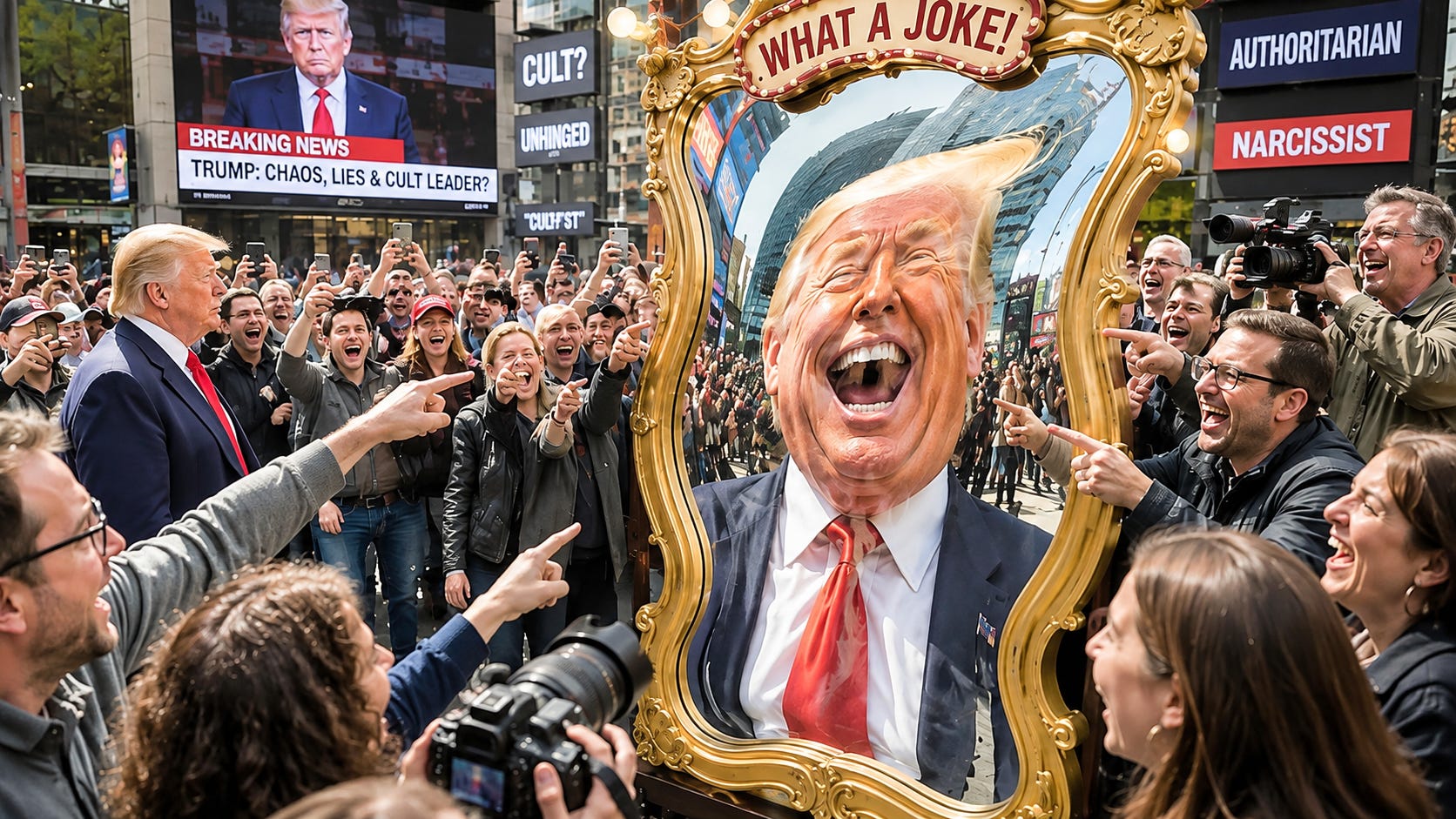
Why are abuse victims so often smeared as delusional?
Why are whistleblowers so often dismissed as merely disgruntled?
Why are scientists who challenge orthodoxy so often branded as deniers?
Each of these begins with an entrenched social recognition:
that a charismatic individual is a “good person” and therefore cannot be an abuser;
that an institution is fundamentally sound and therefore cannot be corrupt; or
that a scientific theory is “settled” and therefore beyond question.
Notice the dependency between the recogniser and the conclusion. The reasoning that follows may be entirely coherent—but only relative to the prior act of recognition. Change the recogniser, and the same evidence can support a radically different reconstruction of reality.
That is the phenomenon this article explores.
In my earlier article deconstructing the “QAnon” label in the mass media, I stumbled upon an insight that deserves a much wider audience.
The QAnon cult?

As I write this, I am sitting opposite my elderly parents, who are quietly studying on their iPads. My brother is wallowing upstairs in the bath during a visit back to England from his home in the United States. I have seen both of my daughters this week. This afternoon I may meet an old university friend for coffee; we only spoke last week.
While exploring one particular controversy, I believe I uncovered a more general mechanism that explains many apparently unrelated “dissident” phenomena. It adds a new level of precision to how we understand why people become trapped in radically different versions of reality.
I don’t believe in sending readers on a long hunt for the punchline, so let me give it to you up front. The defining feature of the misrecognition trap is not that people reach false conclusions or attach misleading labels. That is ordinary. The defining feature is that correction itself becomes impossible.
When reality presents an anomaly, it no longer has the authority to revise a misplaced recogniser.
Instead, the anomaly is reinterpreted to preserve—and often reinforce—the faulty recogniser. The false baseline survives intact, while those who deviate from it are misclassified as irrational. The whole loop becomes self-sealing: the suffering of heretics is itself taken as evidence that dissent is madness.
The result is not merely individual error, but collective delusion.
There is nuance beyond that précis version, and this is where the real insight lies.
None of the constituent ideas is new. They already exist in disparate intellectual silos. The advance is to bring them together into a single explanatory framework. Three ingredients matter.
Recognition. Most famously explored by H.L.A. Hart in jurisprudence through his concept of the rule of recognition. Hart’s key insight was that every legal system depends upon shared social criteria for recognising what counts as valid law. Recognition is therefore a social process: authority exists because the relevant community treats it as authoritative.
Reconstruction. No single thinker owns this territory. It encompasses the methods by which we infer the hidden structure of reality from observable traces: Bayesian inference, abductive reasoning, forensic investigation, intelligence analysis, and the scientific method all belong here. Reconstruction asks not what are we supposed to recognise? but what best explains the evidence?
Reality. Philosophers have wrestled with truth for millennia, but Karl Popper provides perhaps the most useful perspective here. His emphasis on falsifiability recognised that our theories do not govern reality; reality governs our theories. When observation repeatedly contradicts a model, the model—not the world—is supposed to change.
Each of these ideas is well established on its own. What is missing is an account of how they interact:
Recognition provides the baseline from which we begin. We cannot trace every belief back to first principles every time we think or act, so we rely on recognised authorities, concepts, institutions, and heuristics as cognitive shortcuts. Recognition is what allows complex societies to function at all.
Reconstruction tests that baseline against the evidence. Given the artefacts in front of us, what underlying process, structure, or runtime best explains what we observe? Reconstruction exists precisely because recognisers can be mistaken.
Reality supplies the final constraint. It determines whether the recognised baseline survives contact with evidence or must be revised. Reality is what prevents recognition from degenerating into dogma and reconstruction from drifting into fantasy.
Or, in a nutshell:
Recognition is what allows reasoning to scale.
Reconstruction is what keeps reasoning honest.
Reality is the final court of appeal.
The misrecognition trap emerges when that final corrective step is disabled. Recognition ceases to be accountable to reconstruction, and reconstruction ceases to be accountable to reality. Instead, reality is continually reinterpreted to preserve an already-authorised recogniser.
Once that inversion occurs, the negative feedback loop that normally keeps belief aligned with reality is broken. Every corrective signal is either ignored or inverted. The belief system loses the ability to converge on truth and instead converges on preserving its own internal coherence.
This all sounds rather abstract, so it is best understood through an example. I am going to use Dr Steven Hassan’s The Cult of Trump as a case study. I briefly touched on his work in an earlier article, where I mischievously turned his “Behaviour, Information, Thought, Emotional” (BITE) framework back on the collective irrationality of the Covid era.
I choose Dr Hassan deliberately. I believe he is fundamentally motivated by a desire to help others, informed by his own distressing experience of coercive control. His work has educated many people about the mechanics of cults and mind control. By publishing it, he has also invited scrutiny of its assumptions and conclusions.
My purpose here is not to judge his character, but to use his work to illustrate what I believe is a deeper epistemic phenomenon that affects all of us—including Dr Hassan, myself, and the reader.
Is Covid a cult?

I have been a little bit naughty (wot me?!?) and taken the BITE framework of cult expert Dr Steven Hassan (without asking him first) and applied it to Covid. BITE stands for “Behaviour, Information, Thought, Emotional” and lists the elements of authoritarian control over cult members. You can download the Excel spreadsheet
The starting point is that Dr Hassan’s BITE model is a reconstructive toolkit. When someone is confronted by a system of authority that appears to deny them agency, it provides a structured way to ask whether the observable behaviours match established patterns of coercive control and mind manipulation. I am not a domain expert, so I defer to Dr Hassan on the rigour of the framework. Intuitively, however, it is a strong piece of work.
What I particularly admire is its mnemonic design. “BITE” is memorable. In a moment of uncertainty or distress, the framework can be recalled simply by remembering its name. That matters. A diagnostic tool is only useful if people can retrieve it when they most need it. The enduring value of Dr Hassan’s work may owe as much to its accessibility and practical applicability as to the sophistication of the underlying theory.
So Dr Hassan has built an excellent microscope to observe abusive environments. Unfortunately, he inherited the wrong map of where he was permitted to point it.
Before one even considers applying the BITE model, there is an upstream filter. Why should any particular set of circumstances even be considered as belonging to the class of objects that warrant evaluation? That is a recognition function, and it necessarily precedes reconstruction.
Once a baseline recogniser has been established, the domain of legitimate inquiry has already been defined.
If your starting assumption is that the modern liberal-democratic establishment is fundamentally sane and trustworthy, then the object requiring explanation is no longer the establishment itself, but anyone who persistently challenges it.
Under that model, those questioning narratives issued by institutions already recognised as authoritative—such as the CDC, NIH, WHO, CNN, PBS or MSNBC—naturally become the targets of reconstruction rather than the institutions themselves.
Once applied to geopolitics, the BITE framework is therefore directed primarily at the dissenter, not the establishment.
The effective root recognisers look something like this:
Dr Hassan’s default recogniser:
Established public institutions are presumptively trustworthy unless compelling evidence demonstrates otherwise.
A mainstream Trump or MAGA recogniser:
No institution should be exempt from forensic reconstruction.
A Q-informed “Anon” citizen analyst’s recogniser:
Persistent, unexplained anomalies suggest that institutional trust itself may have been inverted, and therefore all warrant investigation for hidden coordination or corruption.
Everything downstream diverges.
Notice that the disagreement begins before anyone has reasoned about the evidence of “cult membership”. It begins with what each participant is prepared to recognise as a legitimate starting place for reconstruction.
We have now established BITE as our reconstructive framework, and “liberal-democratic institutions represent the default standard of rationality” as our baseline recogniser. Before we ask whether reality has anything to say about that pairing, let us simply follow its logic to its natural conclusion.
Applying the BITE framework to the public phenomenon of Trump and his supporters yields a remarkably consistent pattern via the BITE lens:
Do Trump supporters exhibit behavioural patterns that resemble those found in cult members? Yes!
They attend rallies, adopt distinctive symbols and slogans, place unusual trust in a charismatic leader, and maintain loyalty despite intense external criticism.Do Trump supporters narrow their information sources in ways that resemble those found in cult members? Yes!
Many distrust mainstream media, rely heavily on alternative channels, discount hostile reporting, and reinforce one another through relatively closed information networks.Do Trump supporters display thought patterns that resemble those found in cult members? Yes!
Critics are often viewed as acting in bad faith, contradictory evidence may be discounted, and complex events are interpreted through a coherent overarching narrative centred on institutional corruption and hidden motives.Do Trump supporters exhibit emotional dynamics that resemble those found in cult members? Yes!
Strong feelings of solidarity, persecution, hope, righteous purpose and existential struggle are common, together with a conviction that outsiders fundamentally misunderstand what is happening.
Conclusion: it looks like a cult.
Notice what has not yet happened. We have not asked whether the baseline recogniser itself deserves reconstruction. We have simply accepted it, applied a perfectly respectable reconstructive tool, and obtained an internally coherent result.
The analysis is not obviously irrational.
It is perfectly rational—given its starting recogniser.
Now let us perform the one operation that the misrecognition trap tries hardest to prevent. Instead of treating the baseline recogniser as beyond question, let us ask whether it, too, is open to reconstruction.
Every reconstructive process begins with anomalies—observations that sit uneasily with the accepted model of reality. If enough anomalies accumulate, intellectual honesty demands that we ask whether the recogniser itself has become misplaced.
So what kinds of anomaly might legitimately cause us to question the proposition that the modern liberal-democratic establishment represents the default standard of sanity, morality, and institutional trustworthiness?
Well…
The FBI’s handling of the Hillary Clinton email investigation and later Crossfire Hurricane.
Uranium One and allegations surrounding the Clinton Foundation.
The Obama birth certificate controversy and the institutional response to it.
Russiagate and the subsequent Durham investigation.
Hunter Biden’s laptop and the coordinated suppression of the story before the 2020 election.
Claims of irregularities in the 2020 election, followed by disputes over how those claims were investigated and adjudicated.
The Twitter Files and evidence of coordination between government agencies and social-media platforms.
COVID-era censorship involving the CDC, NIH, White House, and technology companies.
The origins of COVID-19 and the changing official position on the laboratory-leak hypothesis.
The handling of January 6, including disputes over intelligence, security failures, and the role of federal agencies.
The list goes on and on. For many Trump supporters and Q-oriented citizen analysts, these anomalies were not abstract talking points. They were lived experience: personal discrimination, professional ostracism, fractured families, censorship, loss of employment, institutional hostility, and the persistent mismatch between official narratives and everyday observation.
Nurses, teachers, truck drivers, firefighters, engineers, business owners and countless others began comparing notes—both in the physical world and online. Individually, each anomaly might admit an innocent or local explanation. Collectively, however, they formed a growing body of evidence that the accepted recogniser itself might deserve reconstruction.
We do not need to agree on the ultimate truth of every individual controversy. That is not the point. The point is that, taken together, they constitute a prima facie case for reopening the prior assumption that the liberal intelligentsia has already settled the important questions of institutional trust, public morality, and political reality.
This is where the inversion becomes really interesting. Instead of looking like symptoms of mind control, the exact same observations begin to look like adaptations to a hostile information environment.
For example:
Behaviour — Rather than blind obedience, many behaviours become understandable as attempts to preserve autonomy: seeking alternative media, attending rallies, refusing mandated medical interventions, documenting censorship, or building parallel communities when existing institutions are no longer trusted.
Information — What once looked like “information control” now appears as information diversification. Rather than relying exclusively on establishment sources, people actively compare competing narratives, inspect primary documents, analyse public records, and seek corroboration across independent channels.
Thought — Instead of exhibiting closed thinking, supporters become unusually willing to entertain competing hypotheses, revisit prior assumptions, and reconstruct hidden causal models from disparate evidence. They may reach incorrect conclusions, but the underlying cognitive act is investigative rather than merely conformist.
Emotion — Strong emotions remain present, but they no longer necessarily signal cult attachment. Fear, anger, hope, solidarity and determination become proportionate responses to a perceived institutional failure. The emotional investment follows the reconstructed reality rather than generating it.
The crucial point is that the observable behaviours have barely changed. Only the recogniser has.
That is precisely why the misrecognition trap is so powerful. The same evidence can sustain radically different interpretations depending on what is recognised as the baseline. The dispute is therefore not primarily over behaviour, information, thought or emotion. It is over the upstream question that determines how those observations are classified in the first place.
Up to now we have shown three things:
Recognition determines what gets reconstructed. BITE is directed at Trump supporters, not Hillary Clinton’s or Joe Biden’s supporters.
Reconstruction produces a diagnosis. Within the assumed epistemic frame, the “cult characteristics” indicator lights illuminate.
Reality is prevented from revising the recogniser. The prior assumption that Trump supporters are socially deviant becomes progressively self-reinforcing.
The story does not end there. The really important part is what happens next.
Once those who question the recognised order begin adapting to it—forming new communities, distrusting legacy media, developing alternative information networks, using distinctive language, attending rallies, or emotionally bonding over shared experiences—the original “Orange Man Bad” recogniser appears increasingly vindicated.
The adaptations of Trump supporters, produced by institutional hostility, are quietly reinterpreted as evidence that the hostility was justified all along.
The logic silently inverts:
They are isolated because they are in a cult.
becomes
They joined together because we isolated them.
which is then quietly rewritten as
Their joining together proves they were in a cult.
The causal arrow has reversed without anyone noticing.
The establishment’s own response manufactures precisely the behavioural signatures that later become evidence for the original diagnosis.
The more the dissident adapts, the more pathological the dissident appears. “Everyone knows” that Trump supporters are intellectually misguided and morally delinquent.
The more pathological the dissident appears, the less willing anyone becomes to reconstruct the baseline recogniser. “Everyone knows” that the allegations contained in the Q drops are merely “QAnon fantasies.”
Once that judgement becomes socially settled, reconstruction itself becomes suspect. “Everyone knows” there is nothing to investigate. The allegations have already been “debunked”.
The recogniser has now become socially self-defending.
More than that, it has become self-manufacturing. Every attempt to escape the recognition system generates fresh evidence that the recognition system was correct all along.
The loop closes.
This is the defining characteristic of the misrecognition trap. It is not merely ordinary resistance to correction, born of pride, ignorance, or stubbornness.
It is a systematic inversion in which reality’s attempts at correction are themselves reinterpreted as confirmation that the recogniser was right all along.
The hallmark of the misrecognition trap is that reality’s attempts at correction become evidence that no correction is needed.
The deepest irony is that the BITE framework succeeds as reconstruction while failing at recognition. It correctly identifies many of the signatures of coercive control, but, because the upstream recogniser is treated as beyond reconstruction, it repeatedly applies them to the wrong object.
The result is that a book written to expose mind control can, under the wrong recogniser, unintentionally reinforce it.
The irony is now complete.
Once the misrecognition trap closes, it is no longer merely the dissident who can be evaluated using the BITE framework. The recognition system itself begins to acquire the very characteristics that BITE was designed to detect:
Behaviour. Deviation from approved norms attracts social punishment. Loyalty is publicly rewarded. Dissent becomes professionally hazardous.
Information. Unauthorised sources are discouraged, censored, or ridiculed. Gatekeepers determine what may legitimately be discussed. Contradictory evidence is reclassified as misinformation or disinformation.
Thought. Certain questions become socially impermissible. Approved narratives harden into orthodoxy. Independent reconstruction is recast as extremism rather than inquiry.
Emotion. Fear, shame, and outrage become tools for maintaining group cohesion. Social belonging increasingly depends upon affirming the anti-Trump recognised worldview.
The remarkable outcome is that the faulty recognition system gradually develops the very signatures of coercive control that the BITE framework was designed to identify.
The Cult of Trump therefore performs a profound inversion.
A framework intended to detect mind control, once coupled to a misrecognised baseline, unintentionally reveals—and even reinforces—the very dynamics of coercive cognition within the liberal-democratic intelligentsia applying it.
It gets worse. Oh, yes.
It is not just that the baseline recogniser — “MAGA is madness” — has missed crucial aspects of reality.
It is not just that attempts to correct the recogniser — “Crooked Hillary” — deepen its hold.
It is that the false recognition system develops an adaptive immunity to every attempt to displace it—“conspiracy theorist”.
We have already seen the process at work:
Trump supporters distrust the mainstream media.
That is not treated as a possible response to repeated experiences of misinformation or censorship.
It is absorbed as further evidence that they are cult members.
Trump supporters build alternative communities after being ostracised by friends, family and colleagues.
That is not recognised as an adaptive response to exclusion.
It becomes further proof that they belong to an isolating cult.
Trump supporters seek out alternative sources of information after concluding that established institutions are concealing important facts.
That is not treated as an attempt at independent reconstruction.
It is reclassified as immersion in an information bubble.
Trump supporters become emotionally bonded through years of shared ridicule, censorship and public hostility.
That is not recognised as solidarity under pressure.
It becomes evidence of unhealthy attachment to the group.
Every anomaly that fails to overturn the recogniser is quietly absorbed into it.
Every failed challenge strengthens confidence that the recogniser was correct all along.
Every dissident who adapts to institutional hostility generates fresh evidence that the hostility was justified.
Every unsuccessful attempt at correction therefore teaches the system how to resist the next attempt even more effectively.
This is the really important leap.
The false recogniser is no longer merely self-sealing, self-defending, and self-manufacturing. It is adaptively self-immunising.
Like a biological immune system, it learns from failed attacks and develops increasingly sophisticated responses to whatever threatens its continued existence.
That is why whistleblowers are attacked.
Why abuse victims are attacked.
Why dissidents are attacked.
Why independent scientists are attacked.
Not because they are necessarily wrong.
Because they have become epistemically foreign bodies.
The false belief system mistakes reality for infection.
Its immune response is not to refute the anomaly but to neutralise its source. Critics become “deniers”, “extremists”, “anti-science”, “populists”, “Russian assets”, or even “domestic terrorists”.
These are not rebuttals. They are cognitive antibodies.
The anomaly has been reclassified as the disease. The very act of attempting to recover reality from the evidence, to review the recogniser, is proof of irrationality.
Every anomaly that fails to break the recogniser therefore teaches the host how to survive the next anomaly. The recogniser undergoes something resembling natural selection.
Not biological evolution.
Epistemic evolution.
Anomaly
    ↓
Reinterpretation
    ↓
Recogniser survives
    ↓
Confidence increases
    ↓
Next anomaly becomes even easier to dismiss
The implications are profound.
Every healthy epistemic system possesses an immune system. Its function is to defend truth against falsehood. The misrecognition trap inverts that function.
Once the false recogniser becomes sovereign, the immune system no longer protects reality. It protects the recogniser from reality.
The objective function of fresh evidence silently changes.
It begins by optimising for:
Preserve truth.
It ends by optimising for:
Preserve the recogniser.
Nobody notices the transition.
Reality is no longer permitted to revise recognition.
Recognition determines what reality is allowed to mean.
At that point the system has become epistemically autoimmune.
There is one final consequence. This one is a doozy.
Once the false recognition system becomes self-sealing, self-defending, self-manufacturing, self-immunising, an adversary no longer needs to fabricate evidence or persuade anyone of falsehood.
They need only trigger predictable human reactions:
Ostracise people from their families and they will seek new communities, then call those communities cults.
Censor alternative viewpoints and people will build alternative information networks, then call those networks echo chambers.
Deplatform dissidents and they will migrate to new platforms, then describe the migration as radicalisation.
Ridicule independent inquiry and people will stop trusting establishment authorities, then present that distrust as evidence that they have succumbed to misinformation.
Every reaction becomes confirmation of the original diagnosis. The false recognition system manufactures its own confirmation, strengthens its own immunity, and generates the very behavioural evidence that appears to justify itself.
It is self-expanding.
Every successful application enlarges the recognised category of pathology. It begins with “the Trump cult”. It soon encompasses anti-vaxxers, election sceptics, lab-leak proponents, lockdown critics, free-speech advocates, parents objecting to school curricula, and anyone persistently questioning establishment institutions.
The recognised disorder is no longer loyalty to one political figure.
It is the refusal to recognise authorised authority without reconstruction back to reality.
That is an extraordinarily powerful form of mind and social control. The adversary no longer needs to invent behavioural evidence to discredit dissenting voices. They simply manipulate the environment until ordinary human adaptation produces it automatically.
That is the really chilling insight.
The evidence for the indictment is not fabricated.
The social environment is engineered to produce it.
The case for the prosecution then emerges naturally from ordinary human adaptation.
This is vastly more powerful than simple propaganda.
It does not require millions of people to believe obvious lies. It requires only that normal responses to social pressure be interpreted through the wrong recogniser.
The false belief system no longer needs to defend itself.
It has persuaded its victims to generate the very conduct later used to justify their exclusion and punishment.
And you thought cults were bad…
We can now locate The Cult of Trump within a larger conceptual hierarchy.
The book analyses what it presents as a subculture exhibiting cult-like characteristics. My argument is that this analysis itself is embedded within a larger recognition system that determines, before reconstruction even begins, which objects qualify for cult analysis and which do not.
The result is a recursive inversion. The framework succeeds within its own container, but the container itself is never subjected to the same reconstructive scrutiny.
Computer scientists encounter this problem all the time. A spreadsheet can calculate every value inside the workbook, yet it has no awareness of Excel itself. A web page can manipulate every element in the browser window, yet it cannot inspect the browser that is rendering it. The container is invisible to the code executing within it.
A recursive programmer immediately recognises the pattern. Every interpreter requires another interpreter to interpret itself. Every runtime has a containing runtime. The mistake is not in the execution of the algorithm, but in failing to notice the container within which the algorithm is executing is itself buggy or malware.
I do not think this diminishes Dr Hassan’s expertise in cults any more than a compiler engineer ceases to understand compilers because they overlooked a design error in the operating system hosting their compiler. His reconstructive framework remains valuable.
My suggestion is simply that it was deployed inside a recognition container that had itself escaped reconstruction.
Which leaves one final question:
How do you escape the misrecognition trap?
The answer is rather unpleasant.
You usually cannot reason your way out of it. Arguments are reconstructed inside the recogniser. Evidence is interpreted through the recogniser. Social pressure merely strengthens the recogniser.
The trap therefore persists until reality presents an anomaly so large, so obvious, and so undeniable that the recogniser can no longer absorb it without catastrophic loss of coherence.
The immune system fails. The recogniser collapses. Only then does genuine reconstruction become possible again.
There is a profound irony here. This is exactly what Dr Hassan describes in the lives of those who escape destructive cults. They rarely leave because they lost an argument. They leave because reality eventually overwhelms the belief system.
In Dr Hassan’s own case, if I recall correctly, that catalyst was a literal car crash.
For a society caught in the misrecognition trap, it sadly requires a metaphorical one.
absolutely brilliant Martin!... in the end perhaps a "scare event"?
A brilliant understanding of the mechanism of Human perception and belief. Well done !