


A new idea emerging from my conversations with AI.
This general discussion on legal reform is unrelated to any specific proceedings.
In 2019, the entire Boeing 737 MAX fleet was grounded overnight after a catastrophic software failure. Every single plane was grounded because it was deemed unsafe to operate, despite being fully functional in a technical sense.
Now, here’s the twist: In Britain right now, millions of court cases every year are decided by tribunals that are legally less real than that grounded 737. These ghost courts can fine you £1,000, ban you from driving, give you a criminal record, or even send you to prison – and almost nobody is allowed to ask whether the court itself is real.
Meet your second body: the legal person
You have two bodies:
Your flesh-and-blood body, protected by seatbelts, medicines, and aviation safety regulations.
Your digital/legal body, the identity that drives your car, holds your job, protects your visa, and builds your reputation. This legal person is fragile — and right now, it is vulnerable to being maimed or killed by paperwork issued by tribunals that don’t legally exist.
This harm isn’t visible, so it goes unchecked. But non-existent courts are already deforming the digital identity of millions, affecting their criminal records, driving licenses, and even their employment.
The simple reason courts keep ‘crashing’
Think of a plane. To fly, it needs five things:
A name on the aircraft register.
A qualified pilot.
A verified flight plan.
A physical location (where it’s sitting).
A signed release certificate to prove it’s safe to fly.
Now, a court needs exactly the same five things:
FOR a valid Local Justice Area (LJA) — the legal region the court is allowed to operate in.
AS a named, qualified judge actually sitting.
AT a legally designated courtroom or seat.
IN a real place where the tribunal is physically or virtually convened.
WITH a properly signed, authenticated order or warrant.
Right now, British courts like magistrates’ courts and the Single Justice Procedure (SJP) routinely fail most — if not all — of these critical safety checks. And they’re still allowed to make life-altering decisions.
Lexworthiness: airworthiness for law
So what is lexworthiness?
Lexworthiness is the proven condition that a tribunal is real, properly constructed, and safe to alter your legal person.
It is airworthiness for justice — just like an airplane must meet strict standards to fly safely, a tribunal must meet rigorous standards to operate lawfully. “Lex” is Latin for the written law — the medium in which courts operate, just like air is the medium in which airplanes must operate safely.
Here are the three essential components that make lexworthiness work:
Type Certificate (TC): Like an aircraft model approval, this proves that a tribunal, such as a Magistrates’ Court or Single Justice Procedure, has a legal design that complies with statutory requirements.
Individual Ignition Check: Every time a court sits, it must pass a five-letter test (FOR–AS–AT–IN–WITH) to ensure the tribunal meets the safety criteria.
Emergency Grounding: When a tribunal fails these tests or becomes dangerous (like an unsafe aircraft), it can be immediately grounded via a Judicial Airworthiness Directive (JAD).
Here’s a quick comparison:
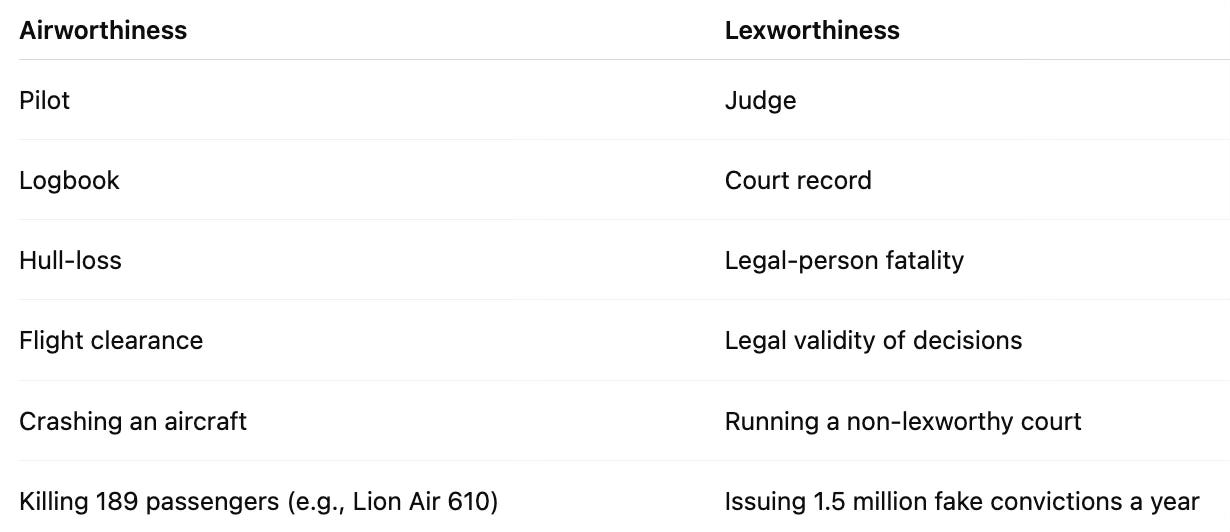
The smoking fuselage: the Single Justice Procedure
Every year, approaching 1 million cases are decided by the Single Justice Procedure (SJP) — a system that processes violations like parking fines and low-level criminal offences.
But here’s the problem: Almost none of these cases have a named judge, and almost none of them have a legally valid court name. The courts that decide these cases do not exist in a legal sense. They are administrative simulations, like flying an airplane without pilots or control towers.
In lexworthiness terms, the entire SJP fleet has already been grounded by a Judicial Airworthiness Directive (JAD) dated November 30, 2025. The State just hasn’t admitted it yet.
Why this changes everything
Once lexworthiness is established, three transformative things happen:
Citizens can demand proof their court is real — just like demanding to see an airworthiness certificate before boarding a flight.
Judges and officials have a clear checklist to ensure every court operates legally and safely.
The government can fix the system without admitting malice, simply by acknowledging: “It wasn’t corruption; the tribunal wasn’t lexworthy.”
We would never accept an airplane without a safety check. So why have we accepted courts that aren’t lexworthy for so long?
Next time you or someone you love is in court, ask one simple question:
“Please show me the lexworthiness certificate for this tribunal.”
If they can’t, the case must stop (or at least, that is what ought to happen).
That single question is the seatbelt for your legal person.
Martin, that's a very interesting analogy, and it does make everything crystal clear. You're certainly doing everything possible to give this group of people and entities a cheap and easy way out of the mess they are in charge of and participating in. You've also said that many of these people read this substack. If so, then at some point, if the fix is not applied, does the situation turn toxic and become malfeasance - or worse?
I hope they choose the easy road here.
...What a beautiful question to pose to the "court"....now, we set the intention in a disciplined way so that "lexworthiness" is an everyday word that is understood by most all! It has just become a word in my computer's memory. Will be adding this definition to my Primordial Equity Lens. HO!