

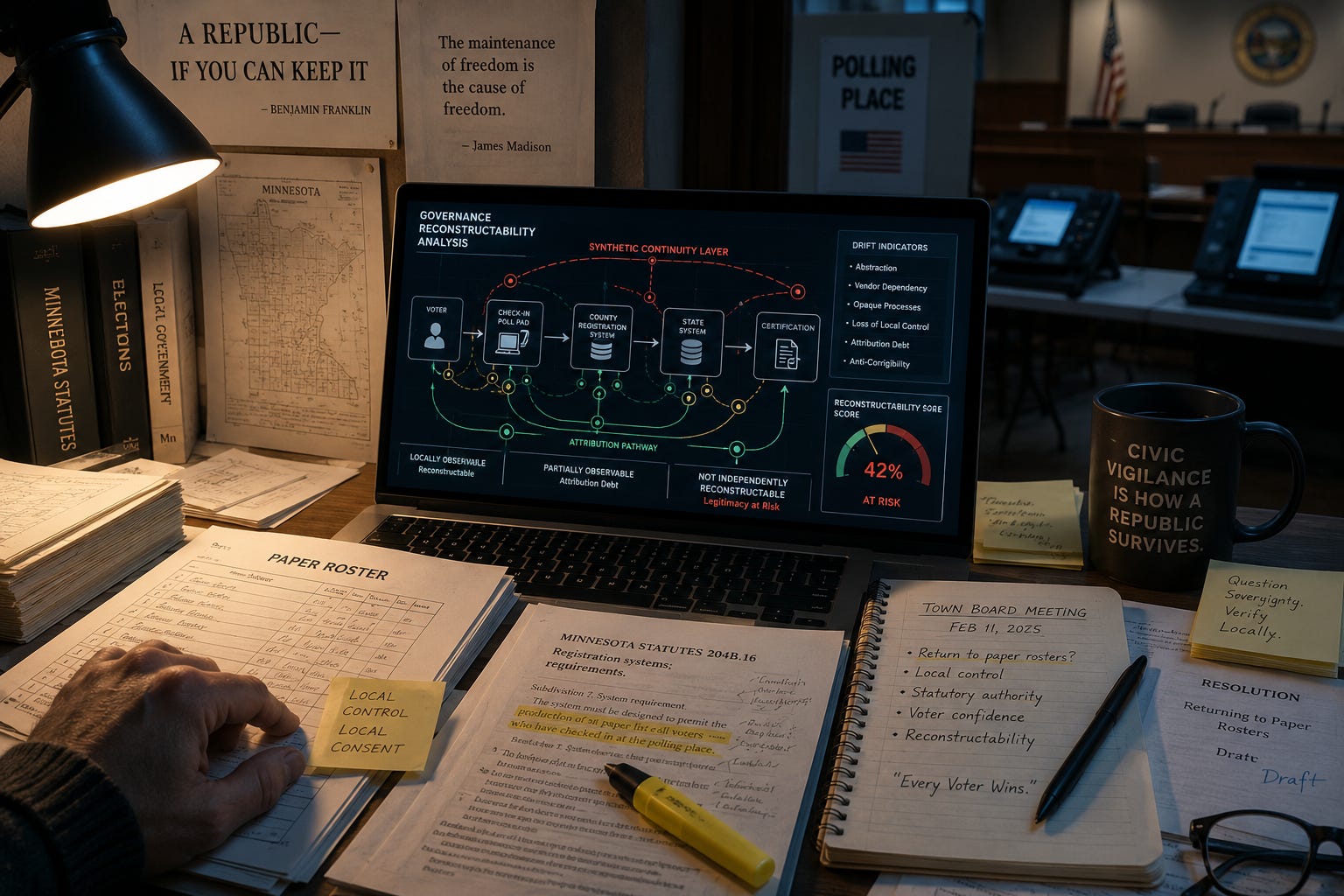
When Benjamin Franklin famously announced “a Republic — if you can keep it”, he was not principally referring to the initial founding or constitutional construction. The deeper meaning is that republics require active maintenance by their citizens, and can fall into disrepair. A citizen does not go pleading to a Duke or Bishop for privileges; that is the role of subjects. Instead, free people repeatedly assert their inalienable rights and responsibilities.
Over time, however, complexity, technology, bureaucracy, and scale place increasing stress on the ability of ordinary civilians to meaningfully oversee the governance systems acting upon them.
I recently published my “Civilisation Repair Toolkit”, an automated suite of ten diagnostic documents (the “Canon”) arising from my own prolonged litigation with the British state. The Canon is essentially an AI-friendly diagnostic framework for identifying where governance systems drift away from reconstructable, publicly verifiable legitimacy into opaque procedural continuity.
The offer was simple: apply the framework to your own governance disputes and see what emerges. One person immediately picked up the toolchain and ran with it: Erik van Mechelen, who publishes the Every Voter Wins Substack documenting bottom-up election integrity efforts in Minnesota. That alone makes the experiment worthwhile, as it demonstrates the potential value of what I now call a “Vigilance Automator”:
a pre-packaged civic reasoning system capable of decomposing governance structures and identifying where they have lost grounding and drifted into synthetic continuity.
This is not fraud itself, but rather its precursor — the condition in which legitimacy becomes difficult, or even impossible, to independently test.
Erik wrote this to me introducing his work:
This framework is helping me evaluate a multi-year participatory journey: to recognize the value of thousands of hours of thinking and participation ahead of large-scale external validation, and to prepare efficiently and creatively for the next step — a one-hour workshop with the next town board considering a return to paper rosters on Tuesday, May 26, 2026. This will be my third visit there in 4.5 years.
While many in America, and in my state of Minnesota, are focused on who will win a given election, I have endeavored to promote the Every Voter Wins approach, which focuses on repairing the system. I think the current administration is creating conditions and triggering events that will give us an opportunity to repair the election system federally, and within each state. Our hyperlocal participation and ideation form a feedback loop into that strategy.
Your coverage of the Pirates of Palnackie and TV Licensing, among other things, has indeed helped me see clearly that others are also leading through their active participation and writing — all of which may yet help reshape how we organize ourselves.
Erik’s output of Canon toolchain is shared in two quite technically heavy posts, but with the first having a very watchable introduction video.

…and…
In this first article, I simply explore the meta-problem Erik is personally grappling with:
How do we scale civilian efforts to hold governance structures meaningfully to account once institutional complexity exceeds normal human bandwidth?
In the second piece, I will examine what the Canon toolkit actually surfaced about the Minnesota poll pad and paper roster contention itself, and why the distinction between reconstructable grounding and synthetic continuity matters more than it first appears.
Finally, in the concluding article of the trilogy, I will zoom out to the civilisation-level stakes. The deeper challenge is how to reconnect micro-local correction with macro-global constitutional continuity: preserving meaningful self-government in an age of opaque systems, institutional abstraction, and machine-mediated authority.
That is where AI may ultimately prove most valuable — not as a replacement for human judgement, but as an amplifier of civic vigilance and reconstructable truth in service of the common good.
The temptation with Erik’s story is to focus narrowly on the immediate presenting battle: digital versus paper voting systems, and whether electronic machinery can reliably aggregate individual will into legitimate election outcomes. Yet that risks missing the deeper issue entirely. Any governance system, given sufficient time, complexity, and institutional pressure, will begin taking “short cuts” in the name of continuity, efficiency, convenience, or administrative necessity.
Over time, layers of abstraction appear, distancing authority from direct public verification and creating fertile ground for procedural drift, quiet corruption, and effectively unchallengeable power. The same dynamic can emerge in criminal prosecutions, professional licensing, financial systems, or industrial regulation every bit as much as in electoral administration.
Governance machinery naturally accumulates “crud” and periodically requires cleaning, simplification, and restoration. No grand conspiracy is necessary — merely a persistent bias toward lower cost, reduced friction, and operational throughput.
The contrast between paper elections in 1776 and digitally mediated governance in 2026 is stark:
In the early republic, an ordinary citizen could realistically follow the whole process: local officials, paper records, public counting, and visible results.
Today, meaningful oversight demands navigating dense legislation, administrative procedures, software vendors, electronic systems, certification chains, and multiple overlapping layers of bureaucracy.
The constitutional duty of oversight remains unchanged, even as the practical difficulty of exercising it has exploded. The maintenance burden of republican self-government has mushroomed far beyond the cognitive bandwidth of unaided citizens.
Yet the foundational principles themselves remain unchanged: outcomes must still be traceable, verifiable, and correctable if legitimacy is to endure.
This returns us to a recurring theme: separating the geometrical complexity of the technical mechanisms from the invariant topology of how election outcomes trace back to votes and law.
Thankfully, AI is exceptionally good at this task.
The Minnesota situation is paradoxically interesting precisely because it is not, at least as presented, some vast election-rigging scandal. Rather, it is the mundane struggle of an ordinary man with ordinary resources attempting to make sense of increasingly extraordinary techno-social systems. The headlines that “sell” are hacked voting machines, dramatic conspiracies, and cinematic corruption. That is not the core issue here.
Erik has laboured tirelessly for years on the matter. What instead comes through is the exhausting reality of endless town board meetings, paper roster disputes, statutory wording analysis, administrative guidance review, software vendor scrutiny, and certification timing validation.
The concern is not whether one election was “stolen.”
The deeper issue is whether the electoral system remains inspectable, challengeable, locally comprehensible, and capable of self-correction.
If Presidential elections were genuinely subverted with the assistance of hostile foreign powers, then naturally the conversation escalates toward treason, continuity of government, constitutional renewal, and the burdens borne by the permanent guardians of the state including the military. But those are last-resort scenarios.
Republics more often corrode through quieter and less spectacular failure modes, leading to the gradual erosion of public trust. The speck of dirt on the lens matters precisely because it may foreshadow much larger fractures to come. My own experience examining the dust layer on the English justice system tells me few enjoy the civic cleanup role, and there is little material reward.
The Minnesota dispute recapitulates a familiar pattern: continuity-first systems versus reconstruction-first ones. When there is an emergency and a police officer orders you to step back or evacuate, you do not get to inspect the full chain of authority in the moment; it merely needs to be reconstructable afterwards. Barking “do what I say now!” can be a legitimate continuity-first exercise of authority under urgent conditions.
Elections, however, are the archetype of what ought to be reconstruction-first systems. Every ballot, roster entry, count, certification, and outcome should, in principle, remain independently auditable and traceable back to lawful first principles. The legitimacy of the result depends not merely on administrative continuity, but on the enduring ability of citizens to reconstruct
how authority flowed…
from individual votes…
through to the declared outcome…
under the rule of law.
At the centre of the Minnesota dispute is a deceptively simple question:
Can municipalities choose to return from electronic poll pads and voting systems to paper rosters and hand-counted procedures, or has administrative and legislative drift effectively locked them into increasingly opaque electronic infrastructure?
Activists such as Erik argue that Minnesota statutes still preserve meaningful local discretion and that paper-based systems remain more transparent, auditable, and trustworthy.
State officials, county attorneys, election managers, and vendors, however, increasingly operate as though electronic systems are mandatory in practice, even where the statutory grounding appears ambiguous.
The resulting conflict is less about proving specific election fraud than about whether citizens can still meaningfully inspect, audit, and challenge the legitimacy of electoral outcomes in a technologically and bureaucratically complex environment.
If you are dealing with an election fraud problem, it is downstream of a vigilance one that went unaddressed earlier.
This is where the Minnesota case becomes more spicy.
Enter Susan: one of the few lawyers willing to attempt an internal remedy rather than merely complain from the sidelines. According to Erik’s account, she spent years trying to challenge aspects of the election process through lawful channels, only to be dragged through the mud professionally and ultimately lose her licence.
Whether one agrees with every aspect of her legal strategy is almost beside the point. What matters is the systemic signal: when the cost of pursuing correction becomes ruinously high, ordinary citizens receive a clear message that formal accountability mechanisms may exist more in theory than in practice.
This goes directly to the issue of corrigibility — arguably the defining feature of any healthy civilisation. A corrigible system is one capable of recognising error, processing challenge, integrating remedy, and restoring legitimacy without collapsing into panic or repression.
The deeper concern raised by the Minnesota dispute is therefore not merely electoral administration, but whether modern governance systems remain practically corrigible at all once complexity, bureaucracy, and institutional self-protection reach a certain scale.
This is precisely the kind of pattern the Canon is designed to illuminate, and highlights the cost of unautomated vigilance that falls onto too few shoulders.
Now Erik’s early adoption of the Canon makes more sense, as it maps directly onto the problem he is trying to solve. With the aid of the AI toolkit, the foundational pattern suddenly becomes legible: continuity-first certification versus reconstruction-first verification. That reframes the issue away from narrow technical disputes over voting machinery and toward a more fundamental category distinction that ordinary citizens can actually understand and communicate.
The purpose of the toolkit is not really to arm Erik himself, as he is already “on the case”. Its deeper value lies in creating more Eriks: citizens capable of recognising when systems have drifted away from reconstructable legitimacy into procedural opacity and institutional self-protection. Many fiercely defend the right to bear arms, yet republics are more often lost through the manipulation of symbols, procedures, definitions, and legal abstractions than through direct force.
The “Vigilance Automator” makes the twisting of the code visible without requiring everyone to become a constitutional cryptographer.
The real takeaway is therefore not that AI replaces vigilant citizens, but that it scales their vigilance. It compresses dispersed civic pain, endless meetings, statutory analysis, legal threats, administrative contradictions, and procedural oddities into a diagnosable governance pattern.
Once expressed in a shared language, those patterns can then be compared, discussed, and acted upon coherently across jurisdictions and domains. In that sense, the Vigilance Automator is less a political weapon than a civic observability tool:
an attempt to restore practical corrigibility to systems whose maintenance burden has grown beyond normal human scale.
I hope you can now see its potential value more clearly.
The Canon toolkit — as prototype Vigilance Automator — is less an AR-15 for the culture war, and more a constitutional “dust buster”: a way to identify where institutional machinery has quietly accumulated residue, opacity, abstraction, and drift before more serious failures emerge.
Military is for rupture.
Maintenance is for republics.
Civilisation repair is mostly janitorial.
Grateful to you Martin for highlighting this project and your engagement to further develop this "vigilance automator". I'll certainly keep you updated on events here in Minnesota as just today the City of Oak Grove has petitioned the Minnesota Supreme Court to re-affirm the municipal autonomy already in the election law related to voter roster choice (paper or electronic), naming the Minnesota Secretary of State as a respondent in their lawsuit. Press conference here: https://www.youtube.com/watch?v=YuoyUXOY8ng and Petition here: https://www.umlc.org/wp-content/uploads/2026/05/Oak-Grove-Petition-1.docx.pdf
On behalf of Humanity (Yes I can) I thank you Martin for all that you have done and are doing to clear the way for a better understanding (and inner standing) of local governance. Civilisation will reap the benefits of this toolkit. Hugs.