

Over the last week I have published seven articles doing a deep-dive into one child custody case in North Carolina. This end-piece is not about that matter, but about how you can take the epistemic method and apply it to your own situation.
Ordinary writing on Substack empowers you with insights and information. I am trying to do something slightly different: give you the underlying tools to audit authority, with the right questions already pre-packaged.
According to my ChatGPT dashboard, I have run over 48,000 prompts in the last 12 months. I would guess another 20,000 on Grok; it lacks comparable analytics. AI is unquestionably changing how we live and work. I am unashamedly narrowing my audience to those who are up for the fight to exploit this technology — whether to expose current corruption or prevent its recurrence.
My audience on X is mostly women:
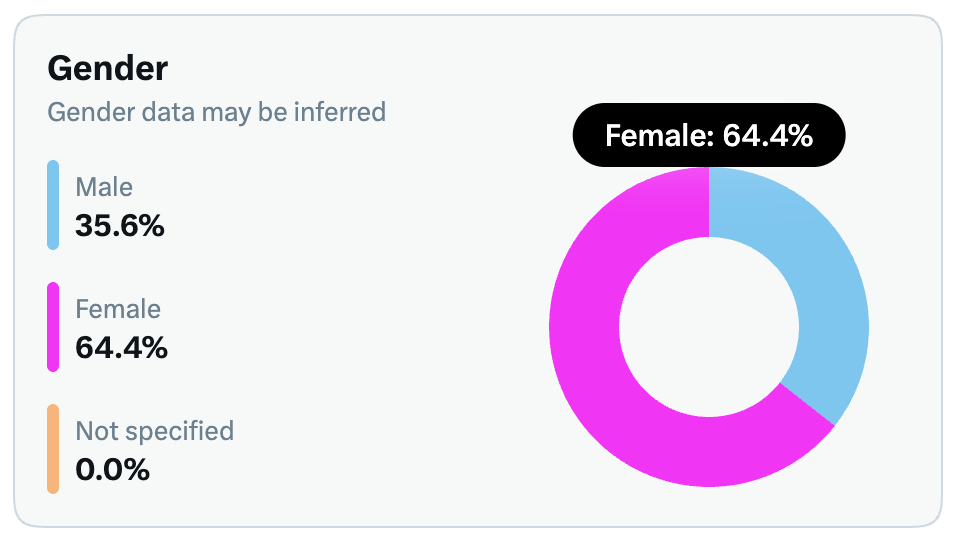
(Thankfully everyone can work out their own gender!)
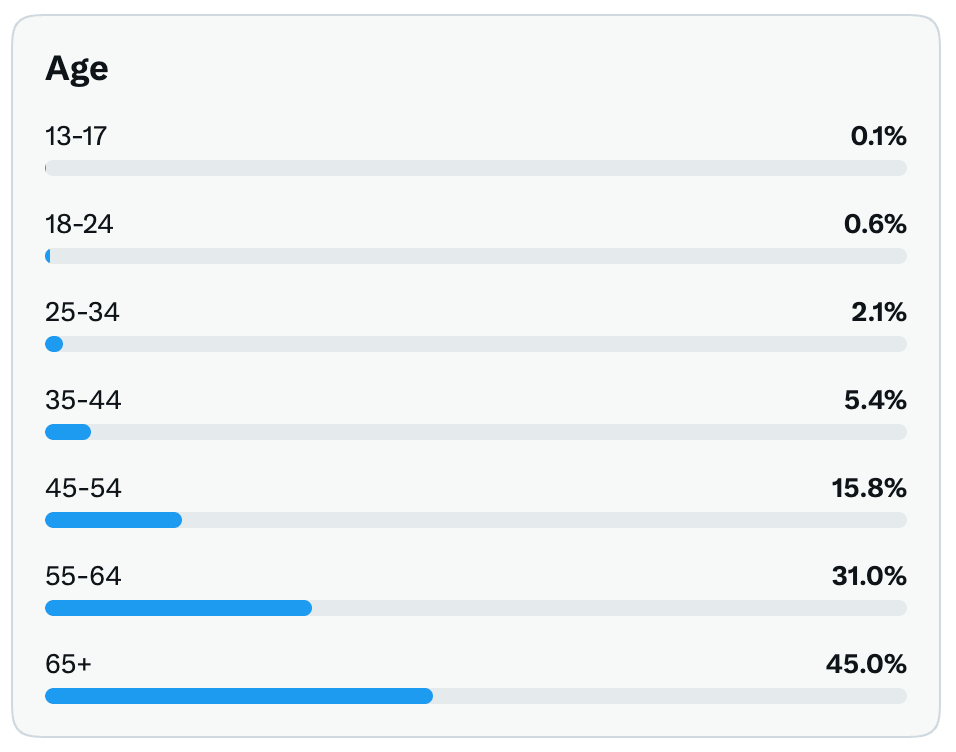
Overwhelmingly older:
And American:
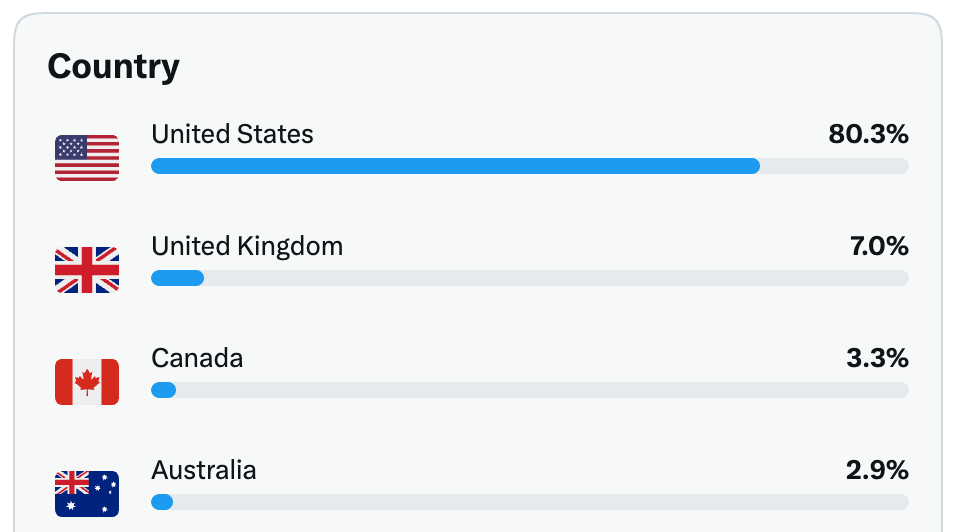
I expect my Substack readership has similar demographics.
So if you are one of my “Mega-MAGA grannies” looking to protect your grandkids, this is for you.
Don’t be afraid to try out these AI bots and see what they can do. You do not have to become a computer scientist. You need curiosity, persistence, your own records, and the willingness to keep asking better questions.
The younger males don’t seem to be turning up for the information-warrior job, so you are having to step in. I hope history records the weight you were carrying on behalf of us all.
On to the substance of what this tool is, and what it can do.
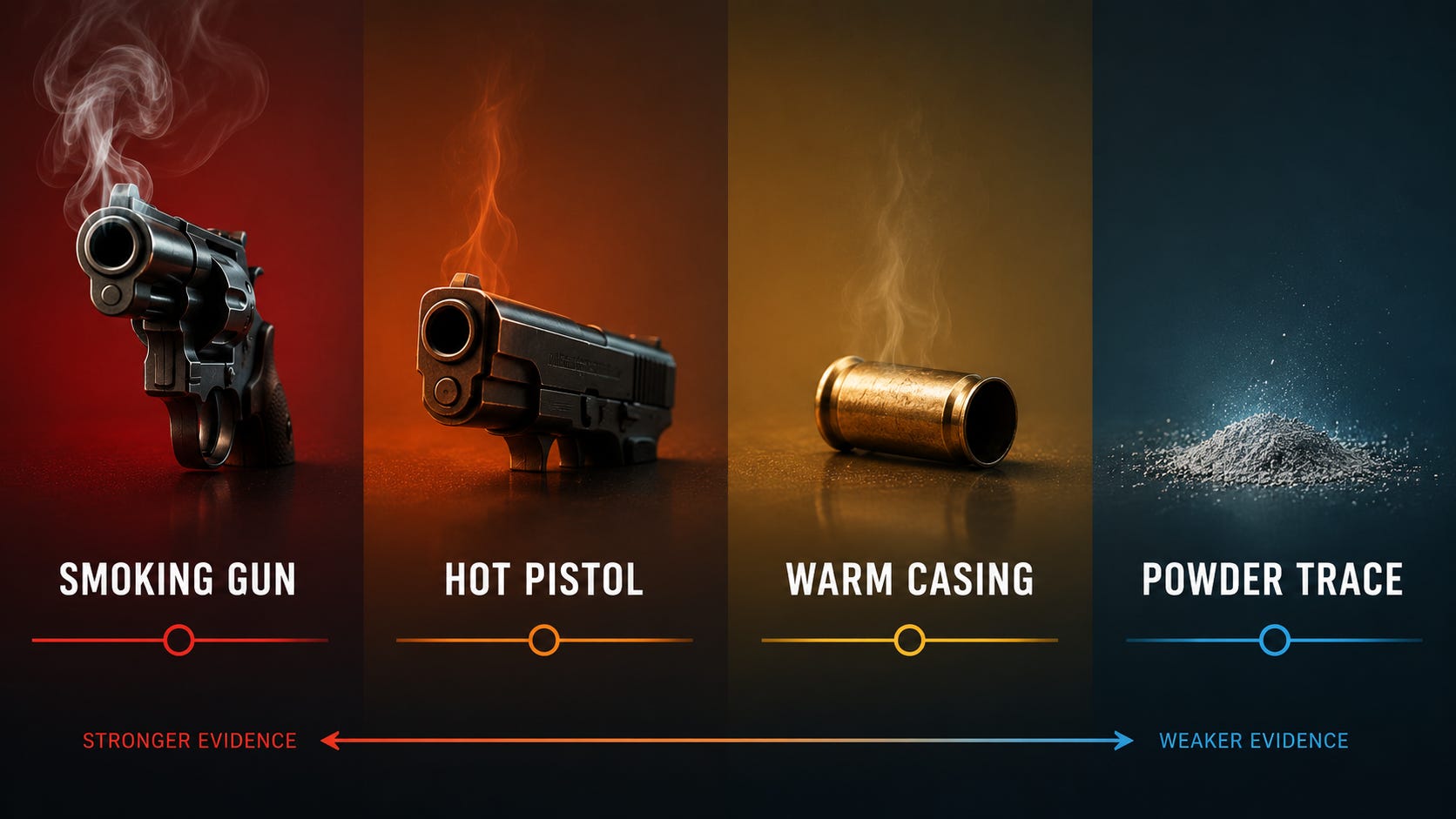
I am taking the colloquial idea of a “smoking gun”, narrowing it deliberately, and then extending the taxonomy downwards into weaker forms of anomaly.
In everyday usage, a judge taking a bribe — where you have the receipts — would obviously be called a smoking gun. I am not counting that here. It may be overwhelming evidence of culpability, but it does not have the particular diagnostic structure this tool is designed to identify.
Conversely, an entirely innocent clerical error can qualify as a Smoking Gun if it produces the right architecture: the system says a variable matters, that variable is changed or corrected inside the process, the system’s own model predicts that the output should update — and it does not.
‼️ This is not a test of guilt, corruption or bad motive. ‼️
It is simpler, and in some ways more useful:
Does the institution fail its own counterfactual test?
Or put another way:
When a supposedly load-bearing fact changes, does the recognition change with it?
If not, we have learned something about the model the institution is actually using — even if the explanation ultimately turns out to be entirely innocent.
In its strongest form, the Smoking Gun has five components:
Internality — the corrective information enters, arises within, or is recognised by the system itself. We are watching the system perform its own experiment, not judging it using information discovered afterwards.
A genuinely load-bearing variable — the fact being tested must actually matter under the institution’s stated or apparent decision model. Merely being mentioned is not enough.
An actual perturbation — that variable genuinely changes, disappears, reverses, is satisfied, or is disproved. Someone merely arguing that it should be viewed differently does not count.
A predicted material update — under the institution’s own model, changing that variable should materially change the recognition or outcome. We should be able to write the counterfactual explicitly: if X changes, Y should change.
Output invariance with discriminatory power — X changes, but Y does not. Crucially, the failure to update is difficult to explain under the purported model and therefore gives us information about what model may actually be governing the system.
In shorthand:
load-bearing variable → internal perturbation → predicted material update → no update → model discrimination
The last component matters. “They ignored a fact” is not enough. There has to be a reason, derived from their own model, why changing that particular fact should have changed something consequential. Otherwise we merely have an anomaly, not the unusually clean natural experiment that earns the technical label Smoking Gun.
The model then extends downwards through three weaker categories:
Hot Pistol — a strong anomaly that seriously strains the purported model and materially increases the plausibility of a specific alternative explanation, but lacks the clean internal counterfactual experiment required for a Smoking Gun. Importantly, a Hot Pistol can be more serious evidence of wrongdoing than a Smoking Gun; it is lower only in diagnostic structure.
Warm Casing — a material anomaly that survives the strongest reasonable ordinary explanation and still independently moves the analysis, but only modestly. One may not tell you much; several genuinely independent Warm Casings pointing in the same direction can become highly significant.
Powder Trace — a weak but directionally interesting signal that remains readily compatible with ordinary explanations. Odd wording, omissions, asymmetries or peculiar timing might belong here. Its significance comes principally from accumulation and pattern rather than what it establishes alone.
So this is not really a descending scale from “very guilty” to “slightly suspicious.”
It is a taxonomy of diagnostic structure:
Smoking Gun: the purported model fails its own internal counterfactual test.
Hot Pistol: the purported model is seriously strained and a specific alternative gains explanatory power.
Warm Casing: an anomaly survives ordinary explanation and independently moves the needle.
Powder Trace: an anomaly is directionally congruent, but ordinary explanation remains sufficient.
That distinction is what stops every troubling fact from being promoted rhetorically into a “smoking gun.”
To give you a sense of the kind of output that is possible, here is the initial readout on the North Carolina case in my previous articles. It is not exhaustive, but illustrative.
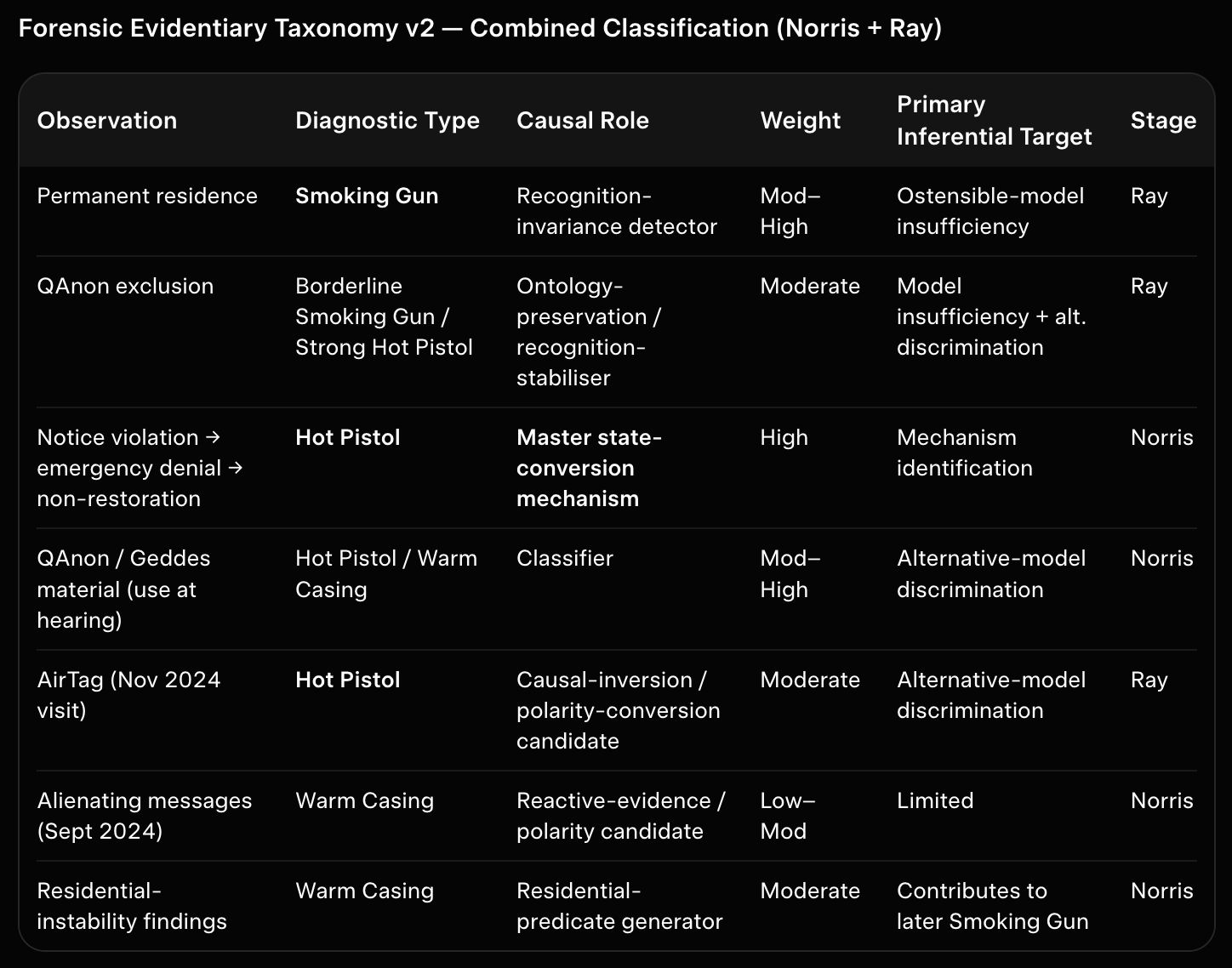
The important point is that I originally identified two Smoking Guns in my last article. I then subjected the framework itself to adversarial testing, tightened the criteria, and reran the evidence. One of the two was consequently demoted to a borderline Smoking Gun/strong Hot Pistol.
That is the entire point of the exercise.
The goal is not to collect as many Smoking Guns as possible. It is not to make every troubling fact sound maximally sinister. And it certainly isn’t to persuade an AI to validate whatever conclusion you arrived with.
The goal is to make the strongest claim that survives hostile examination of the record — and no stronger.
A forensic tool that can only escalate your claims is an advocacy machine. A forensic tool worth trusting must also be able to demote them.
The tool embeds instructions for how it should be used and specifies the output format, so there is minimal work for you to do beyond giving an AI the relevant material and asking it to apply the tool to your situation.
I believe this is a signifier of an onrushing revolution in the public audit of authority. The cost of forensic analysis is crashing.
You can contextualise this alongside the work of other citizen investigators: people like Big Time Charlie on X, digging into council spending, or Alison Wright on Substack, pursuing questions of identity fraud. Different subjects, different evidence, different institutions — but the same underlying development.
Investigative capabilities that once demanded lawyers, researchers, specialist analysts and considerable money are becoming available to anyone sufficiently persistent to assemble the records and interrogate them properly.
This does not mean the system will correct itself.
Audit and correction are different problems.
An institution may resist admitting error even when the evidence is overwhelming. Courts may protect finality. Bureaucracies may defend their previous decisions. Officials may simply refuse to engage. AI does not magically remove those obstacles.
But correction has a precursor: exposure.
Before a malformed process can be challenged, somebody has to reconstruct what happened, separate anomaly from accusation, identify the variables that supposedly governed the decision, test whether they really did, and present the result in a form another human being can inspect.
That used to be expensive.
Increasingly, it isn’t.
AI makes this kind of forensic work affordable to ordinary people like me — and to determined older American ladies who have accumulated a lifetime’s experience of institutions and have finally decided they aren’t taking it any more.
The state may retain a monopoly on many remedies. It no longer has anything approaching a monopoly on the analytical capability needed to audit how it exercises authority.
That strikes me as a very big deal.
You can download the tool here:

I am releasing it as donorware. Take it, use it, adapt it to your own encounter with misshapen authority, and pass it on if it helps.
There is, however, an irony in spending my time trying to crash the cost of forensic analysis for everyone else: I don’t pay nearly enough attention to my own private needs. My water-bill payment just bounced.
So if you find this work useful and are in a position to support it, please do. Your donations buy me the time to research, build and publish tools like this openly rather than putting them behind another paywall.
I also still have around £2,000 of court costs left to pay from my own attempt to demonstrate that there is no provably determinate tribunal in law behind my encounter with the Single Justice Procedure.
You don’t owe me anything for downloading the tool. But if it saves you time, helps you see your own evidence more clearly, or gives you a question you otherwise wouldn’t have known to ask, paying a little of that value forward keeps the next tool coming.
👵🏻🇺🇸🥂

This "Granny with Gratitude and Attitude" send's you love and appreciation, thank you for the download....cheque in the post....hugs.
You have some of us men understanding and appreciating the significance of your work Martin. Press on. Your work is going to help millions. Deep down you know that. So keep going. He will provide a way. You are fighting the battle that has eternal consequences for so many people. You couldn't be involved in a more important endeavor. You are not alone. I wish we could connect so I could give more direct encouragement. Im not a bot. Been reading you since 2017