

I suspect that people ten or fifty years from now will look back at the testimonies of this time in utter disbelief. How did people manage to put up with a society where the state, entrusted with their protection, had become predatory, yet the machinery continued to operate as if everything was normal, when it manifestly was not? My purpose in pulling out my laptop today is to document what I anticipate many of us feel, but rarely express.
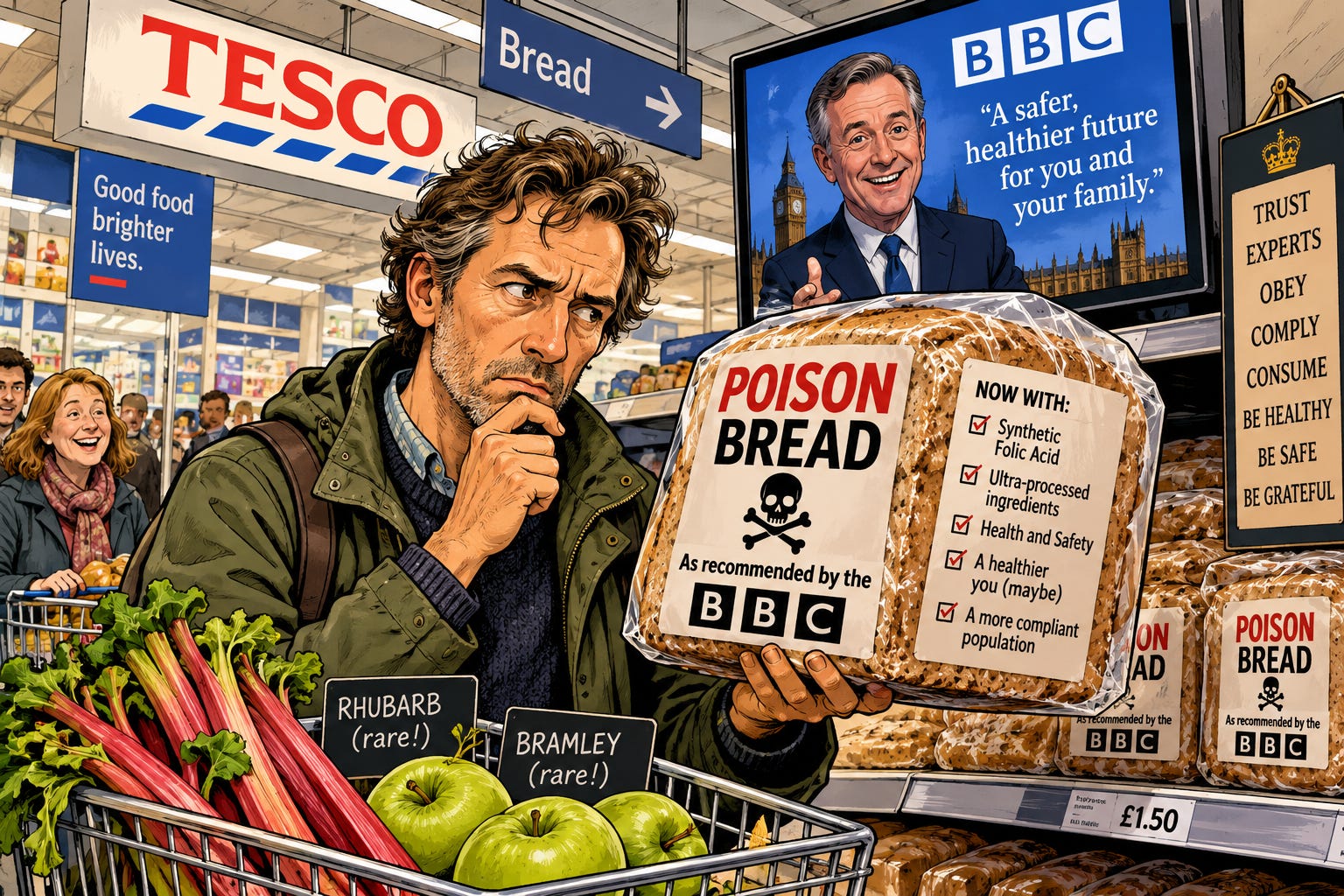
Let me make this real. Yesterday I forced myself outside for my daily walk, and made my local Tesco the destination rather than a round of the pond in the park. I hit jackpot in the fruit aisle, finding both delicious rhubarb in stock (a rarity) as well as giant Bramley cooking apples (also not common at my Tesco). Flush with my provisioning victory, I headed over to the bread aisle.
I have been reading a lot about synthetic folic acid (SFA) being mandated for our flour, and its possible negative effects. Allegedly wholemeal bread doesn’t automatically have to contain it, so I check the loaves. They all have SFA except one, which has a bunch of other undesirables. There aren’t any of the more exotic grains, like spelt, which are exempt from the rules.
So I walk away, without bread.
Perhaps it’s time to get a cheap bread-making machine and bake my own from heritage flour from a boutique mill that falls outside the regulations. I don’t really have spare cash or counter space, but as hardships go, it is minor.
Or is it?
Once you experience the state as being murderous (think Covid), rapacious (taxed to death), and treasonous (cultural destruction via mass immigration), your relationship to officialdom fundamentally changes. It doesn’t particularly matter, for the purpose of this essay, whether you agree with those assessments. What matters is what happens to a person who has reached them sincerely, after years of watching and investigating, yet must wake the next morning and continue living inside that system.
In a conventional kinetic war there are obvious weapons and visible injuries. A bomb may fall nearby, and the soldier with PTSD forever reacts to sudden loud bangs.
A trip to Tesco is, for me, a bangless war zone.
The paradox is that almost every imposition of authority, no matter how small, can acquire the same triggering power. The wounds are psychological, yet absolutely real. You can become an emotional cripple while seeming to be fully functional. You shop. You cook. You work. You answer messages. Yet the nervous system has learned that institutions presenting themselves as sources of help and protection may instead be sources of danger.
The inversion of care and killing pervades ordinary life. The state speaks health and safety, welfare and protection, even of the unborn, while on the face of it acting to cause or facilitate mass injury and death.
The price is a ubiquitous threat environment. Every interaction with authority needs audit for subversion and deception. And authority is everywhere. On the tax demand. On the hospital form. On the parking sign.
Even on the ingredients list of your loaf of bread.
There is nowhere safe to retreat to.
This creates the first pain I want to describe: ambiguity.
Do I know that this SFA is actually being added to flour as claimed? No. Do I know whether the danger is real, or whether I have misunderstood its scale? No. Do I know for sure if this is intentional poisoning by the rump of an outgoing regime? No. Do I know whether supermarkets that joined WEF programmes are implicated in anything more sinister? No. Do I even know if the risks from this one additive are sufficient for me to need to take notice?
No.
Do I know whether asking all these questions is prudent vigilance, or evidence that living this way has already injured me?
No.
That may be the most painful question of all.
Once trust has collapsed far enough, your own threat perception enters the audit. You cannot outsource reality to institutions you no longer trust. But neither can you personally investigate everything. Toxicology, medicine, food, law, finance, communications, surveillance, energy, education: the verification workload is infinite.
Meanwhile you are surrounded by people with an effortless certainty you no longer possess. They watch the news, visit the doctor, pay the bill, sign the form, buy the bread and get on with their lives. Their certainty offers no solace whatsoever, because I regard much of it as misplaced. Yet I cannot replace it with certainty of my own.
The very concept of reality becomes amorphous and fluid.
That brings us to the second pain: incompleteness.
If the goal is to evict evil from this realm for a hundred generations and more, then we are in a transitional space. The problem is not only the rollback of normalised enslavement to debt, nor the prevention of catastrophic collapse in the interim. It is embedding the outcome so deeply that evil cannot find a purchase upon humanity again for a very long time.
There is, presumptively, a place in that process to deal with problems like SFA in food and whatever harms it may actually cause or facilitate.
But not yet.
And we are in the now, not the then.
So one has to face not only the ambiguity of not really knowing what one is confronting, but the incompleteness of whatever process of truth and justice may be underway. There is no closure. No clean before and after. You inhabit the gap.
My nervous system now perceives bread as danger, rightly or wrongly.
Maybe that’s a good thing!
But my capacity to hold prospective invisible harms is finite. At some point you just become a wreck trying to navigate ordinary living.
I notice the same thing with hope. Every quasi-official hint that resolution and liberation are approaching has a dual effect. One part energises me, reinvigorates me, restores my determination to prevail. But another is a burden. Every teaser of financial relief, “truth TV”, disclosure or social reconciliation that fails to manifest rapidly in reality degrades whatever remaining capacity I have to engage with a perverted daily life.
There is a cost to inhabiting multiple versions of reality at once: that of the “normies”, that of the “Anon”, and whatever reality ultimately sits underneath them both.
You cannot settle into the old world because you believe it is dying. You cannot inhabit the new world because it has not arrived.
Again: we are in the now.
Which brings me to the third pain: impotence.
None of these societal matters is under my control. Taking bread as our case study, I don’t even bother signing petitions against SFA. Once you believe an authority itself is acting illegitimately, petitioning it begins to feel absurd. You don’t plead with people you believe are harming you. You want the harm stopped, the facts established, and those responsible held to account.
The relationship between citizen and state has broken somewhere much deeper than disagreement over policy.
Take another example. This week there has been discussion of replacing the BBC television licence with a levy attached to broadband. The merits don’t interest me here. What interests me is my reaction.
I regard the BBC as a propaganda outfit that has caused immense social harm. I spent a year engaged in part-time litigation involving the BBC and Capita over TV Licensing and the coercive methods used to extract information from people who have no obligation to provide it. It was stressful, at a time when I had little capacity for more stress.
I don’t want the BBC’s product. I don’t accept its claim to moral authority. I don’t wish to fund it.
And now somebody proposes attaching the financial obligation to an essential communications service instead.
You withdraw here; the claim reappears there.
There is an almost comic personal footnote. The new Director-General of the BBC is someone I went to school with. As a teenager I rowed doubles on the Thames with his younger brother, and we all got rides to the boat club together. He later became a senior executive at Google.
I would argue that both Google and the BBC have done me serious personal harm through censorship and manipulation of public perception. YouTube deplatformed me. The BBC participated in the “QAnon” framing that, in my view, smeared rational inquiry into Q’s claims by replacing them with an invented collective identity and associated caricature.
And now an old school contemporary sits at the top of one of those institutions.
I pass no judgement on him personally. I only note the extraordinary divergence of paths. For all I know he could turn out to be part of the BBC’s demolition and reconstruction crew; plenty of good people work inside bad organisations.
But there is a price paid by those on the outside.
I have experienced a form of exile from respectable society, enforced not by a border guard but by invisible boundaries around what polite company permits one to believe and say. As an outcast from the professional mainstream, I now earn less in a year than the current annual fees for my old private school. How my working-class parents afforded to send my brother and me there, I have no idea.
Life has a sense of humour.
The point is not that I envy the insider and resent the institution. It is that the machinery continues to confer prestige, salaries, offices and legitimacy upon itself while those who believe they have been harmed by it are expected to absorb the damage and carry on.
That is impotence.
And it exposes a still deeper problem. The choices we face can be extreme in moral meaning while utterly trivial on the surface.
Do I buy the bread?
Do I pay a water company that fluoridates the supply when I regard that practice as potentially harmful?
If I pay, am I participating in something I believe is wrong? If I refuse, am I merely inflicting damage upon myself without helping anybody?
How much of my conduct is excusable by necessity, and how much do I excuse merely because everybody else does the same?
Where does one draw the line between principled resistance and needless martyrdom for causes that are not one’s personal remit?
The final cruelty of an odious state is that moral cleanliness becomes impossible.
I cannot simultaneously withdraw from food, water, communications, transport, medicine, banking, taxation and law. Nor can I spend every waking hour auditing every institution with which ordinary existence forces me into contact.
In sovereign finance there is a concept of odious debt: the idea that certain liabilities incurred by a regime without legitimate public purpose should not bind the population that inherits them. I increasingly experience the state’s claims upon me through a similar moral lens. The ledger feels inverted. Why am I the debtor? Why is the balance not towards restitution rather than taxation?
Positive law can tell me what the state demands.
It cannot answer what I morally owe an authority whose legitimacy I no longer accept.
And yet I still have to live here.
That, I think, is what I have been trying to articulate.
The loaf of bread is not the injury.
It carries the accumulated weight of thousands of encounters in which the same questions recur. Is this safe? Is this honest? Is this legitimate? Must I comply? Am I participating in something wrong? Can I afford to resist? Have I understood correctly? How much more research must I do before I am allowed simply to live?
There is never a final answer.
The cumulative effect over years is making me unwell, and I mean physically, not metaphorically. Even tiny setbacks involving officialdom can now produce a reaction wildly disproportionate to the immediate event. Today I realised that I had left my car’s annual safety check too late. Nothing catastrophic happened. I booked an MOT.
Yet my nervous system responded as though something much larger were at stake.
People have been indoctrinated to recognise evil only when it comes wearing jackboots, erecting concentration camps or building torture chambers. Those things are unmistakable. What is harder to see is banal evil: the cumulative psychological injury of living among institutions you no longer experience as benign, while everything retains the appearance of normality.
The supermarket is open. The shelves are stocked. The BBC broadcasts. The water comes out of the tap. The government website accepts your payment. The MOT station opens on Monday morning.
Nothing looks like a battlefield.
And yet the person living inside this experience can feel permanently under attack.
There are reasons for hope. I see signs everywhere that something better is being put in place, and I believe the days of living under an odious state are numbered.
But hope doesn’t abolish the present tense.
We are in the now, not the then.
So perhaps that is the testimony I wanted to leave for whoever reads this ten or fifty years from now. If you wonder why people didn’t simply refuse, leave, fight back, or carry on as normal, understand that none of those choices was clean. Ordinary existence itself bound us into the systems whose legitimacy we questioned.
We still had to buy bread.
We still had to pay bills.
We still had to maintain cars, answer emails, earn money, care for people, and somehow remain human while carrying questions far larger than any individual could resolve.
The pain was not only in what was done to us. It was the ambiguity of not knowing the full truth, the incompleteness of living before resolution, and the impotence of being unable to withdraw cleanly from what we believed was wrong.
That is what makes an odious state so exhausting to survive.
There is nowhere entirely outside it from which to live.
You articulate so well how I feel, how I think, the ongoing internal battle that I keep to myself because I don't know of anyone else who is contemplating every little thing and seeing them as a battle. It is exhausting. There are scars and open wounds concurrently. I so desperately long for solid ground to live upon so we can begin to create permanent things. Rest upon solid ground that doesn't contain continual attacks from all angles sounds like heaven (almost). I pray we get to experience that environment soon.
I haven't heard anyone else express the desire/need for a change so severe that it will last for 100 generations. I agree that is what is necessary. Anything less is unacceptable. The only bright spot I see in our current state of (ambiguous, incomplete, impotent) living as it trudges along is that longer it takes the more thorough the exposure will be and the greater the pre-planned and designed solution must be.
I just can't imagine the group of people who have led this campaign of exposure, don't understand better than I do, the importance of expelling ALL of it out AND replacing the current system with a hardened, incorruptible system in its place. I can't wait to see how amazing and well thought out that system turns out to be. I think it's going to be awe inspiring.
Selfishly, I hope there are places of creative license for us "average people" to contribute to the creation and perpetuation of the new living system.
Buy organic wholemeal rye flour (no folic acid) (Doves Farm is stocked at Tesco - my Tesco anyway) and make sourdough rye. Use the same rye sourdough for wholemeal spelt (Also by Doves Farm at Tesco). Buy the book "Bread Matters by Andrew Whitley (Amazon) for the how-to. It's actually easier than yeasted bread, more forgiving if you leave it a bit too long, just needs a longer ferment - but that gives you time to enlighten us! Sourdough bakes a more compact loaf with a different flavour that keeps longer, but you could still bake a traditional yeasted loaf with spelt if you prefer (and it makes cracking toast!), just don't let it rise too high or it gets too crumbly.