

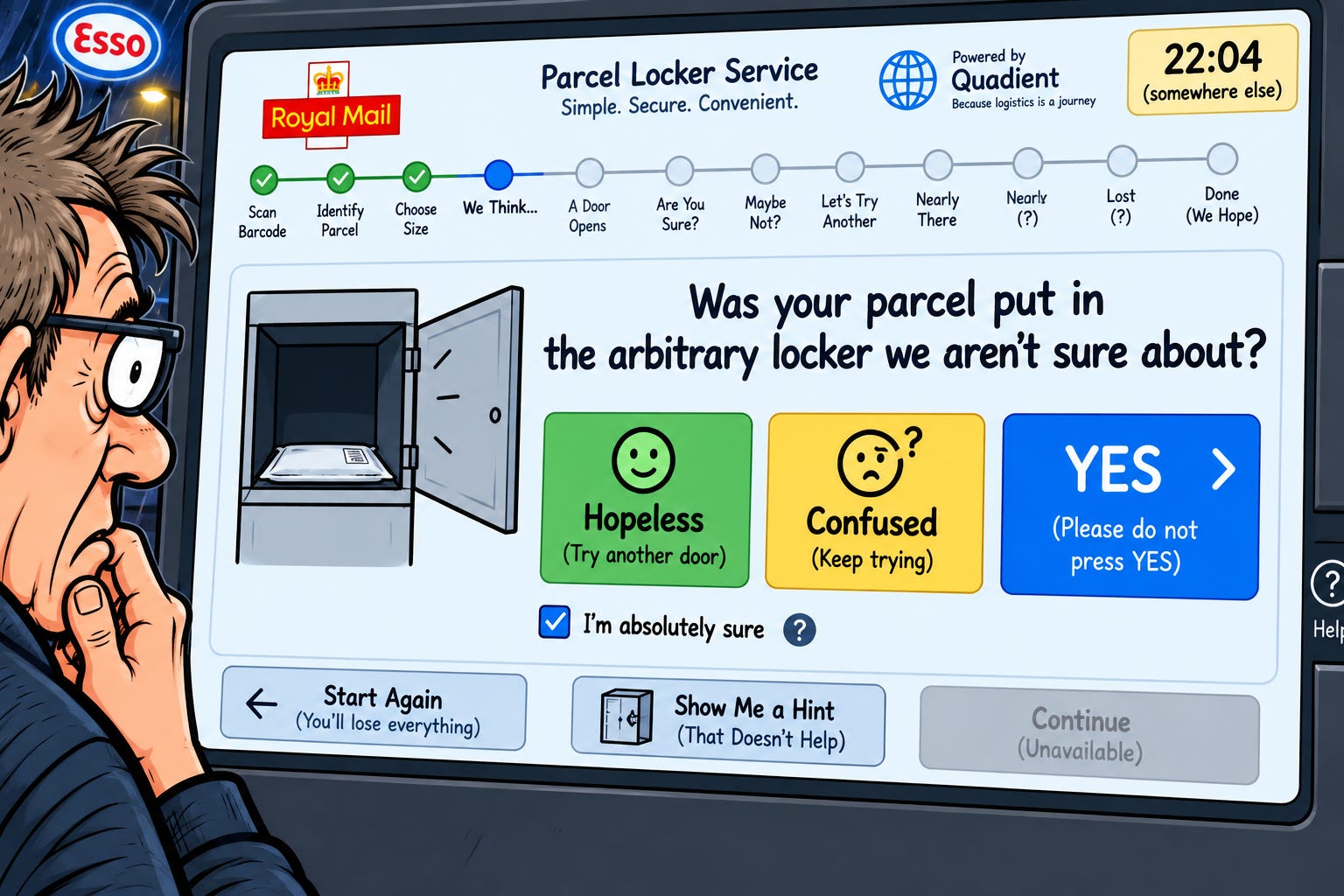
I’m quite good with computery things, most of the time.
Before I left school, I co-designed with a friend a 12-bit CPU including microcode from the ground up. He went on to become a chip designer at ARM.
Then at university, I studied formal methods, which is what computer science aspires to become when it lets go of the computer craft.
Later in my career, I helped explore the performance limits of stochastic systems, notably quality-assured broadband.
So I am not typically intimidated by everyday objects that are digital and automated. If I am struggling, then the problem generally isn’t me (although I have my dumb days).
This context is to explain why I have spent a whole working day preparing a 16-page field report for Royal Mail on my experience of one of their parcel lockers last night.
I did manage to send my 13 consignments of art prints. Eventually. But it required me to apply my skills to geometry, logic, and protocol design puzzles while standing in the rain close to midnight.
The patterns behind the failure are more interesting than the technical problems themselves. What looks like a collection of bad interface decisions turns out to be a deeper problem:
What happens when physical reality has to cross boundaries between digital representations — and the customer is left to reconcile what the machines cannot.
The title of this article is a little in-joke for us compsci folk. When you learn about state machines, concurrency, and consistency — God bless Communicating Sequential Processes — the archetypal application is the vending machine. Just as cryptography has its Alice and Bob, everything begins with a single cultural totem. There can hardly be a soul alive who has not, at some time, obtained a drink or candy bar from one.
Normally I skip the vending-machine stage when posting my photo art, and use a real human. I print the labels at home, but use the actual handoff to the postal system as an excuse to take a 10-minute walk into town to the real Post Office. The justification may not be entirely my health and wellbeing, as there are adjacent temptations of coffee, cake, and donuts to which I am prone to succumb.
That said, barring the few minutes waiting in the queue, it’s a pretty easy affair. I hand over the whole batch, say they are prepaid, and the nice lady (they’re all ladies) types in some details, scans the barcodes, and at the end hands me a proof of postage for the whole lot. The user interface is simple, and I haven’t yet failed at it once. My mastery of being a postal customer is, hitherto, unchallenged and unquestioned.
Being an adventurous type, I decided last night to try something new. There are Amazon-style parcel lockers at a nearby petrol station, so I thought that, for a change, I might try depositing my precious artworks there instead. After all, I had spent hours printing, signing, wrapping, packaging and labelling, so it was getting late at night. Even the convenience store in the next town over, the latest-opening option available, closes at 11pm.
That I am writing about this experience at all gives away that the outcome was… problematic.
I will spare you the gruesome detail, and stick to the key issues. As a first-time user, the Royal Mail product sizes confusingly don’t map onto the third-party locker provider’s taxonomy. The locker repeatedly failed to detect my light and thin items. But most of all, the user interface is… peculiar. So when it fails to detect your item in the relevant compartment, you get a thoroughly bizarre message, shown below.
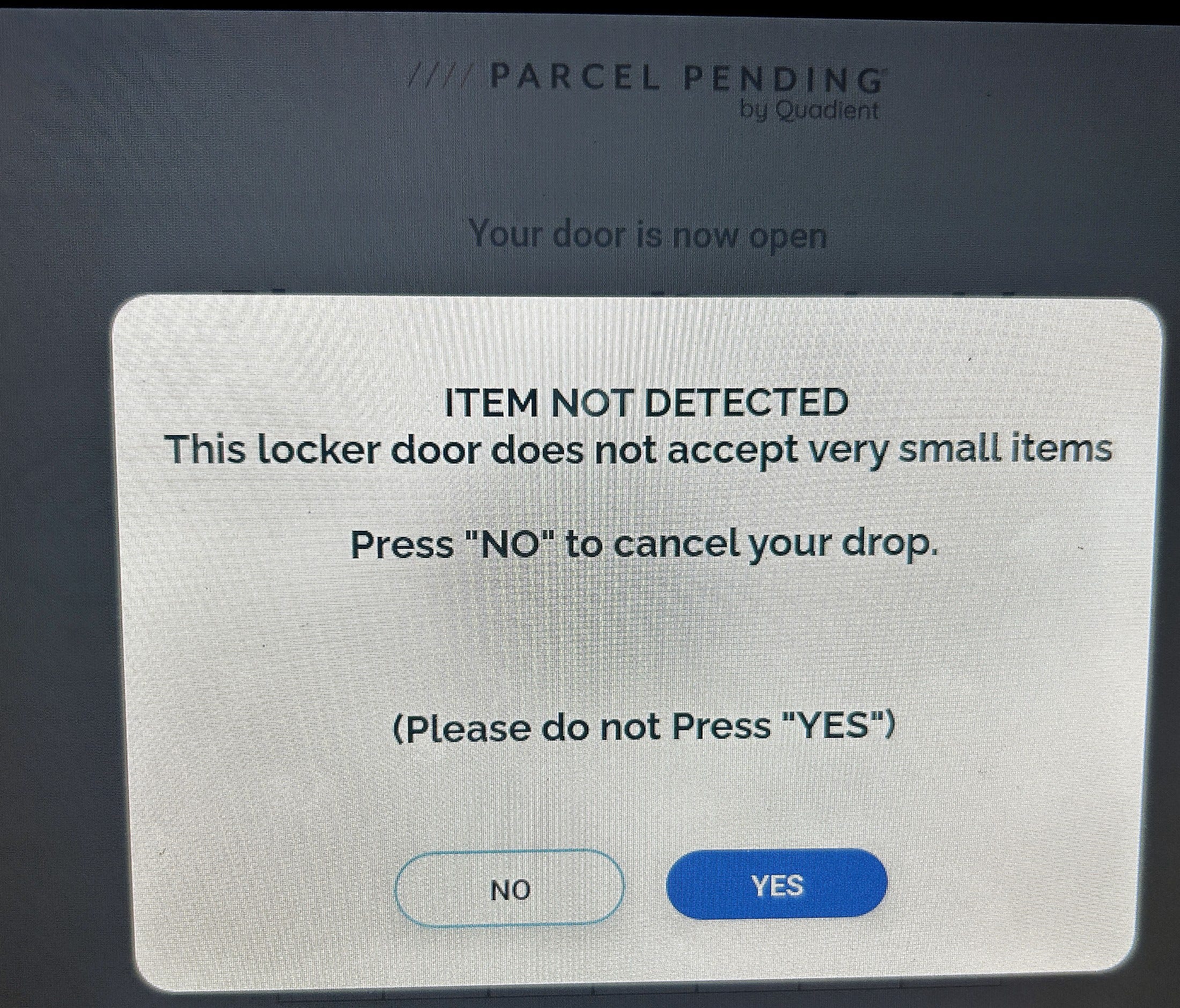
Err… um… so you hit “no”, and you go around the same loop over and over, with the locker opening the same door and failing to recognise your item as existing, but taunting you with a “yes” default option that you are strictly banned from touching.
I touched it.
Hehe.
😈
That opens a different door, and the process repeats. In some cases I went through several compartments before one successfully detected the item. Aha! A vending machine with seemingly non-deterministic behaviour, hidden state transitions, protocol loops, and observable traces that included forbidden events. I know all about these! So I couldn’t resist having a bit of fun.
There are a bunch of other design issues that I won’t go into; the point is that my “worst consumer experience ever” (as dictated to ChatGPT while I tried to debug the vending machine in increasingly heavy rain) was logician’s catnip.
So I decided to turn the UX turd into manure, so someone can grow roses.
Here is the abridged cover letter of a package I am just about to post to Royal Mail customer services:
Dear Royal Mail,
I am writing because I value Royal Mail and would very much like the Parcel Locker service to work well. My use case is straightforward: I make sporadic fine art print sales from home and need to send small batches of items from time to time. The ability to buy postage online, prepare everything at home and deposit it locally at any hour is therefore genuinely useful to me.
I am an experienced IT and technology professional and am accustomed to working with unfamiliar technical systems. Even allowing for this being my first use of a Royal Mail Parcel Locker, the experience fell well below what I would reasonably expect from a modern self-service system. A task that should have been simple became confusing, repetitive and unnecessarily time-consuming.
I am not seeking compensation, a refund or an apology. I am writing because I would like the service to succeed, and because the difficulties I encountered appear to expose some significant and potentially quite fixable problems in the interaction between Royal Mail’s service, the Parcel Pending by Quadient software and the physical locker itself.
I arrived with 13 prepaid and individually labelled Royal Mail consignments and was ultimately able to deposit all of them. However, the process exposed problems with compartment selection, item detection, contradictory controls, batch handling and timestamps, as well as a broader integration gap between buying postage and using the locker.
The recurring pattern is not simply that the system possesses information which it fails to show. In some places, relevant state is already known. In others, information needed to support the customer’s task is incomplete or does not appear to be carried across the end-to-end journey.
I have therefore prepared the enclosed report, documenting what happened, examining what may be going wrong across the customer journey, and suggesting some specific improvements.
I would be grateful if it could be passed to whoever is responsible for the product and technical integration of Royal Mail services with the Parcel Pending by Quadient locker system, rather than being handled solely as an individual customer-service complaint.
None of this is intended as criticism of the Parcel Locker concept. Quite the opposite. Being able to prepare postage at home and deposit mail locally outside Post Office opening hours removes substantial friction from using Royal Mail. That is why I have taken the trouble to document the experience in detail.
I hope the report is useful.
And attached is the following report:

What’s in the report?
Why a prepaid Royal Mail parcel still leaves the customer solving a separate locker-sizing puzzle.
How incomplete compartment dimensions turn a simple choice into a geometry problem.
What happens when the locker repeatedly fails to detect a thin item that is physically inside it.
The extraordinary “Press NO / Please do not Press YES” interface — and why pressing the forbidden YES actually works.
How the workflow can trap the customer in loops and expose hidden state transitions.
Why 13 parcels become 13 largely separate transactions rather than one batch-posting session.
How postage eligibility, physical locker compatibility, and available locker capacity are three different things.
An apparent UTC/BST timestamp error that can make a parcel appear to have been deposited before its postage was purchased.
Ten practical recommendations for making the whole system substantially less aberrant.
I used to do this stuff for a living, although I haven’t submitted a consulting invoice since 2019. So it’s a chance to take a peek at what I used to do as a tech guy.
It’s quite a fun read, if you’re into aberrant vending machines.
Which I understand is a niche amusement.
I asked Grok what this piece of unprompted free consulting might be worth to Royal Mail, and it came back with an estimate of around £8,000 (about USD$10k). Take the number for what it’s worth. What interests me more is that, with the help of AI, I can pump out in a day what used to take me a week. The point isn’t to boast about my own skill, but that the work comes from an interesting posture.
I am funded by the public to do public-minded things. This might be a small niggle, but it’s an important one. The postal system is basic civilisation infrastructure. Automation is typically good; failed automation is waste. So I have used some of the time that you, my readers, choose to fund to do some free work.
Underneath this is something noteworthy and transferable. The representations of my parcels, individually and as a batch, are different in the mail retail system and the locker handoff system. “Nice Post Office lady” ordinarily reconciles these worlds for me so effortlessly that I never have to know the mismatch exists.
What I study are the correspondences between those representations and reality, and whether they are corrigible.
So this is really a test of whether Royal Mail and Quadient — who I will send their own copy — can accept correction.
In particular, can they take this feedback on board when it is presented in a non-accusatory and appreciative manner, to a professional standard, with no shame attached to failure, and no desire for compensation or reward?
In that sense, it’s a spiritual experiment as much as a busman’s holiday as a computer scientist.
Can correction be offered without attack, and received without defence?
I’ll let you know how it goes…
😇

I truly hope they respond. The result will be interesting.
Martin! U need to bill them!