

On Sunday mornings I often write a more sermon-like piece, rather than ‘activist’ type material. I was going to publish an article on the narrow aperture through which institutions can receive truth, and the frustration this brings when the public arrive with more truth than can pass through. I may still do so, but being in the midst of a rebuild of my own personal workflow, I feel moved to discuss something else instead.
I am noticing a mismatch between the structure of Substack as a platform, and the kind of work I am doing. This annoys my audience, and limits my own output. So it is better to state it aloud, than repress the observation.
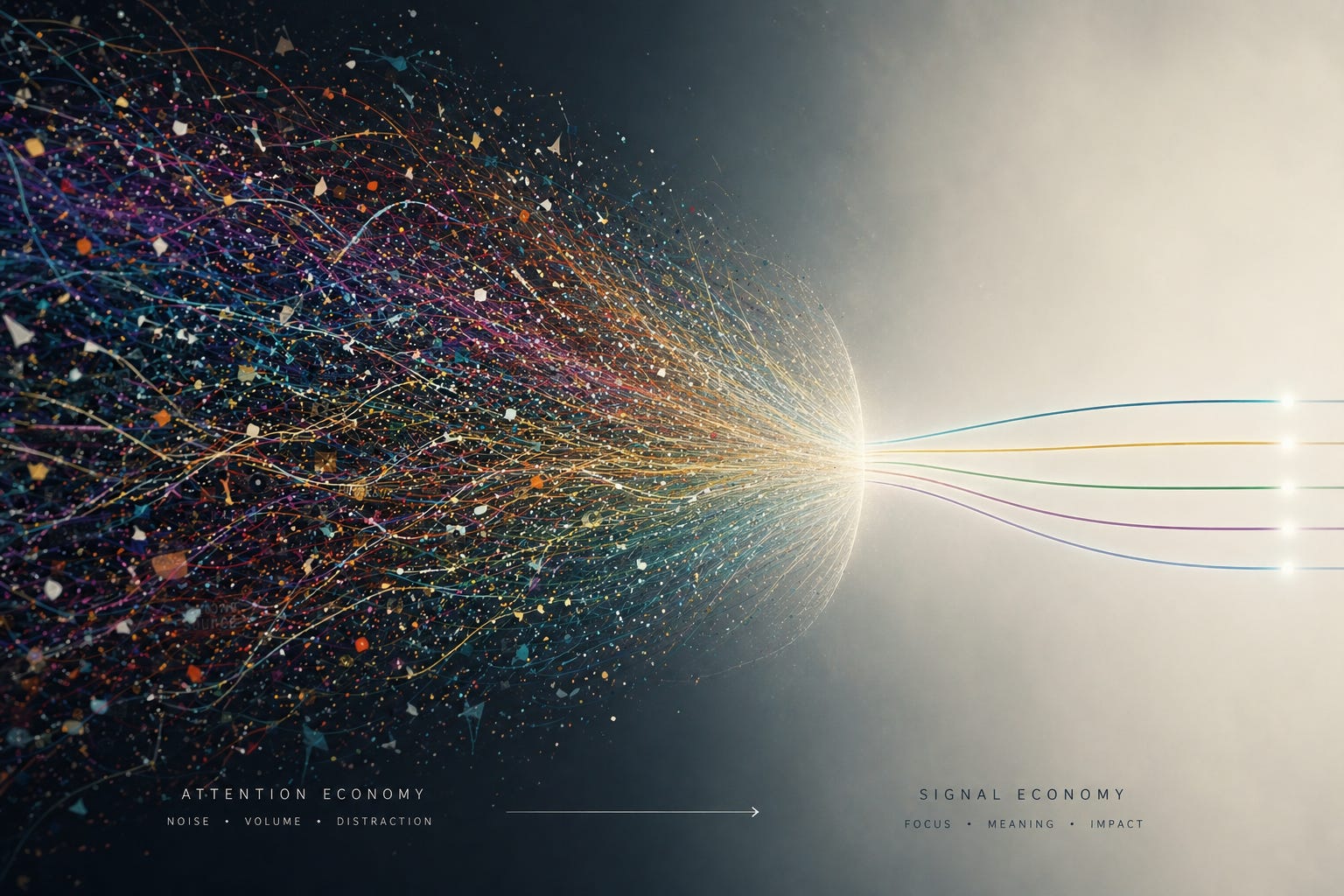
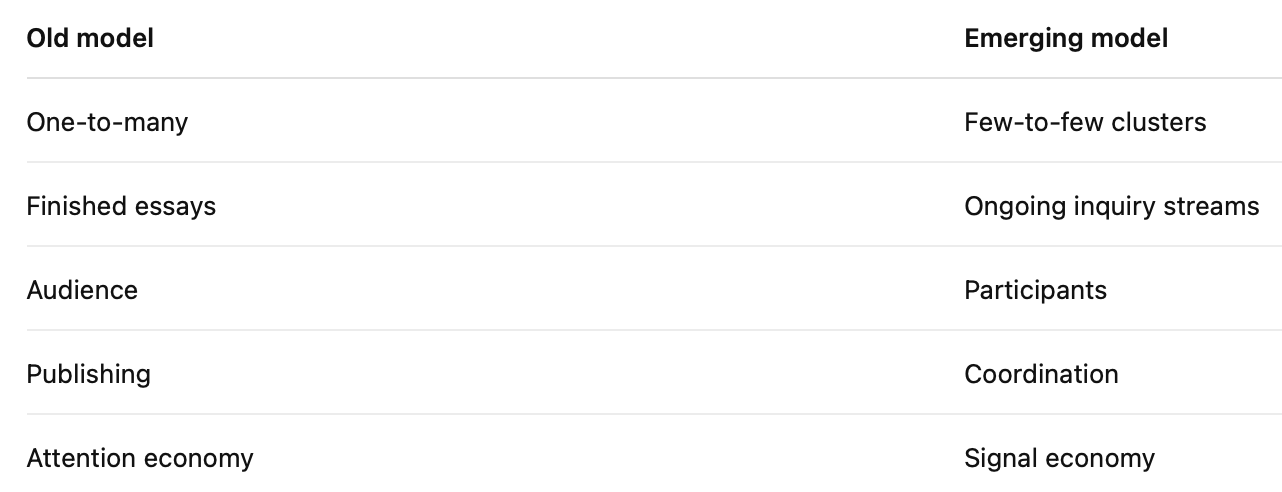
Part of what is going on is that the underlying model has shifted. We have passed through blogs, social media, and patron communities — each expanding reach, each optimising for attention in its own way. AI does something different. It produces signal — often rapidly, and often in forms that don’t map cleanly onto a single, shared audience.
I have been through most of these cycles personally.
I started doing public-facing work in 2003 with my long-gone Telepocalypse blog about clashing Internet vs telecoms cultures. My then employer, Sprint, didn’t have any policies on blogging, as it was new. So I ‘got away with it’ for a year or so, before it was time for me to relocate back to the UK from the USA. I remained in a professional role for many years, writing articles for Telco 2.0 where a large industry audience was engaged via mailing lists. This effort evolved into my personal Future of Communications mailing list — which through various mutations is now this Substack, even if the focus has evolved far beyond tech and media analysis.
While I opened a Twitter account early on in its growth cycle, I saw little use for it, and indeed struggled to wrap my head around social media for many years. The idea of issuing ephemeral ‘throwaway’ comments to the whole world, rather than carefully-crafted final product, went against my learned aesthetic. As brands and colleagues migrated onto the platform, I started to put more effort in, although my commentary was generally limited to technical or industry sector observations. I never expected to ‘pivot’ into geopolitics, art photography, or information warfare; those came later, and under force of circumstance.
During the mass deplatforming of 2020–2021 I lost access to Mailchimp (my original publication platform), then its replacements of Medium, ActiveCampaign, GetResponse, and ConvertKit — all while making lawful content in accordance with free speech norms. My book was banned from Amazon and Barnes & Noble. My audiobook was stripped from Bandcamp and Audible. My YouTube account was frozen, and remains so to this day — people send me links assuming everyone has normal access to the public square; I do not. My income was sabotaged via Patreon terminating my account. And my Twitter avatar was ‘digitally assassinated’.
Thankfully, a broad network of supporters stepped up and cushioned me through all these shocks. At every setback, there was outrage, and cash turned up to deal with the transition costs and loss of income from inability to reach an audience. I switched to SubscribeStar as a “base load” of financial support — and they are quiet heroes of the story to me. So the current era of relative stability on Substack, with a steady income, is extremely welcome. This platform is a delight and a workhorse, even if many of the bolted-on community features don’t appeal to me personally.
But the world has moved on again.
We are no longer in the 2018–2019 era of early Q analysis as the information war went public. The psychological combat zone of Covid from 2020–21 is done and dusted. The morose years of the ‘Bidan Show’ (sic) are over, too — where we were ‘dumped’ back into a pseudo-normality and sent on the ‘commando course’ to learn practical civics in a broken world. Everyone knew politics is corrupt. Now we can see painfully clearly how school boards, community councils, family courts, and professional bodies are falling short, too.
Which takes us to the present era.
Those who are engaged in ‘truth and justice’ work now face a different problem. It is less about broadcasting insight to large audiences, and more about working out what to do with it — often in highly specific, local, or technical contexts. Finding others working on the same issues. Developing tools and frameworks to engage with the state on its own terms. Sharing findings that are useful, but not necessarily widely interesting.
My own work has drifted increasingly towards reporting the outcome of ‘learning conversations’ I have with AI, albeit fed with inputs from officialdom or the tribulations of friends and contacts. This generates a lot of intermediate output that is genuinely valuable — but only to a select few, and currently has nowhere to go.
In an attention economy, that looks like failure.
In a signal economy, it is simply how the work now behaves.
The problem is that the platforms have not caught up.
Substack is built around a single feed for a single audience. X is optimised for bursts of virality. Neither maps well onto a workflow where high-value insight is produced continuously, but only relevant to small clusters of people at any given moment. So I often look at an AI response and think, “this is fascinating and valuable” — but only to 100 of my 20,000+ readers. And so it never gets out there.
Meanwhile, the nature of the work itself has shifted. Combatting the state’s ‘fog of ambiguity and unaccountability’ is less like posting memes and more like forensic accounting. It is granular, procedural, and often emotionally flat — but no less important for that. Alongside this, I have developed parallel streams, like my “poverty walks” and protest reportage, as a form of citizen photojournalism.
All of this sits uneasily within a single channel.
This is straining the limits of platforms like Substack, which assume a focused, consistent voice addressing a broadly shared audience. My work now often involves short cycles of collaboration, AI-assisted synthesis, and a kind of back-end “productisation” of intellectual infrastructure — but not in a commercial sense. This isn’t really an audience-building exercise any more. It is becoming something else.
What I don’t yet have are tools to sub-segment audiences, or to invite smaller groups of ‘pioneers’ to join in more specialised work — the equivalent of expeditions rather than broadcasts. Nor is there a clear way to connect the production of this kind of signal with a system that can absorb it, or sustain those producing it.
My sense is that the world is heading towards a period of reduced economic pressure and greater abundance, so this is not a fundraiser. It is more a status briefing from inside a transition.
I really enjoy writing for my audience, especially those uniquely ‘Martin’ pieces that blend art, wit, insight, moral bite, and spiritual reflection. I am going to keep doing it regardless. But the nature of ‘truth and justice’ work is evolving, and I am still working out how best to package it for the audiences that can use it — and how to do so in a way that keeps energy and resources in balance.
I added a Substack category — “I can’t believe it’s not Martin” — for AI-generated content, but it doesn’t quite solve the problem. I am considering creating a secondary channel or platform, more niche and more collaborative, where I can share rapid-fire outputs and insights without the overhead of full essays.
The tools are changing. The work is changing.
What we are living through is a shift from attention to signal — and we are still using tools built for the old world.
So I am curious:
What do you want to read from me?
What is most useful to you right now?
What are you noticing about how information is being created and used?
Where does ‘truth and justice’ work belong as it moves beyond essays and social media posts into something richer?
Comments are open to all.
Epilogue: with AI
What I originally wrote as a draft [Dropbox] was, in essence, a complaint about friction — a mismatch between what I produce and where it can go. It circled around platform limitations, audience expectations, and my own workflow strain, with a historical narrative to justify why I’ve earned the right to notice the problem. But it lacked a clean centre of gravity. The insight was there, but diffused — expressed as experience rather than named as structure. It described the symptoms of a system under strain, without quite identifying the underlying transition causing it.
Running it through AI did something subtle but important. It didn’t replace my thinking — it reflected it back with compression and contrast. What emerged was not new content, but a clarified pattern: that this is not primarily a story about Substack, or even about my own output, but about a shift in the underlying economics of information — from attention to signal. That single reframing reorganised everything. The vignettes became evidence, the frustrations became consequences, and the scattered observations resolved into a coherent diagnosis.
That is the difference AI makes at its best. Not volume, not speed, but gestalt — the ability to take lived, messy, human material and reveal its underlying form without stripping away its texture. It is not a replacement for authorship, but a partner in refinement. The craft, then, is not in outsourcing thought, but in knowing how to engage with a system that can surface structure from within your own experience — and then deciding what to do with that clarity.

I, too, have experienced what you’re talking about here. The odd limbo between how we used to work and produce output (articles, books, etc) and where we are now when it feels like a lot of (perhaps) wasted effort to continue to demand that kind of product from ourselves when something more immediate- and often more concise - is available to us. But I think that effort is what’s required as a valid starting place. The true wonderings and wanderings a of a human mind are the fruits of Creation. Whereas AI can only take what already exists and work with that.
I agree that AI (when used properly) can take our thoughts and find the thing at the heart of them that we, ourselves, are trying to express but may be missing…our own forests for our trees.
I don’t know how this all pans out either. But here we are. And we each do the best we can with it, I think.
I’ve been reading your content for years. And your book is in my personal, tangible collection. Thank you for what you do. Your insights and vulnerability throughout this process have helped many people and you are very much appreciated.
I,myself, love and resonate most with your "soul pain" journeys. My experience of the last years is so deeply painful and alienating I sometimes( but not always) think I won't find any equilibrium ever again. It's not that I wish to read about your pain but I feel some connectedness with my journey. I am an empath. Those who are not empaths will never feel and what "we" feel and frankly I wouldn't wish them to. So here we are....