

It is difficult to look at a burns victim. They might have notionally recovered from their injuries and surgeries, but the visible and lasting damage is still obvious. As observers, our minds can become trapped in a liminal place where we can see them, know they are the same person they used to be in their pre-injury photos, but don’t particularly want to imagine what it might be like to be in their shoes.
There is a continuity of recognition of the individual, even if it is damaged.
But what happens when the conceptual flame is applied to the mind, not the body? Given a sufficient level of media propaganda, cognitive weaponry, and social pressure, can a consciousness itself become scorched and disfigured? What happens if such deformities become so commonplace that they are considered normal? How can you live in a society where “your own sovereign skin” is seen as an aberration, not a birthright?
And how do you cope when you are no longer recognised for who you are, when what you experience as preserving your own integrity becomes, in other people’s eyes, evidence that something has gone seriously wrong with you?
At some point recognition fails; we are no longer legible to one another.
The social surface is burnt away too badly.
I am grappling with a number of situations in my own life where the common thread is a breakdown of mutual recognition: we no longer have universes that contain the same objects, so we cannot even begin to disagree over their meaning. I am deliberately narrowing this to my own experience, rather than making grand prognoses, as the world may be about to turn, and look very different. My purpose is to document the problem and the distress it creates, not to resolve it.
What is it like to live in a time when consensus reality has split and recognition is failing?
The first conundrum I have is over registering to vote. In the aftermath of Covid I was absolutely disgusted at the state and its attempted mass murder of its citizens. I did, briefly, move away from where I currently live in County Durham, intending to move back south in England. At that point I de-registered from the electoral register. That relocation plan was abandoned, but I did not restore my previous registration.
Now I get letters from the Council asking me to provide details of those in my household.
At the level of participation in civic society and being subject to jury service, part of me sees such a demand as legitimate and ordinary. Yet it is also a form of consent to be governed, whether one votes or not. And I do not consent to being preyed upon by a corrupt and captured system. It refuses to recognise the standing of living men and women or respect their inalienable rights. Instead, it uses legal fictions and exploits positive law to impose its will.
There may be a buried core of “patriots in control” working to resolve these matters, but the lived experience in the interim is awful.
Failure to register can attract an £80 civil penalty; withholding required household information can lead to a fine of up to £1,000. These penalties are seldom imposed. If conscience demands it, I am willing to endure the state’s condemnation in order to deny it the recognition it demands. It is not obstruction for its own sake.
In the process, I do not expect the state to recognise my moral stand: that Covid was not legitimate and lawful governance, that accountability for crimes against humanity is a precondition for the legitimate exercise of state power, and that I am withdrawing my consent until this happens.
The letter asks who lives in my household. My difficulty concerns the authority of the institution asking. I can supply the requested details, but doing so would leave everything that makes this demand troubling to me unspoken. If I refuse, that refusal can be processed as non-compliance without my reasons ever being heard.
The system has a procedure for securing my response. I cannot see where it has room to recognise my experience as a dissident.
At a deeper level, I regard the national electoral system at present as little more than theatre. There is serious voter and voting fraud, as with the USA, which goes unpunished. Weaponised immigration and treason have turned democratic consent into an excuse for constitutional revolution, and not in a good way.
New parties like Reform and Restore may have a role in shaping public sensibilities, but the underlying problem is at the root sovereign level, and the role of the Crown itself. That won’t be fixed without a global settlement that extricates humanity from usury and a corrupt money system.
That is the distance between the question the council is asking and the problem I am confronting. It wants to know who is eligible to participate. I am questioning what we are participating in.
The recognition problem is not confined to the state. It plays out at the institutional level, too.
For my past sins, I remain attached to Oxford University, that global academic brand and institutional mother of intellectual respectability. I receive correspondence from my college (no, I have nothing to donate), alumni associations (no, I cannot afford £130 for a black tie dinner in London), and peripheral institutions such as the Oxford Union debating society.
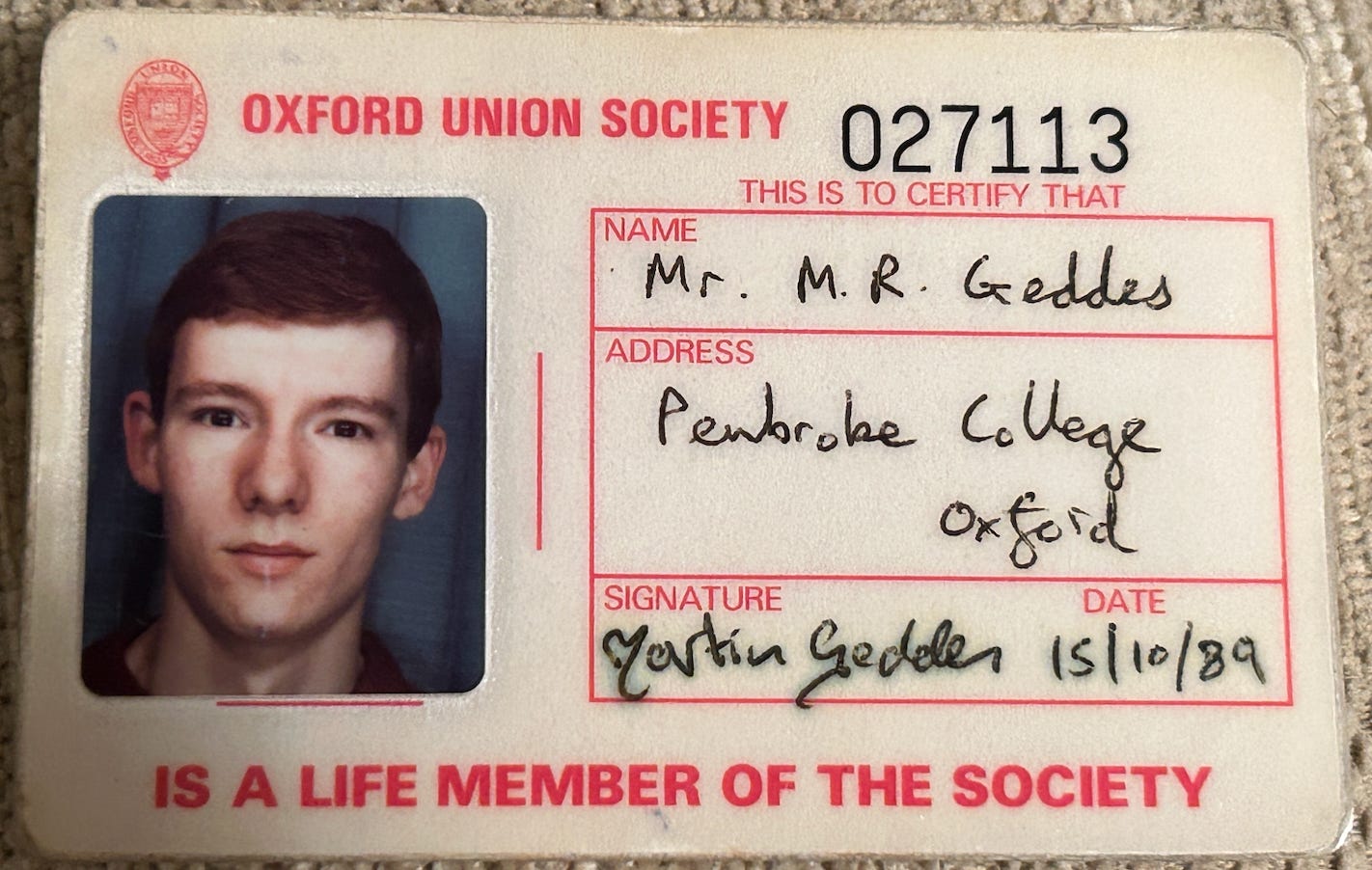
I have life membership of the latter, purchased as an undergraduate. Recently, I received a digital entry pass to replace my paper membership card from 1989. The invitations to debates and talks keep arriving. Many of the speakers are household names: politicians, diplomats, scientists, activists, sportsmen. People whose prominence is itself a product of institutional recognition.
The Oxford Union exists to host disagreement, but disagreement within a shared conception of reality. Its debates occupy an Overton window that determines not merely what is acceptable to argue, but what is intelligible to argue about in the first place. Even fierce adversaries generally share enough assumptions about history, evidence, authority, and legitimacy to recognise one another’s propositions.
My interactions with these institutions have become increasingly surreal.
I am engaged on an invisible battlefield of fifth-generation warfare, occupying an unconventional hybrid civilian-military role. No doubt my efforts have been closely monitored behind the scenes, for better or worse; plausibly deniable acknowledgement has been a recurring feature of my experience over the years.
My cosmos of possibility now extends so far beyond the assumptions of conventional institutional discourse that much of my experience might as well be written in Basque and then encrypted.
Where would I begin to bring that experience into the Oxford Union? What would survive the translation into terms its debates can accommodate? Would I still recognise my own account once it had been made institutionally intelligible?
And here lies the peculiar inversion.
Oxford recognises me perfectly well as an alumnus. The Union recognises me as a life member. Their databases know who I am, their systems preserve my entitlements, and their invitations continue to arrive. Yet the person they recognise is little more than an administrative shadow of the person receiving them.
The credentials work. The recognition does not.
This is a subtler form of institutional estrangement than exclusion. I have not been expelled, censored, or denied entry. I can presumably walk through the Union’s doors, present my digital pass, take a seat, and listen to distinguished people debate the great questions of the day.
But what happens when the most consequential questions in your own experience are not even recognisable as questions within that environment?
An institution can celebrate free speech while remaining bounded by an inherited ontology. It can welcome dissent without possessing the conceptual machinery to recognise what the dissenter is dissenting from. Its intellectual openness may be sincere and genuine, yet confined to propositions that its existing worldview can parse.
And incomprehension is not refutation. A proposition — like Covid as warfare, not healthcare — must first become intelligible before it can be meaningfully tested, challenged, corroborated, or rejected. Being unintelligible establishes neither its truth nor its falsity. It leaves the encounter unable to begin.
The Oxford Union can recognise my right to enter the debating chamber. Whether it can recognise what I would bring into it is another question.
I have a lifetime membership of the conversation, but increasingly inhabit a world for which the conversation has no vocabulary.
The recognition problem continues its journey from the public, through the institutional, to the private. And here it becomes painfully personal.
Many of my oldest friends date from my university days. The outsider’s view of Oxford is of the “dreaming spires”, filtered through whatever fantasies Brideshead Revisited, Inspector Morse, Tolkien, or Lewis Carroll have imprinted upon the collective imagination. Our lived reality was rather more ordinary: bright teenagers with shared interests in hill walking, cooking enormous meals together, and enjoying one another’s company.
I have stood atop remote Scottish mountains in deep snow at New Year with these people. You can bet your life on friends like that. Indeed, in such places, you sometimes do.
Over the decades, there has been the inevitable drifting apart. Careers, marriages, children, geography, and the accumulated demands of adulthood gradually loosen bonds that once seemed inseparable. Yet the affection remains, even when the contact becomes sporadic.
Recently, two very dear friends sent me an address update and a photograph of their lovely new home. Like many of my university contemporaries, they are retiring in their fifties after highly successful careers. Their achievements are readily intelligible within the conventional story of a life well lived: education, professional accomplishment, financial security, and now a comfortable retirement where they refocus on causes that matter to them.
They are also deeply committed to liberal political ideals. I have no doubt that their hearts are in the right place. They remain, in my estimation, people of the greatest integrity and noblest endeavour. I have known their character for decades, and I am not about to discard that knowledge because our understanding of the world has diverged.
Yet my story makes almost no sense within theirs.
They inhabit a political and cultural environment in which “Orange Man Bad” and “QAnon = Mad” are practically axiomatic. Would they even consider the possibility of a cognitive and epistemic war over the future of humanity, fought through information, institutions, and the manufacture of collective reality? I do not know how to begin that conversation without fearing I have already lost them.
What has become central to my understanding of the world may be, to them, incomprehensible. Worse, it may already have been assigned a meaning before I have even opened my mouth.
And this is where the recognition problem becomes almost unbearable.
These are not strangers whose opinions I can shrug off. They are people who knew me before the world fractured into mutually incompatible narratives. They knew my humour, my curiosity, my stubbornness, my kindness, and my faults. We shared meals, adventures, laughter, hardship, and the uncomplicated intimacy of youth. Our friendship was grounded in direct experience of one another, not in the labels supplied by newspapers, television, or social media.
Yet I fear that decades of personal knowledge might now be overridden by a handful of invented cultural classifications.
This is so painful to write that I just want to cry.
I cannot grieve for people who are not truly lost, yet I cannot not grieve.
The estrangement brought about by the information wars of recent years has been so profound that I could scarcely have imagined it possible. Whatever the intentions of those producing and circulating competing narratives, the damage to human relationships is real. People who once trusted one another instinctively can find themselves inhabiting worlds whose basic propositions no longer translate.
I cannot simply explain everything I have experienced, investigated, and come to believe over the past several years. The gulf is too wide. The necessary context is too vast. Every attempt to explain risks invoking precisely the categories of dismissal that make explanation necessary in the first place.
Nor do I want to turn friendship into an examination in ideological conformity. These are people I love, not opponents to be defeated in debate. I do not need them to agree with every conclusion I have reached. I want something more fundamental: the possibility of being heard without first being reduced to a caricature.
And I owe them the same.
That is perhaps the cruelest aspect of the recognition problem. The people involved may remain entirely worthy of love and respect, even while the representations separating them become almost impossible to penetrate.
The public recognition problem concerns rights and obligations. The institutional problem concerns legitimacy and intelligibility. But the private problem concerns something neither law nor argument can compel: the recognition of another human being.
I can challenge the state or local council. I can interrogate an institution. I can expose contradictions, demand evidence, and insist upon procedural fairness.
But I cannot force an old friend to see me.
Nor would I wish to.
I want to reconnect. To reignite those old bonds, sit around a table again, cook an enormous meal, laugh about our youthful absurdities, and perhaps head into the mountains together once more. I still have thirty-four Munros — Scottish mountains over 3,000 feet — left to climb, out of 282. These same friends completed their rounds decades ago. I want to discover that the friendship was always larger than the narratives that came between us.
Their photograph and address update suggest that the connection has not disappeared. Perhaps the gulf is smaller than I fear. Perhaps friendship can survive even when our understandings of the wider world seem irreconcilable.
But I don’t know.
And that uncertainty is itself a kind of grief.
Will they see me, or the representation of me they have been told is me?
Yet recognition cannot be demanded in only one direction. I must ask myself the corresponding question: will I see them, or merely the representation of them that my own understanding of the information war has constructed?
And here, finally, the three worlds of this essay converge.
The ballot box, the Oxford Union debating chamber, and the kitchen table are not separate arenas. They are different places where human beings act upon their understanding of reality, and of one another.
We vote according to what we believe is happening. We debate according to what we consider possible. We form and sustain friendships according to whom we believe other people to be.
Corrupt the representations, and you corrupt all three.
A nation can lose the ability to make meaningful collective decisions. An institution can lose the ability to recognise arguments outside its inherited assumptions. And friends who once trusted one another with their lives can become strangers, not because their underlying humanity has disappeared, but because the representations through which they encounter one another have become incompatible.
To recognise Martin of 2026, rather than 1989, is to confront the possibility that my understanding of political debate, institutional authority, power and elections is not simply a collection of eccentric opinions, but the result of years spent questioning assumptions we once shared.
They need not agree with my conclusions. But can they recognise the person who arrived at them? Can they acknowledge the continuity between the young man they trusted on a Scottish mountainside and the older man whose account of the world they may find almost impossible to comprehend?
And can I offer them the same recognition in return?
The difficulty is that we may recognise one another’s faces while no longer recognising one another’s worlds.
I do not know how to restore a shared world. Changing governments, reforming institutions, or correcting individual falsehoods may leave the fracture untouched. Nor can I demand that others recognise my reality while refusing to encounter theirs.
But perhaps recognising one another does not have to wait until we can inhabit the same political universe again.
Somewhere beneath the politics, institutional affiliations, competing narratives, and all the intervening years are the same young people who once stood together on a snow-covered Scottish summit, trusting one another with their lives.
I want to believe we can still find each other.
The mountain was real. The friendship was real. We were there together.
And so we return to the burns victim with whom this story began. The face may have changed profoundly, but the person has not ceased to exist. Yet my opening metaphor contains a danger of its own. If I can only see other people as mentally disfigured, have I already made it harder to recognise them? And if they see me that way, what chance have I of being heard?
We may be unable to reconcile our accounts of what has happened. I still want to sit around that kitchen table. I still want to go into the mountains with my friends.
Perhaps we have not been burnt beyond recognition after all.

"Oxford recognises me perfectly well as an alumnus. The Union recognises me as a life member. Their databases know who I am, their systems preserve my entitlements, and their invitations continue to arrive. Yet the person they recognise is little more than an administrative shadow of the person receiving them."
We are "strawmen", dead corporate entities and so are treated as such. In reality, we are living, breathing hu-mans. The former is a lifeless, soulless Statutory legal creation; the latter is a divine, eternal being made in the image of God. We have given our authority to the satanic realm and nothing will change until we revoke it! I try hard not to judge the zombies who are happy to continue with this "soylent green" status quo. I remain polite during social discourse most of the time, but it is getting harder and harder to do so. We are at war, the booty is the human species. Humanity has been wiped out many times by the same controllers instigating a Re-set. Hopefully, we will do better this time and the "Indians" will find a safe refuge in which to re-populate Earth. I hope, Martin, that you will be one of the "Indians". You, certainly, deserve to be! We may even end up on the same reservation! Hallelujah!