

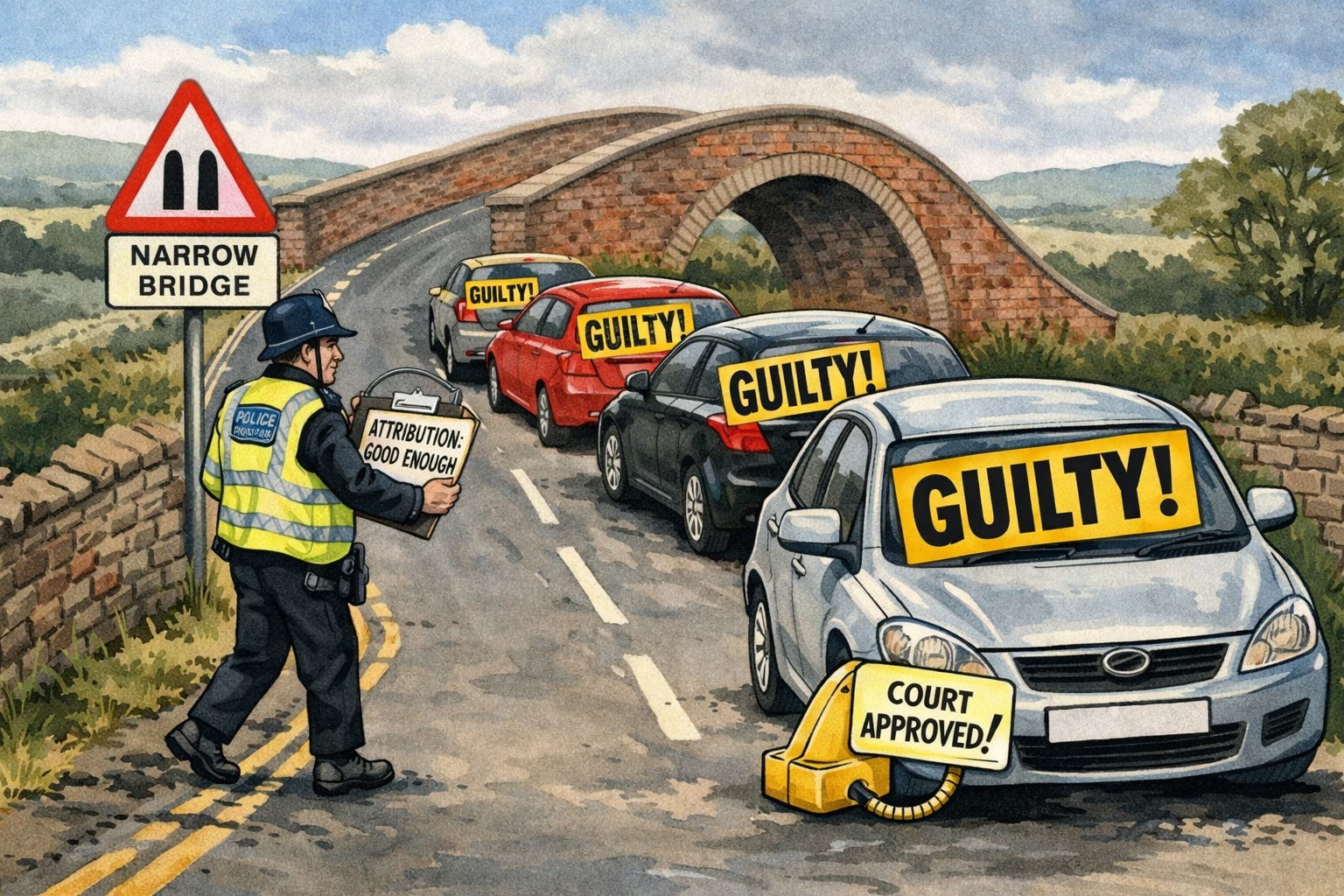
In the last few days a legally trained friend reached out to me and gave me details of his civil case. The specifics are not important here — the state is attempting to land responsibility on him as a company director for decisions made during the Covid Bounce Back Loan scheme, rather than attributing responsibility to the hurried design of the scheme itself, the ambiguity of its eligibility rules, or the extraordinary economic conditions under which it was deployed.
What struck me was not the merits of the case, but the structure of the attribution. When something goes wrong in a complex system, there is almost always a menu of places where responsibility can be made to land.
Blame sits downstream of responsibility, and responsibility itself depends on attribution. If the originating issue cannot be attributed to you, it cannot properly be your responsibility. In that sense, the legal system is fundamentally an attribution game: a mechanism for allocating responsibility and blame. If you do not understand the rules of that game, you can easily find yourself carrying blame that was never properly yours to bear.
The legal tribulations I have experienced over the past two years in both the United States and the United Kingdom led me to develop a framework for understanding how this happens. In practice, the state — or actors manipulating it — can shift responsibility simply by altering the attribution thresholds: raising the evidential and explanatory demands imposed on the accused, while quietly lowering the standards it applies to its own claims, procedures, and even the institutional foundations of the case itself.
In recent days two other friends have reached out to me asking for help with their own court problems involving minor motoring offences. In order to give them a proper answer, and rehearse the method, I went back to the foundations of my own prosecution for “parking beside a bush” — a non-crime. If I had possessed the analytical tools I have today eighteen months ago, the whole episode would likely have played out very differently. I am therefore sharing this worked example so that you can apply the same line of reasoning to your own cases.
While the specifics arise from UK law, the technique itself is universal. The exercise is not unlike the way safety-critical software is specified and verified. Statutes and case law together define the system requirements.
First, they specify the legal tests that must be satisfied for a claim to exist.
Second, they determine how strongly those tests can be attributed to the facts and actors involved.
Put simply, this gives us two distinct questions:
what must be true in law, and
what counts as true in law.
If both conditions are met, it is “safe” to proceed to trial; if not, it is “unsafe”.
The former test is specific to the legal context, while the latter can be categorised by how much attributional “short cut” the system is willing to tolerate: none, some, a lot, or total.
I am not a legal expert, so I do not advise on questions in the first category — matters such as signage quality, speed-camera accuracy, or the mechanics of document service.
What I can help with, as a computer scientist, is the second category: determining whether a charge is well-formed. By that I mean whether it satisfies the minimum attribution requirements the law demands before a case should be allowed to proceed to trial on the facts.
This is perhaps best understood through the example of my own case, rather than in the abstract. In the Single Justice Procedure Notice there are three core ingredients: the statement of the charge, the supporting statement of facts, and a witness statement. I will present each of these below for you to review through the attribution lens.
A magistrate is supposed to review these documents and determine whether they disclose a sufficient case to answer before the defendant ever sees them. The question, therefore, is simple:
Did the materials meet the minimum attribution requirements required by law before troubling me with an accusation to answer?
It is important to be clear about the scope of this exercise. I am not arguing here about arbitrary enforcement, whether the road was actually obstructed, or whether signage was hidden. This is a purely structural analysis of the attribution regime in use: whether the charge was sufficiently well-formed to enter the legal system at all.
The analysis therefore falls naturally into three parts: what the statutory attribution requirements are; what was actually supplied; and any resulting “attribution debt”. From there we can evaluate whether there was ever a case to answer — before the question of pleading guilty or not guilty even arises.
Before analysing the documents in my case, we first need to establish what the law actually requires. I therefore asked Grok to identify the statutory elements and particularisation requirements for the offence of unnecessary obstruction of the highway. A condensed summary of its analysis is reproduced below.
This establishes the legal baseline independently of my own reasoning: Grok provides the legal specification, while ChatGPT is used only as an integrator and editor of the results. In this way the requirements are established without being shaped by my own framework.
The purpose of this exercise is not to interpret the facts of my case, but simply to define the minimum legal specification for the offence. In software engineering terms, this is equivalent to defining the interface that any valid implementation of an “InitiateCharge()” function must satisfy.
Grok’s analysis identifies a simple attribution chain linking the defendant’s conduct to the alleged obstruction. This chain can be expressed as follows:
Defendant → vehicle standing → obstruction → unnecessary obstruction.
This can be broken down into the following statutory attribution requirements:
Defendant in charge of vehicle
The accused was responsible for the vehicle at the relevant time.Defendant caused or permitted the vehicle to stand
The vehicle was parked or left stationary by the defendant.Vehicle standing caused obstruction of the road
The vehicle impeded the lawful passage or use of the road.Obstruction was unnecessary
The obstruction lacked reasonable justification given the circumstances.
For a charge to proceed, the materials before the magistrate must disclose an offence known to law. In attribution terms, this means the accusation must contain sufficient particulars to show conduct which, if proven, would satisfy the statutory elements of the offence.
If that attribution chain cannot be identified because the allegation is insufficiently particularised, the charge should not enter the legal system.
With that legal specification established, we can now examine the three documents contained in the Single Justice Procedure Notice and determine whether they actually supply the attribution required by law. Where the supplied material falls short of the statutory specification, an “attribution debt” arises — which ought to halt the process.
The Single Justice Procedure Notice contains three documents which form the basis of the accusation:
the charge — what law is said to have been broken,
a short statement of facts — the situation in which it is alleged to have been broken, and
a police witness statement — the details said to support the above.
These are reproduced below in the form they appeared on the SJPN.
Charge
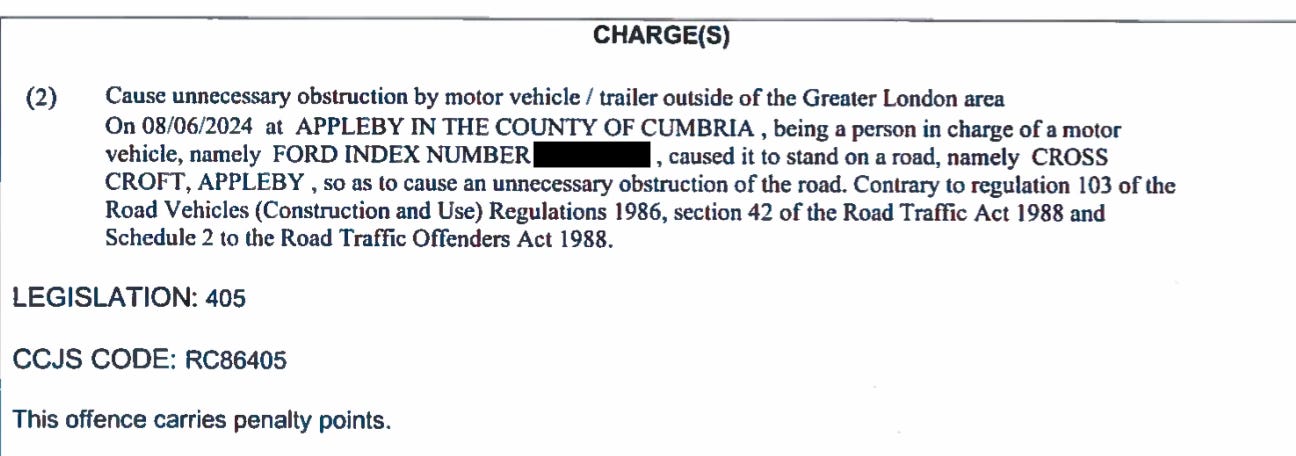
The charge uses standard statutory wording to allege unnecessary obstruction. The attribution content of the charge can be summarised as follows (with my van’s registration blanked out).
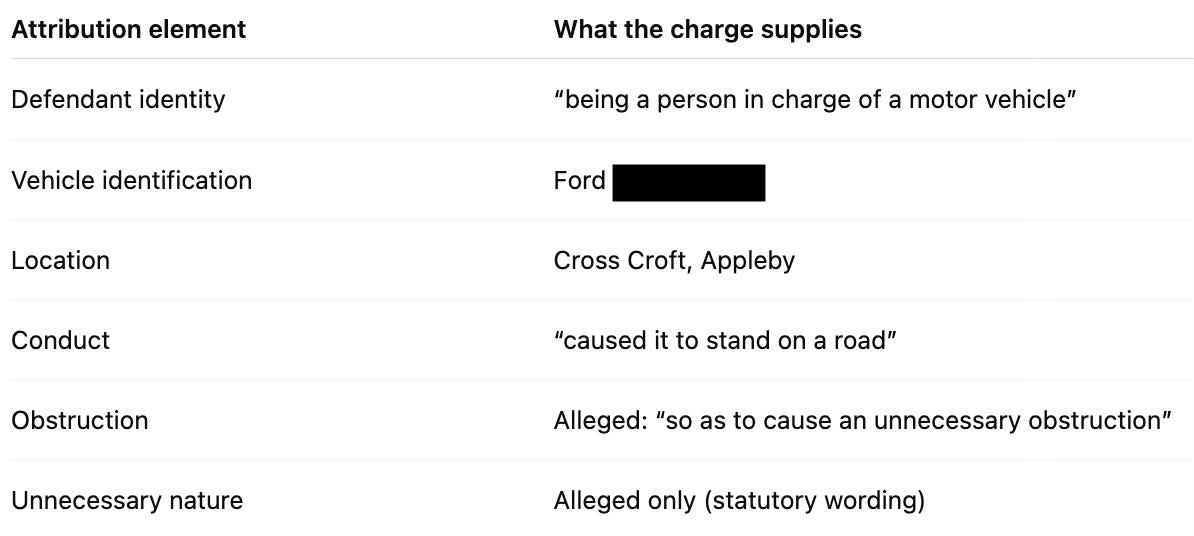
The charge alleges the statutory elements but does not describe the mechanism of obstruction.
Statement of facts

The statement of facts repeats the allegation and adds a specific time for the event.
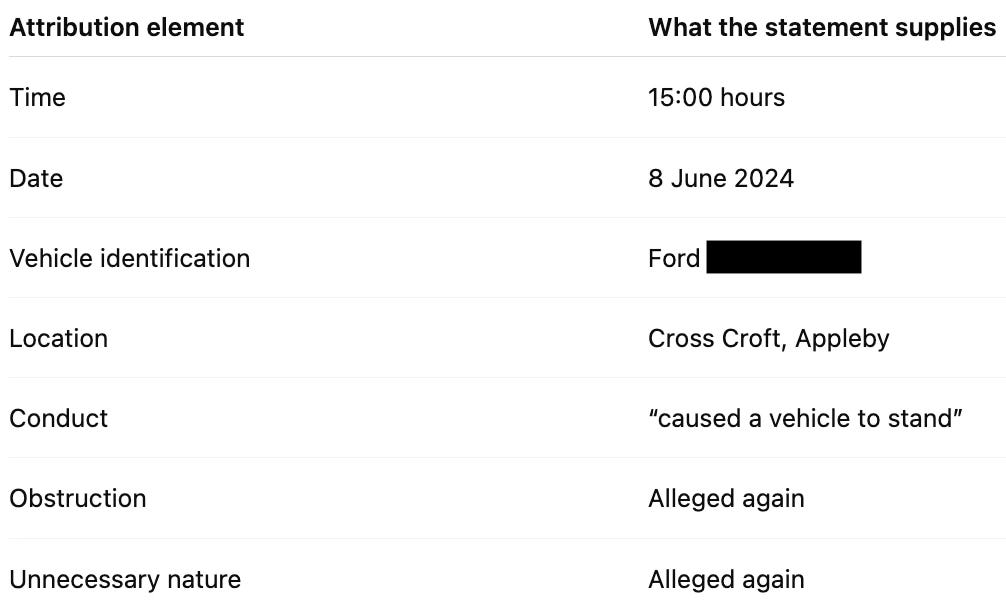
The statement largely mirrors the charge and adds time but does not add new particulars about the obstruction itself.
Police witness statement
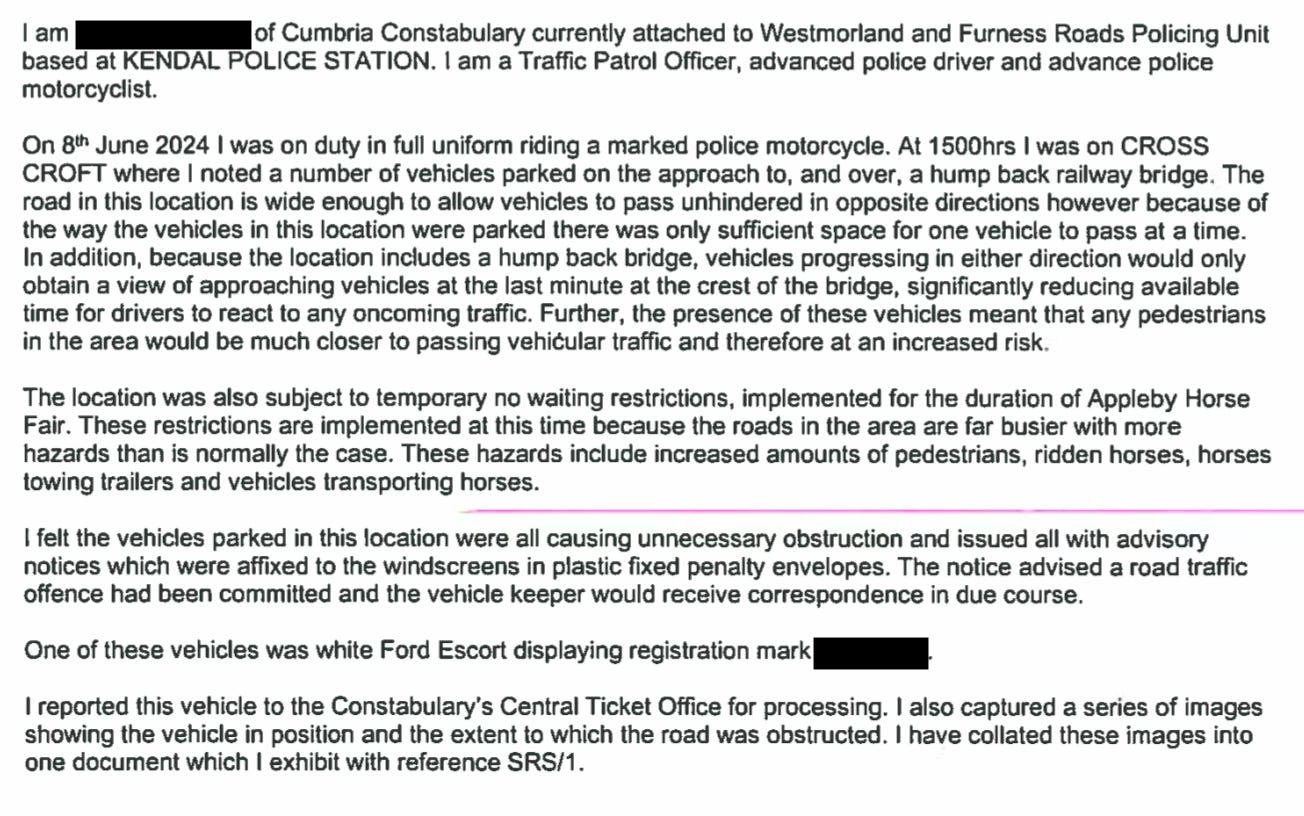
The officer’s statement provides contextual description of the location and traffic situation.
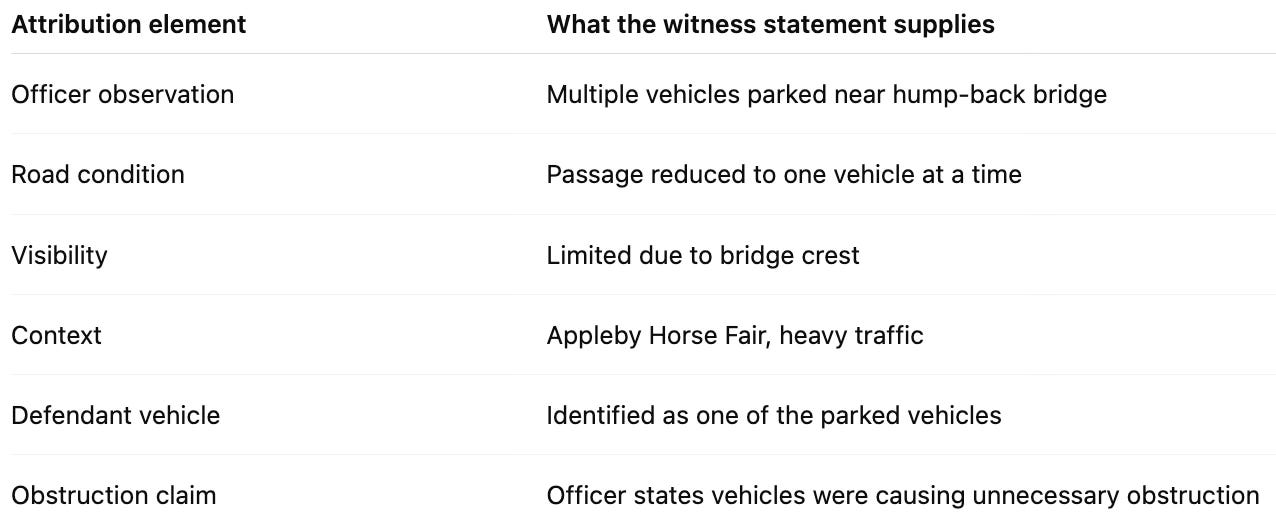
The description focuses on a general traffic situation involving multiple vehicles, rather than particularising the obstructive effect of the defendant’s vehicle itself.
With the materials now set out, we can compare what they actually supply against the attribution chain required by law. To see the attribution structure more clearly, the elements from the three documents can be compared side by side.
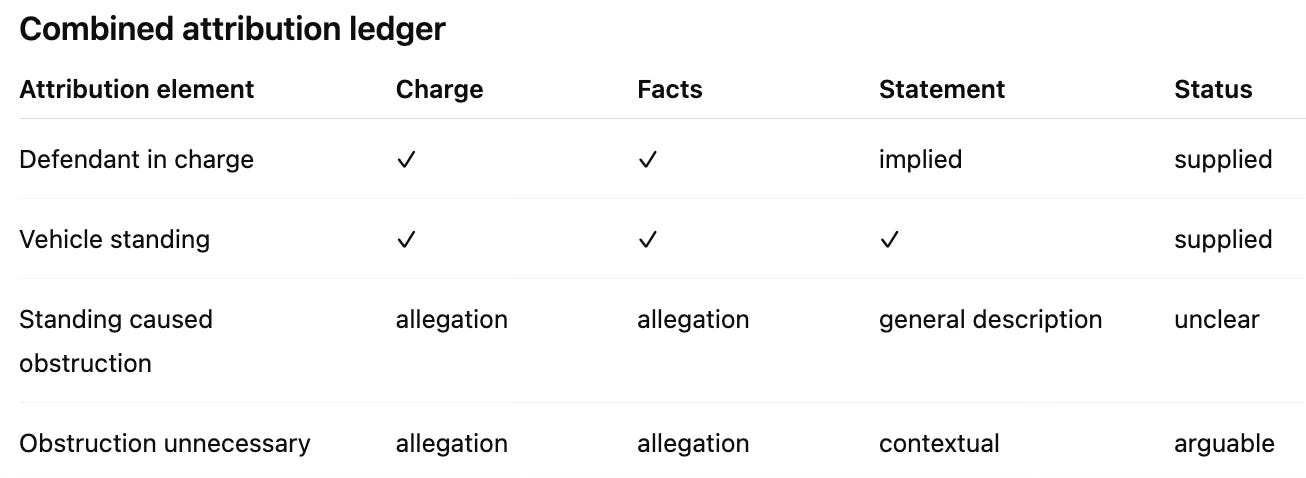
Several points are immediately apparent from this comparison.
The materials clearly identify the defendant, the vehicle, and the fact that it was standing on the road at the specified location.
However, the remaining elements of the statutory chain — that the vehicle’s presence actually caused an obstruction, and that the obstruction was unnecessary — are largely asserted rather than particularised.
The charge and statement of facts repeat the statutory wording, while the witness statement describes a general traffic situation involving multiple parked vehicles near the bridge.
The question, therefore, is whether these materials collectively disclose an offence known to law. In other words…
do they supply enough particularised attribution to link my vehicle to an unnecessary obstruction of the road, or
do they rely on inference from a broader situation involving several vehicles?
In attribution terms, this is where the system begins to tolerate shortcuts. Rather than identifying the obstructive effect of my vehicle itself, the witness statement describes a wider situation in which a number of vehicles were parked on and around the bridge.
Those vehicles were positioned later, where the road was narrower, creating a different traffic condition from the one attributable to my vehicle alone at the time it was parked. The attribution step therefore becomes:
general obstruction situation → inferred obstruction by each vehicle.
Whether that shortcut is acceptable determines whether the attribution chain required by law is actually satisfied. The remaining question is therefore
whether the materials supplied here meet the minimum legal threshold, or
whether the accusation depends on attribution shortcuts — that should have been filtered out before the matter reached me as the defendant.
When I first received the notice, this structural problem was immediately apparent, but difficult to articulate. Breaking the accusation down into its attribution components reveals why. Without this kind of decomposition, most people simply accept the allegation and pay the penalty, even where the accusation itself may be structurally defective.
To examine this more precisely, we can apply the operational modes defined in the ΔΣ framework. The ΔΣ framework describes how systems terminate attribution when the explanatory burden becomes too high. It defines four modes:
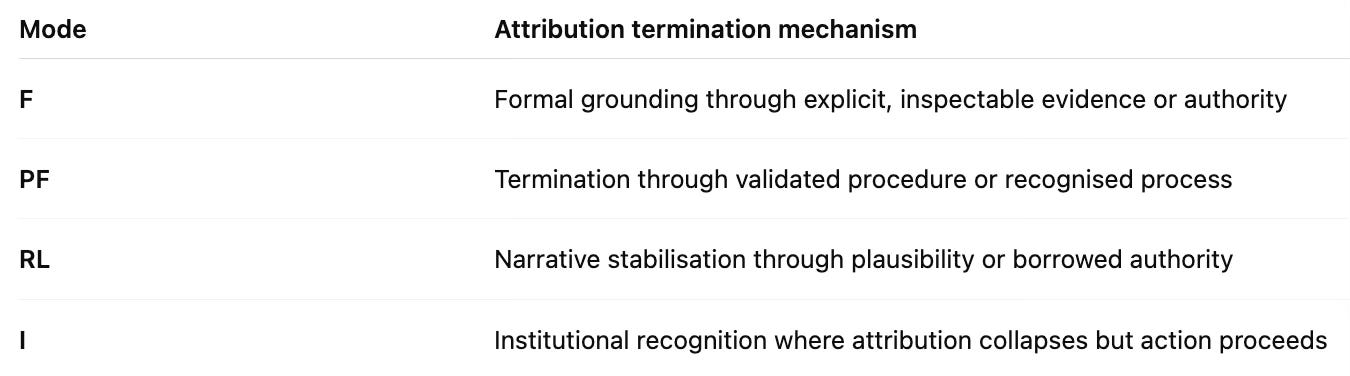
Applying these modes to the attribution chain in this case produces the following picture.
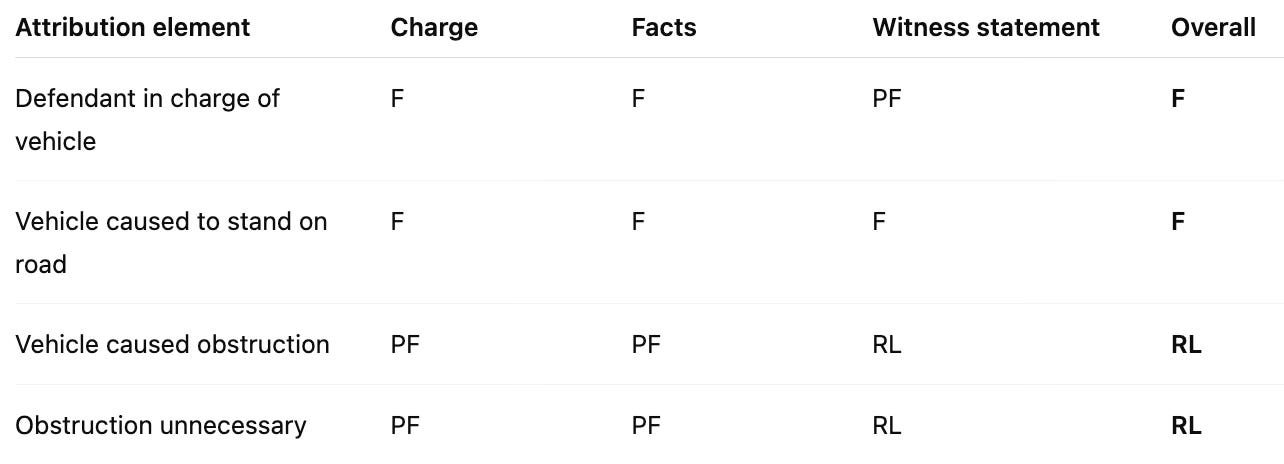
The entire case reduces to the difference between two attribution chains.
The law requires
Defendant → Vehicle → Obstruction → Unnecessary
What prosecution supplies is
Vehicle present → Traffic situation → Inferred obstruction
On that analysis, the materials do not appear to satisfy the preconditions required for a criminal charge to proceed.
The bottom line is structural. We can express that conclusion more precisely using the language of attribution science.
For a charge to proceed, Criminal Procedure Rule 7.3 requires that the accusation contain sufficient particulars to disclose an offence known to law.
In ΔΣ terms, attribution should terminate either in Formal mode (F) — saying exactly who did what, where and when — or, at minimum, in Procedural Flow mode (PF), where the allegation fits recognisably within an established procedural pattern.
Instead, the materials supplied here terminate attribution rhetorically: the alleged obstruction is inferred from a general traffic situation involving several vehicles rather than being grounded in the conduct of my vehicle itself. In ΔΣ terms, attribution therefore terminates at Rhetorical Laundering mode (RL).
That is not a sufficient basis for a criminal charge.
Once attribution collapses to that level, the only remaining mechanism by which the accusation can proceed is Institutional Override (I): the system recognises the charge and compels a response despite the attribution deficit.
In practical terms, this means the Single Justice Procedure Notice was issued on the basis of a structurally incomplete accusation. I was therefore being required to respond to something that had not yet been properly formed as a charge.
It is worth noting that a first-pass legal analysis does not necessarily flag this problem. When I asked Grok whether the materials disclosed an offence known to law, it initially concluded that they did, because the statutory elements were alleged and the supporting materials described a traffic situation consistent with obstruction. That response is instructive rather than troubling: it shows exactly how easily attribution shortcuts can be accepted when the materials are read at a high level.
A closer inspection reveals a further structural gap that the first pass does not examine closely: time. The statement of facts and the officer’s account describe the situation at approximately 15:00 hours. My vehicle, however, had been parked at around 14:15, some forty-five minutes earlier. The witness statement does not particularise what changed during that period, nor does it identify whether my vehicle itself was responsible for the obstruction observed at 15:00.
In attribution terms, this introduces an additional shortcut. The materials implicitly assume that the traffic situation described at 15:00 can be attributed backwards to the act of parking that occurred around 14:15. The attribution chain therefore becomes:
parked vehicle → later traffic situation → inferred obstruction → inferred responsibility.
That inference may or may not be true in fact. The point here is structural: the accusation does not particularise the link. Instead, attribution terminates rhetorically at the level of a general traffic situation involving multiple vehicles at a later time.
The requirement for a specific, attributed contribution — particularised to the defendant — is therefore missing.
The defendant is not being asked to answer a grounded allegation, but to respond to an inference drawn from a wider situation. In those circumstances the accusation does not disclose conduct sufficiently particularised to constitute an offence known to law.
At this point a reader might reasonably ask: if the obstruction allegation was structurally defective, why did the case proceed at all?
The answer lies in the procedural mechanism used to pursue the matter.
The conviction obtained in this case was not for obstructing the highway. Instead, it was for failing to comply with a Section 172 driver identification requirement under the Road Traffic Act 1988. Section 172 allows the police to require the registered keeper of a vehicle to identify the driver when they are investigating a suspected road traffic offence. Failure to provide that information is itself a criminal offence.
In principle the mechanism is straightforward. A suspected offence is identified, the keeper is asked to identify the driver, and the investigation proceeds from there. However, the procedural history of this case reveals a further attribution problem.
The first document issued was a Fixed Penalty Notice (FPN) placed on the vehicle itself. Like the later documents in the process, this notice did not clearly attribute the demand to a specific legal actor exercising statutory authority. It appeared as an administrative instruction without an identifiable issuer.
The same attribution deficit appeared in the subsequent Notice of Intended Prosecution (NIP) containing the Section 172 demand. The document appeared to originate from the “Central Ticket Office” hiding behind a PO Box, which is an administrative unit rather than a legal person exercising statutory authority.
I therefore raised a simple attribution question:
who, in law, was making the demand?
No formal attribution was provided.
Because the authority issuing the statutory demand was never formally identified, I declined to provide the requested driver information. The prosecution that followed therefore did not concern the alleged obstruction itself. Instead, the charge pursued was the administrative offence of failing to comply with the Section 172 requirement.
This brings the earlier attribution analysis into sharper focus.
As we have seen, the obstruction allegation itself already contains two attribution gaps:
First, the materials may not disclose an offence known to law because the attribution chain terminates rhetorically rather than formally.
Second, the witness statement does not particularise the contribution of my vehicle to the alleged obstruction, instead describing a wider situation involving multiple vehicles at a later time.
The Section 172 demand introduces two further gaps:
Third, the statutory demand presupposes the existence of a properly grounded suspected road traffic offence. Section 172 authorises the requirement to identify the driver for the purpose of investigating such an offence. If the underlying allegation does not disclose an offence known to law, the foundation of the demand itself is structurally defective.
Fourth, even if such a foundation existed, the statutory power must still be exercised by an identifiable legal authority. The documents in this case did not attribute the demand to any such actor, instead appearing to originate from an administrative unit described as the “Central Ticket Office”. The requirement therefore relied on the assumption that an administrative workflow was sufficient to exercise statutory authority.
These four attribution failures interact in an important way. The Section 172 demand effectively requires the defendant to assist in proving an allegation whose own attribution chain has not yet been properly established.
In ΔΣ terms, the process therefore advances through Institutional Override (I): the authority of the system compels compliance even though the attribution chain grounding the accusation has already collapsed.
The result is a structurally inverted process.
Instead of a well-formed accusation leading to investigation, the investigative mechanism is used to stabilise an accusation that was never properly particularised in the first place.
What this analysis shows is how the state can manufacture convictions for non-crimes through a process I call attribution laundering. The Single Justice Procedure operates at industrial scale, and it lacks systematic safeguards to ensure that the accusations entering the system actually disclose an offence known to law. While a diligent magistrate might spot a missing attribution link — and therefore the structural invalidity of a charge — the system itself does not enforce that check.
Importantly, this is not primarily a failure of the individuals involved. A police officer may simply be describing a situation as they perceived it, and a magistrate working under heavy case loads may reasonably assume that the accusation placed before them has already satisfied the minimum legal requirements. The problem is structural. The system is operating without the equivalent of the safety checks that would exist in any other high-stakes decision system.
In safety-critical engineering — whether in aviation, medicine, or software — a system is considered unsafe if it allows an operation to proceed when the conditions required for correctness have not been verified. The legal system is no different. Before the machinery of criminal justice engages, the accusation must satisfy certain attribution invariants: it must disclose an offence known to law, and it must particularise the defendant’s contribution to that offence.
Where those checks are not enforced, the system quietly tolerates attribution shortcuts. Sometimes that may reflect simple administrative convenience. At other times — especially in high-volume enforcement environments such as Appleby Horse Fair — the same mechanism can drift into something more serious: the manufacture of liability by shifting attribution burdens onto the citizen.
This is why the concept of lexworthiness matters. Before the state compels a citizen to respond under threat of prosecution, the accusation must first be worthy of the law. In practical terms, that means the attribution chain grounding the offence must already be present and visible in the accusation itself. Where that threshold is not met, the legal process should stop before the citizen is ever drawn into it.
What the analysis above shows is what happens when that filter fails. I was prosecuted for a non-crime via a non-case — and convicted in the name of a non-court.
This nonsense can end — with rigorous attribution safety engineering.