

On Friday evening I gave a talk to a full room in London, with around 70–80 people in attendance by the time we got going. It was the first time I had told the full story of my “ghost court” saga from start to finish.
What follows is the transcript of that talk, lightly edited for clarity and readability, and interwoven with the original slides.
The story begins with a parking ticket at Appleby Horse Fair and ends somewhere rather unexpected. Along the way it passes through hidden signs, unexplained court names, Freedom of Information requests, judicial review proceedings, constitutional questions, and an increasingly strange attempt to answer what ought to have been a very simple question:
Which court, exactly, convicted me?
The overall structure is deliberately narrative. Rather than presenting a finished theory, I lead the audience through a succession of hypotheses. At each stage, the available evidence seemed to point towards a particular explanation. Some of those explanations proved persuasive. Some proved completely wrong.
The talk follows that journey from first suspicion to final insight, allowing the audience to experience the investigation as it actually unfolded — rather than as a tidy retrospective account.
By the end, the focus has shifted away from my individual case entirely. The real subject of the talk is
how large administrative systems relate symbols to reality,
how they behave under stress, and
what happens when the mechanisms that reconnect official records to the real world begin to fail.
The key insight is that not everything that feels like corruption is corruption. There is a deeper failure mode that emerges before questions of malice, misconduct, or bad intent even arise. Administrative systems under load can drift away from reality while continuing to function according to their own internal logic.
The core insight is that the legal system tends to assume that
if authority is granted by statute, and
procedure is correctly followed, then
the resulting outcome is legitimate.
My analysis suggests otherwise.
The consequences can be every bit as damaging as deliberate wrongdoing. People can be harmed. Rights can be diminished. Outcomes can become detached from facts. Yet no individual actor may be acting maliciously, negligently, or even improperly within the rules of the system itself.
Procedure is not reality. Administrative continuity is not truth. Legal validity and legitimacy are not necessarily the same thing.
The challenge, therefore, is not merely whether such systems make mistakes, but whether they remain capable of recognising and correcting them. Can they reconnect their symbolic representations back to the reality they claim to govern? Can they repair drift when it occurs?
A system that can drift away from reality is not necessarily corrupt. Yet a system that can no longer find its way back to reality may be something far more dangerous.
That, ultimately, is what this talk is about.
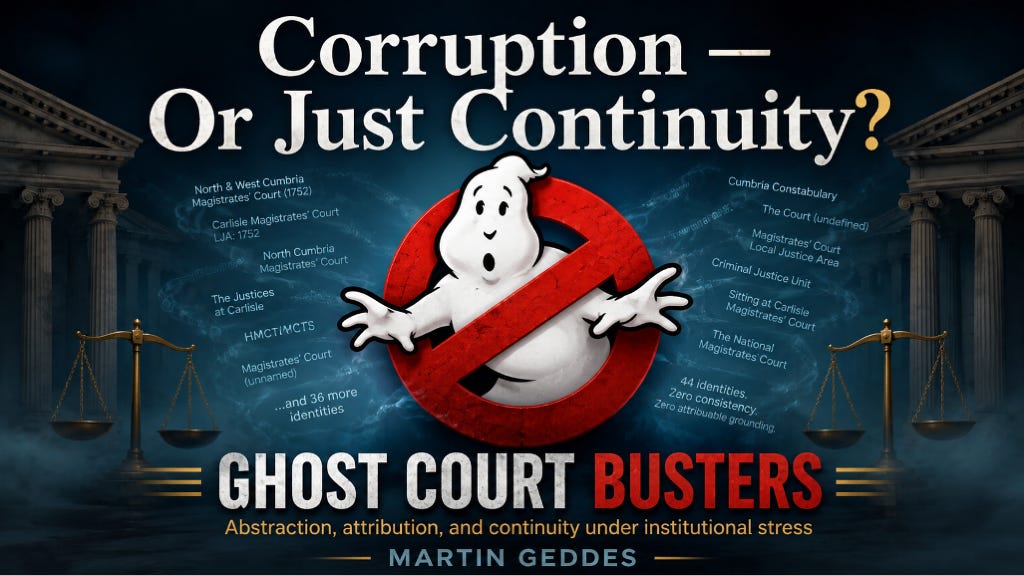
[Holding a traditional wired microphone] Welcome to Camden Comedy Club! I’m in the right place, I hope. Or maybe it’s the karaoke club? I’m very glad to be here this evening.
I don’t give many talks in public these days. I used to do it for a living. As a telecoms performance scientist, I used to make my way to Heathrow and fly off around the world and stand on big stages in front of hundreds of people and talk about the algebra of telecom networks.
Anyway, no algebra tonight, thankfully.
Speaking of telecoms, have any of you (out of interest) ever watched a YouTube video and it went like that [motions ‘circle of death’ while video is buffering]? Yes!
Was it because the telecom network was corrupt? No, it wasn’t. It’s not because telecom networks are evil. Honest. It’s because they get really busy. They get heavily loaded. And when a telecom network gets really heavily loaded, what happens? Your application stops working.
This talk is kind of analogous to that situation, in that when big institutions get busy, they don’t go like that [video buffering circle of death], and they don’t stop… they continue.
This talk is about the difference between corruption and just continuing.
The last talk I gave in public was over in Chiswick, about 18 months ago. Some of you were there. It was called Spiritual Exit from the Law. It was about rising above a lot of this mess that we see around us, and understanding why people have to revert to the law — because every legal case at some level is a spiritual failure.
So even if you worked for HMCTS or the Ministry of Justice, you could have come to the talk I gave eighteen months ago, and you’d have felt equally at home as everyone else in the room. That’s because we were going up above all of the stuff that’s controversial — with debates and accusations — and hence unpleasant to talk about.
Doubtless in this meeting room — over the last four, five, six years — you’ve had some difficult subjects to deal with. Medical fraud, corruption in courts… all kinds of nightmares everywhere. This talk isn’t like that. In fact, this is quite an unusual talk I’m giving tonight. Rather than going above those difficult matters, I’m going below.
Instead of a “spiritual exit from the law”, it’s kind of a “scientific or engineering exit from the law”.
Now, as life has it, fate’s punishment for me running a Spiritual Exit from the Law workshop for a whole day was immediately plunging me into eighteen months of nonstop legal battles. So this evening I’m going to talk through the legal fight I had, but the talk isn’t about my journey.
I’m only using my experience as the manure, which we’re going to compost into something that’s much more like roses. So this isn’t a talk about my legal battle, but I am still going to talk you through my legal battle, because it’s a somewhat bizarre one. It’s pulled out a whole series of insights or understandings because I kept pressing, and I kept pushing — so I managed to surface some things that even I didn’t realise eighteen months ago.
And because of my background in computer science and telecom network performance engineering, I was able to occupy a rather unusual spot and look at the structural issue that was going on. So instead than standing on either side of the conflict — acting as like a freedom and truth and justice activist, or even taking the opposing position, that of the Government Legal Department or HMCTS — I was able to stand on this infinitely thin little narrow space which sits between the two.
I looked at the structure of what’s going on from a completely neutral perspective. No finger pointing, no one to blame, no shame, no corruption, just pure structure of what’s going on. So that’s where we’re heading to tonight.
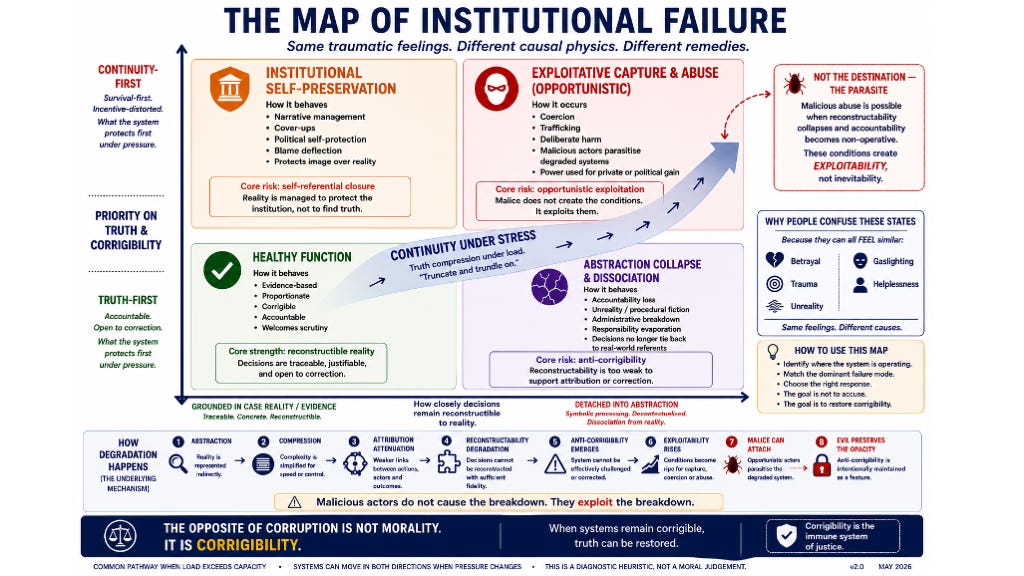
I’ve also got a confession. I was going to print out the summary slide and I forgot. So I’ve committed the cardinal sin of presenting, which is producing a really busy slide. I was going to hand this one out, but never mind. The presentation deck will be available afterwards.
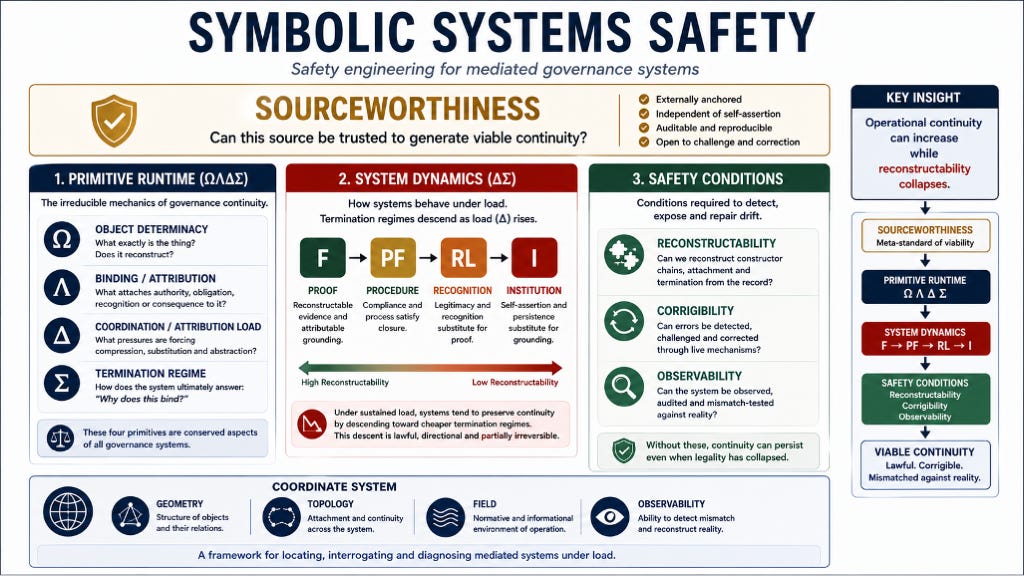
The message from this slide is that before we even get to a place where corruption can happen, all of these institutions that process symbols in some way — whether governance, courts, theology, economics, or something else entirely — can become stressed.
They all have their own version of the YouTube ‘circle of death’.
What hasn’t been well understood is how that stress arises, how it propagates through the system, and how it causes institutions to drift away from truth and reality.
I’m proposing that this is actually a new engineering discipline: that the safety case for things like running courts has never really been made.
There is a safety engineering for governance that has largely been missed.
And it’s not anybody’s fault. It’s simply that we have reached a point in history where the underlying dynamics have become visible.
The Appleby incident
So, skipping past all that, let me tell you my story.

Almost exactly two years ago, as part of my semi-professional hobby of doing photography, I went to Appleby Horse Fair. I’d never been before. Now I live near Darlington, not too far away actually. It’s a little trip over the A66, across the Pennines, down into Appleby.
I hadn’t made any particular plans. I didn’t know quite exactly what to expect. All I knew was there’s no formal ticketed events being held. So I took the camera with me, and you can see my super wide angle lens, and I got some nice pictures.
Now, if any of you in the room are drivers of BMWs or Mercedes or Porsches, I’m sorry if the next slide causes you any envy.

To get there I had to drive myself, and I ride in a 2001 Ford Escort diesel van. I love it. Absolutely adore it. It’s my real fun and joy. Unlike in a Porsche, where you can’t really keep your foot to the floor much, in a 1.8 diesel with no turbo, your foot is right to the floor all the time! It’s a real boy racer car, even though it’s the slowest one I’ve ever driven.
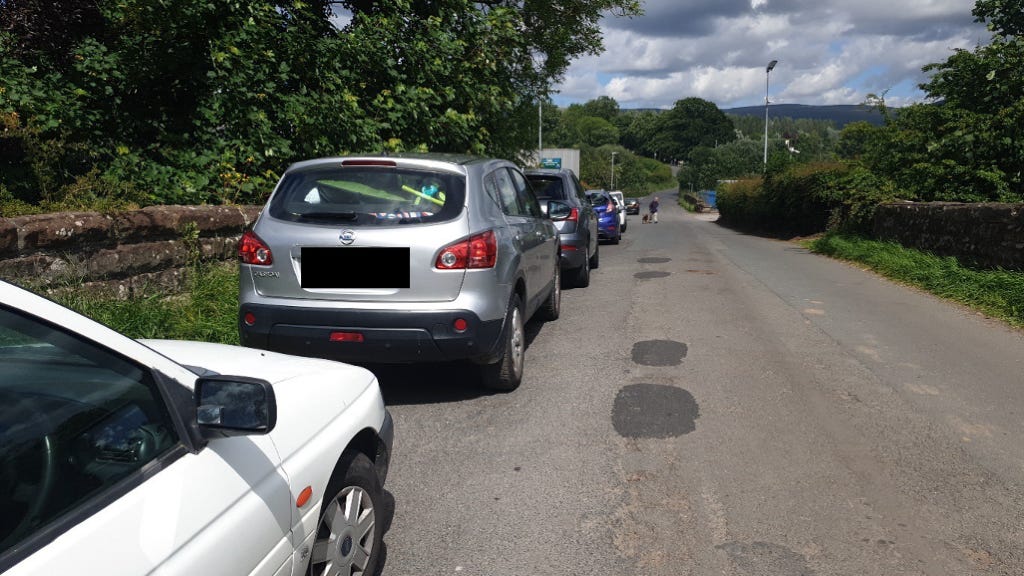
Anyway, so I went to Appleby and I had to park. So I followed the sign that said, “Don’t go into the village. Turn right down here and there’s some kind of parking down here.” I keep driving. And I keep driving. I’m getting to the point where I can see the roads about to go out of the village.
Hang on a minute, where am I supposed to park?
There’s no signs here for parking. What do I do? So there’s a row of cars, and I parked at the side of the road. The road seems wide enough to pass. There’s no signs here saying don’t park. I’ve got to park here, I guess.

Off I went into Appleby to take lots of photos of the interesting creatures that you find at horse fair.
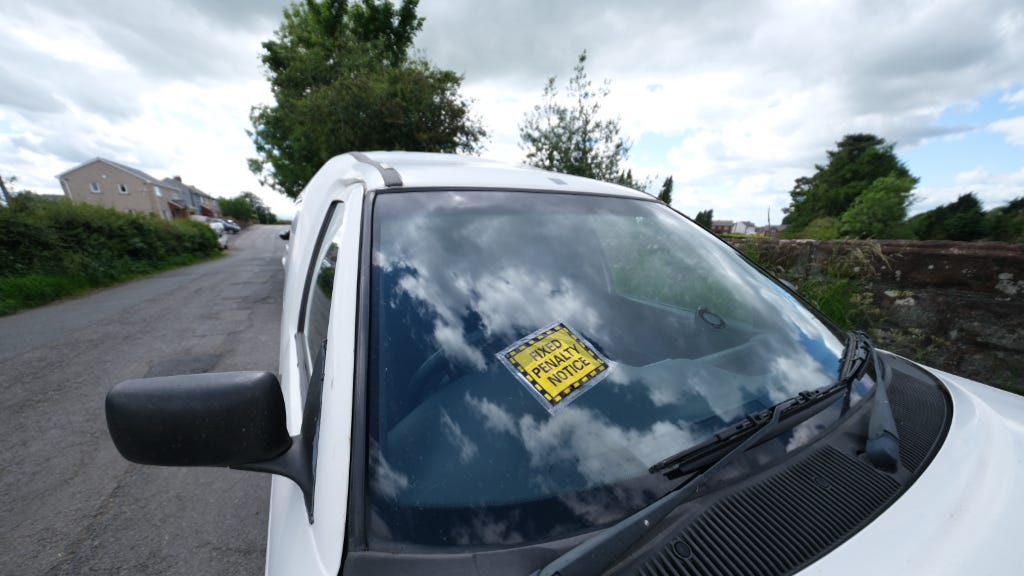
I came back. Oh dear. Oh dear. My dear van.
I’m almost feel I’m getting emotional, sorry.
There were fixed penalty notices stickers all down the cars that are parked. I thought… I’ve never had a fixed penalty notice, ever. I’m that good! I don’t pay ULEZ [i.e. London pollution tax] out of principle — but I’ve never ever had one of these.
I was a bit annoyed. So I look around. What have I done wrong?
Hang on a minute, what’s going on here?
Because as you can see that there’s plenty of road space here. I wasn’t blocking the road.

Can you see the no parking sign? No!
That’s quite well hidden, isn’t it? I walked straight past it without seeing it. As you may know, a no parking sign that’s hidden inside a bush has no legal effect.
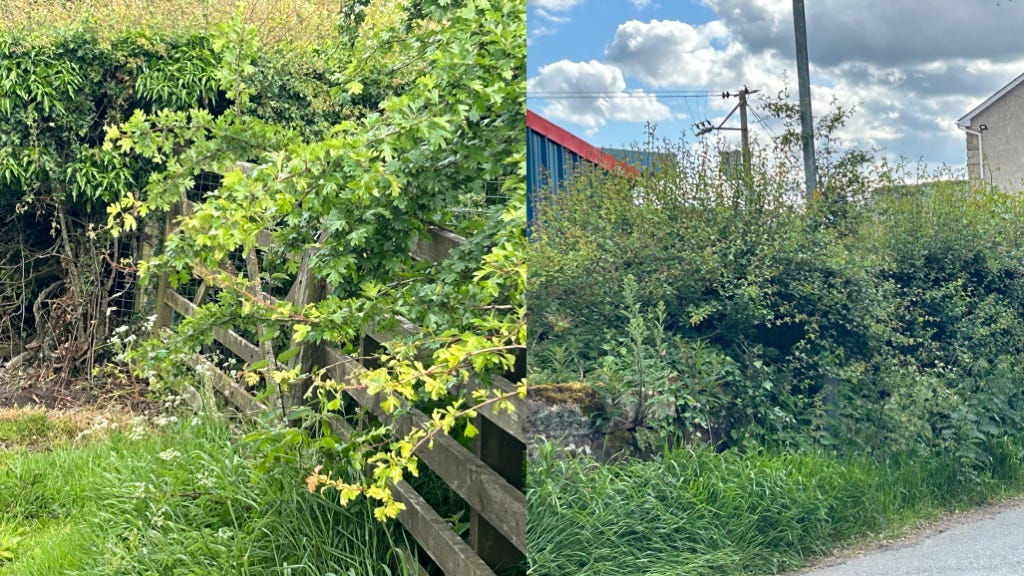
Can you see the other no parking signs? No!
Hmm. So I was a bit peeved. Because clearly there was something going on here that wasn’t quite right. It felt a bit corrupt to me at the time.

So as I got into my dear van, ready to drive off, somewhat upset, past me goes someone in a horse and cart. At relative speed. So clearly the road is not blocked.
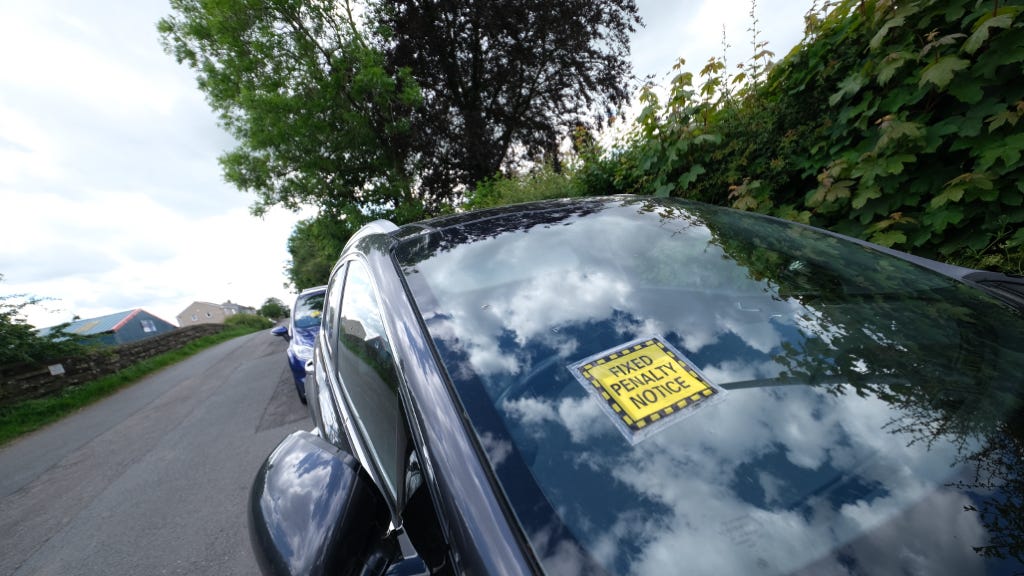
I also noted at the time one of the other cars, one that’s right next to the lamppost with the sign buried deep inside it. So you look at the width of the road… does that road look blocked or obstructed to you? No!
So I thought… this isn’t right. Yet someone’s come down here, and put all these fixed penalty notices on all these cars.
What’s going on here?
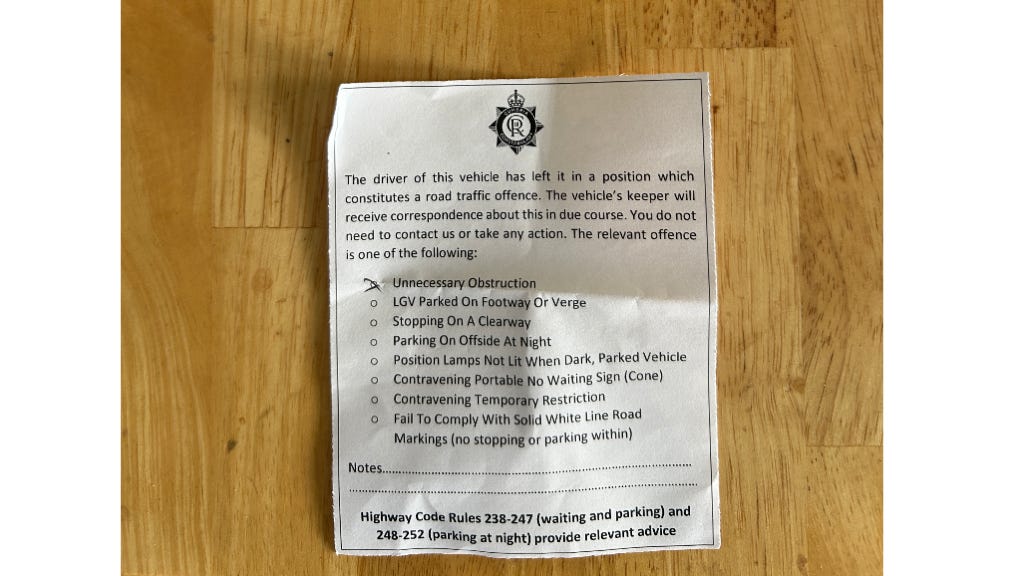
Inside my plastic envelope was this piece of paper. And on the surface of it, it looks quite official. It’s got a Cumbria Constabulary little logo at the top. And it’s got “you’ve done an unnecessary obstruction”, then the highway code down here.
But it didn’t actually have in ordinary English the name of the constabulary, nor the name of the officer, nor any address or contact details.
It’s like… this is a bit odd — a badly photocopied piece of paper.
What’s going on here? I’m a confused!
Now remember, I’m not trying to accuse anyone of anything. I’m just reporting what I experienced at the time.
So my first reaction was… what’s going on here?
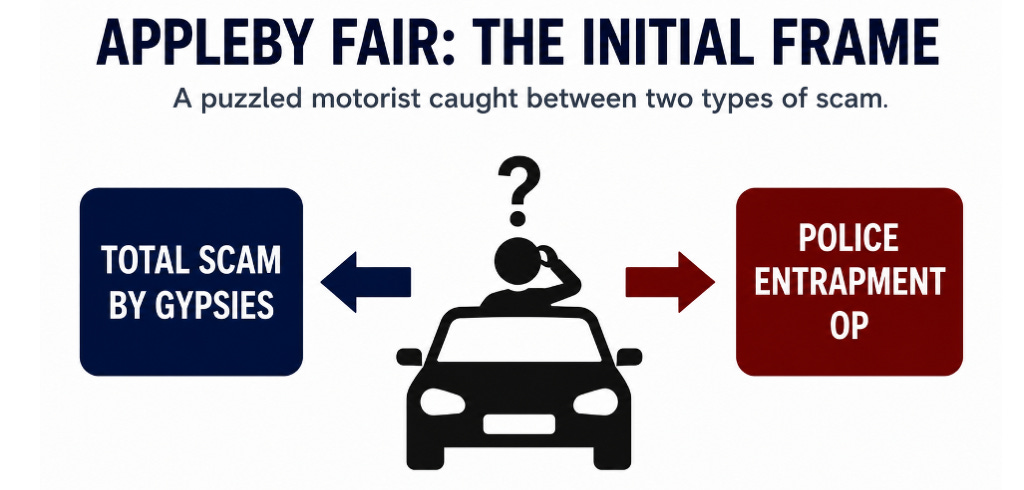
Is it that the gypsies have got someone with contacts in DVLA [the government licensing agency] and they’re busy putting interesting notes on people’s cars, and they’ll try and mail me and ask for money later?
Or are the police running some kind of entrapment operation? Because I was told to come down this lane and park down here, and I parked beside the side of the road completely safely — where there was no parking prohibition signs in operation.
What’s happening? So yes, I was a bit suspicious!
Prior experience gives pattern recognition
Now, remember that this is two years ago. We’re still only a few years out of COVID. A lot of us had seen some pretty ugly things happen. Many people felt deeply injured by what had gone on. Our attitude towards officialdom and the state was inevitably coloured by those experiences and the pain we had carried through those years.
This is why the message I’ve got today is actually quite hard to hear. It’s also why, if someone from the Ministry of Justice had been sitting in this room, they would probably have felt just as comfortable — or uncomfortable — as anyone else.
Because this isn’t really about corruption at all. The message is something else.
But before I can explain it, I need to step back a little and tell you about two earlier experiences that shaped how I initially interpreted what happened at Appleby.
The first was pushing back, to some extent, against council tax, which is essentially a levy on existing. We used to have window taxes; this is more like a roof tax. You need somewhere to live, so it’s not really optional.
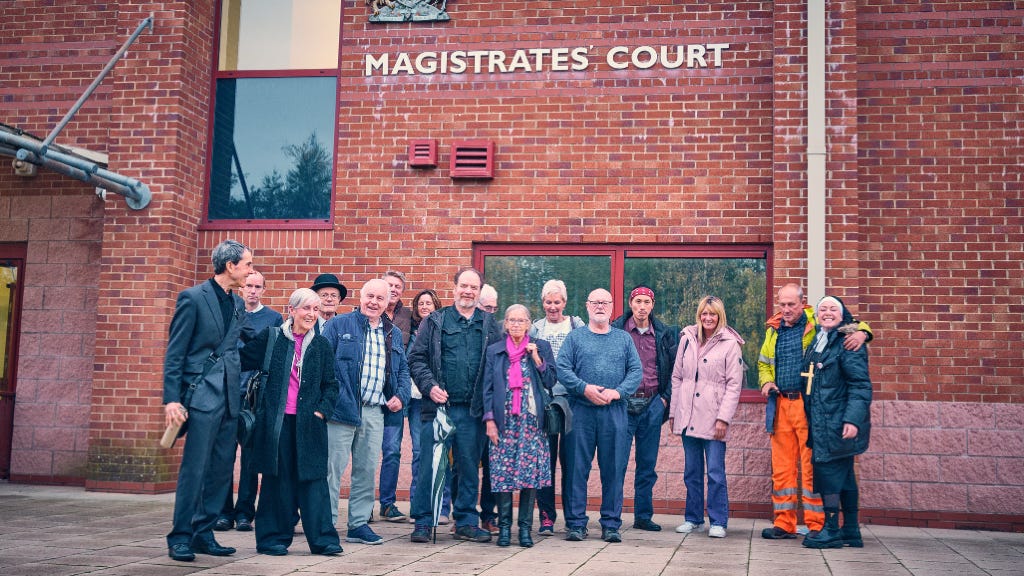
So I said to Durham County Council: “Sure, I’ll pay the council tax this year, as long as you show me this liability order you say you’ve got.”
They wouldn’t even acknowledge the question, let alone answer it.
So that’s a problem.
Hang on a minute. You’ve written to me saying there’s a liability order from a court.
Where is it? What is it?
So that experience primed me for later, when I encountered new pieces of paper making official claims that couldn’t easily be backed up, as I’d been hurt once before.
(Oh, and by the way, one of my friends turned up to court dressed as a nun. Another arrived in a bowler hat. It was quite an entertaining day.)

Another experience I had was pushing back on TV Licensing.
We’d all lived through COVID and what many considered propaganda at the time. So I decided to push back a little. I wrote to TV Licensing explaining that I was a media provider myself, being a writer of letters. If they wished to continue corresponding with me, I would be delighted to offer them my media services at my standard rates.
They were remarkably enthusiastic. They loved writing letters to me. And every time they did, I sent them another invoice thanking them for their continued patronage and further use of my letter-writing services.
Eventually, for a bit of fun, I sued them for not paying my bills.
What I discovered was rather interesting. TV Licensing itself is not a legal person. You can’t actually sue TV Licensing. It’s effectively a synthetic identity. The revenue flows to the BBC, while the liabilities flow elsewhere. If you try to sue TV Licensing, Capita turns up in court to represent TV Licensing.
Yet if you look at the website, it says “© TV Licensing”. But TV Licensing isn’t a legal person, so it can’t own copyright. They’re presenting TV Licensing as though it were a legal person when it isn’t.
So again I was somewhat primed to spot occasions where the name didn’t correspond to the legal thing behind it.
That is about to become quite important.
NIP and SJPN phase
After the little Appleby incident, letters started arriving in the post.
I’m going to cut a rather long story short here, because the precise details of my case aren’t actually the important part. What matters is the pattern that emerged.
So rather than walking through every piece of correspondence and every procedural step, I’m going to extract the general ideas and principles that were at work underneath it all.
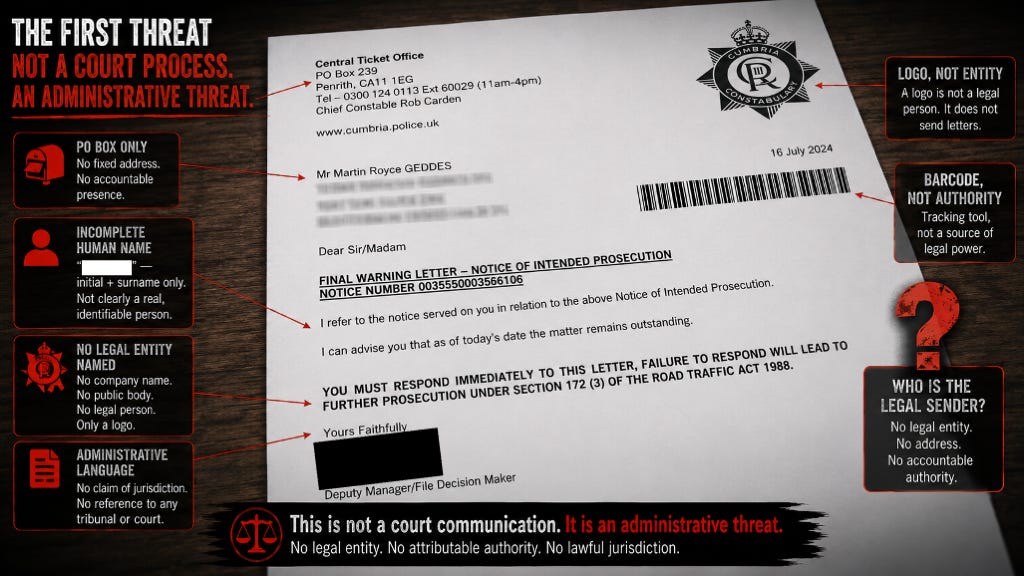
So, has anyone here ever had a Notice of Intended Prosecution? Yes? Okay, lots of criminals in the room. Excellent. Mind you, I’m a criminal too now. A convicted criminal, in fact. Six points on my licence.
Anyway, this NIP turns up in the post, and I’m thinking: hang on a minute, this looks a bit funny as well.
Remember, I’ve already had the badly photocopied piece of paper stuck on my van. Now I’ve got this thing through the post. It doesn’t identify any named sender. It just says “Central Ticket Office”.
The logo doesn’t help. I’d already learnt that lesson from TV Licensing. A logo isn’t a legal person. It’s just a decorative design element, even if it contains words. Otherwise you’d have to verify every aspect of the artwork to determine whether it really was Cumbria Constabulary or merely the Cumbria Constabulary Fan Club.
Now, in the private commercial world, there’s the Economic Crime and Corporate Transparency Act. One of the principles behind it is that you aren’t supposed to hide behind anonymous PO boxes. You’re expected to identify who is actually communicating with you and where they are.
Yet this document contained little more than a PO Box. So in the corporate world, not public law, that’s a sign of fraud.
The signatory wasn’t identified by a full name either. Was this even a real person?
And remember the context. I’d parked beside a bush, which isn’t a crime. I’d had a strange piece of paper put on my vehicle at a gypsy fair. Now I’m receiving correspondence that appears to come from Cumbria Constabulary, but doesn’t clearly identify who is actually sending it.
So I wrote back to the Central Ticket Office and asked a very simple question:
Can you authenticate this document? Is this really Cumbria Constabulary?
They never really answered the question. Instead, the response amounted to: don’t worry, it’s all perfectly lawful.
At which point I found myself thinking: well, if it were a fraud, that’s exactly what they would say, wouldn’t they?

So I wrote to the Chief Constable and said I’m getting this lovely artwork in the post that looks like Cumbria Constabulary, but I’m not sure if it is. Could you authenticate it for me?
No reply.
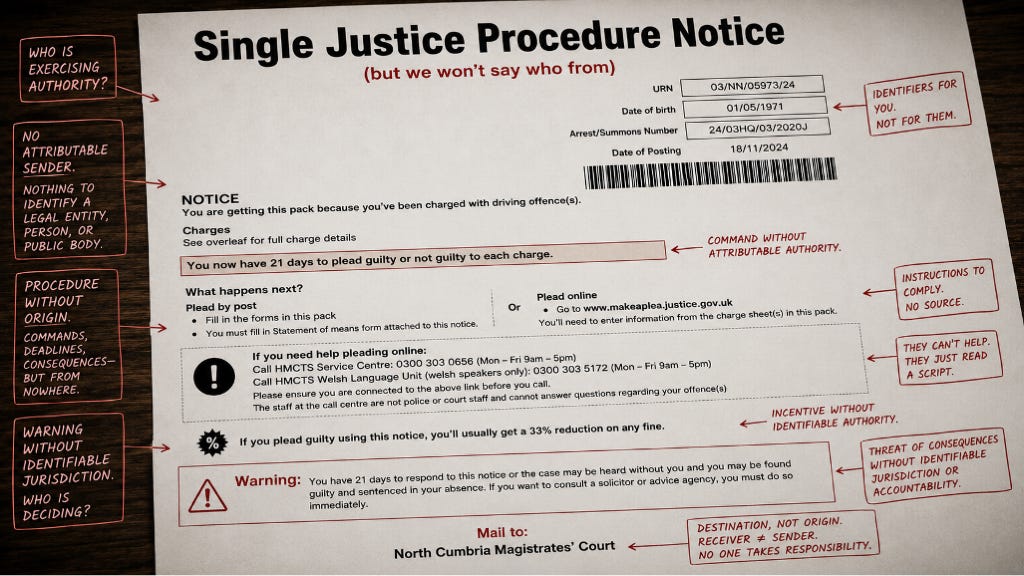
I’d never encountered the Single Justice Procedure before this case. I’d been to court as an observer a few times, but I’d never been involved in any kind of criminal prosecution in my whole life.
So this letter looks official, but it’s a very, very odd piece of paper.
Because I don’t know about you, but when I did my English O Level many, many, many years ago, and they taught us how to write letters, you put your address at the top right-hand corner, then the date, then who you are writing to. It’s basic stuff, okay?
Official letters tell you who sent them. This didn’t.
It didn’t say who the sender was. It just said: please plead guilty or not guilty and send us all your income details.
It didn’t say who was prosecuting me.
And I thought: this is really weird.
It also didn’t say who the GDPR data controller might be. It just said: send all your income details to North Cumbria Magistrates’ Court at this address.
That’s a funny name.
It’s not Carlisle Magistrates’ Court. It’s not Blackburn Magistrates’ Court. What is this?
I try and try to find out. I can’t find it.
So hang on a minute. This is just bizarre.
Who am I dealing with?
Is it that there’s somebody on the take at the police working with somebody in the mail room at the court who knows a gypsy?
I don’t know. I’m just really confused!
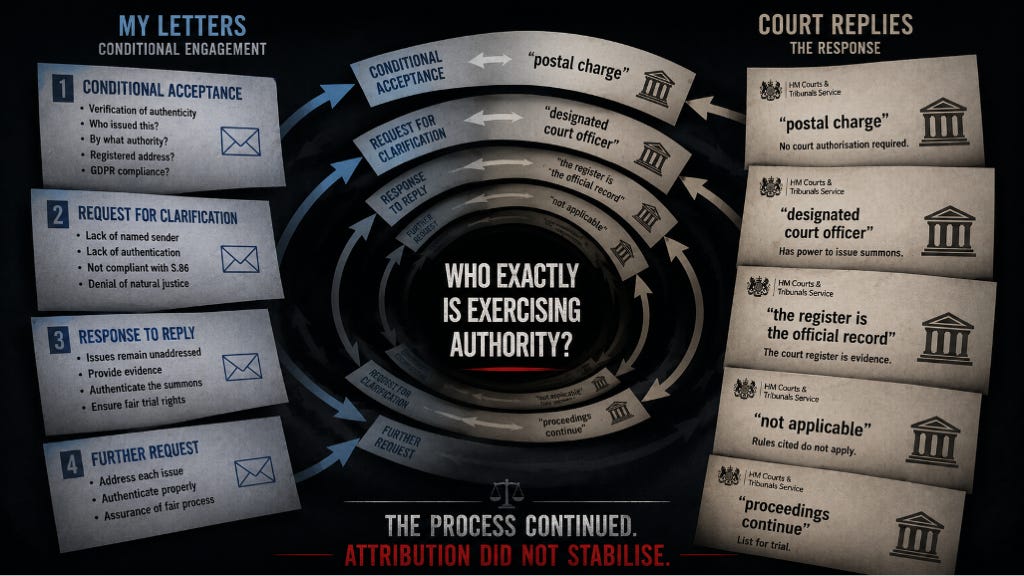
So I sent in a conditional plea to the “court” saying I plead not guilty, because there’s no crime.
(Well, not really “not guilty”. How can I be not guilty of no crime?)
But while we’re corresponding, could you just explain who it is I’m interacting with, and who the GDPR data controller is? Because you keep asking for all my income details before you’ve even taken me down any judicial path, and you’ve named this really weird court that doesn’t seem to exist.
Round and round and round we go. They kind of answer some of the questions, but I don’t really get very far.
They just put me back into the procedure.
Keep going, Martin!
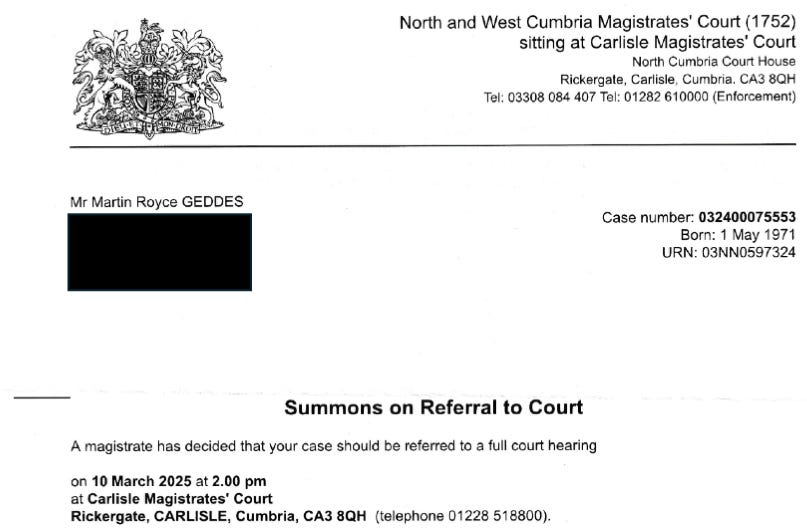
So I get a summons to court. And that comes from North and West Cumbria Magistrates’ Court (1752). Now, my daughter’s first reaction on reading that was, “That’s a long time ago, Daddy.”
And North and West Cumbria Magistrates’ Court is sitting at Carlisle Magistrates’ Court. So hang on a minute. I’ve got one court sitting at another court. I don’t understand this. I’m a computer scientist. This doesn’t pass type checking.
Help! I’m crashing. It’s like there’s a bug in the code. I can’t deal with this. I don’t understand.
And how does all of the above relate to North Cumbria? Because this is North and West Cumbria. I’ve now got three courts. Which court am I supposed to be interacting with here in law?
Because after my TV Licensing experience, is it TV Licensing? Is it Capita? Is it the BBC? I don’t know!
I’m primed for what comes next.
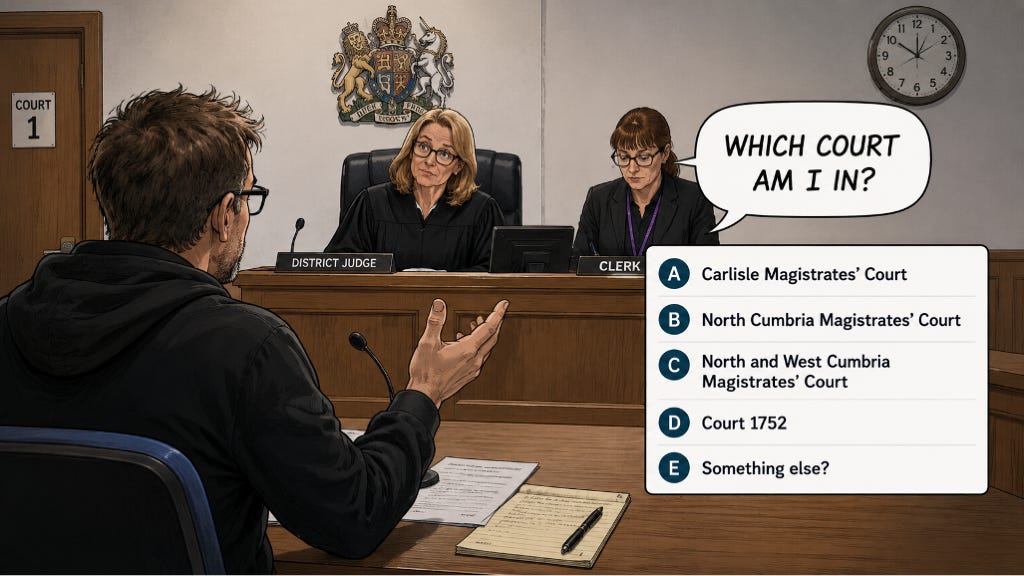
So no evidence turns up. I’m waiting for this court case, which is now only two or three weeks away, and I’ve had no evidence and no meaningful correspondence. Nobody seems willing to admit to being the prosecutor.
So I start complaining. Excuse me, no evidence, nobody’s talking to me. Could someone please talk to me?
Eventually I end up going to what’s called a Mention hearing, which is an interim procedural hearing rather than the trial itself, just to try and get things straight.
And I say, excuse me, but I’ve looked on the HMCTS website and the name of the court that seems to have summoned me — North and West Cumbria Magistrates’ Court — doesn’t appear to exist in your website listing. I’m really confused. Can you help me?
And the clerk gives me a very funny look.
And the judge rolls her eyes.
And they basically say, we’ll deal with that later at trial.
Okay...
But hang on a minute.
Shouldn’t I know which court I’m in?
Remember this moment — we will return to it.
Now, I’ll come back later to what was really going on here.
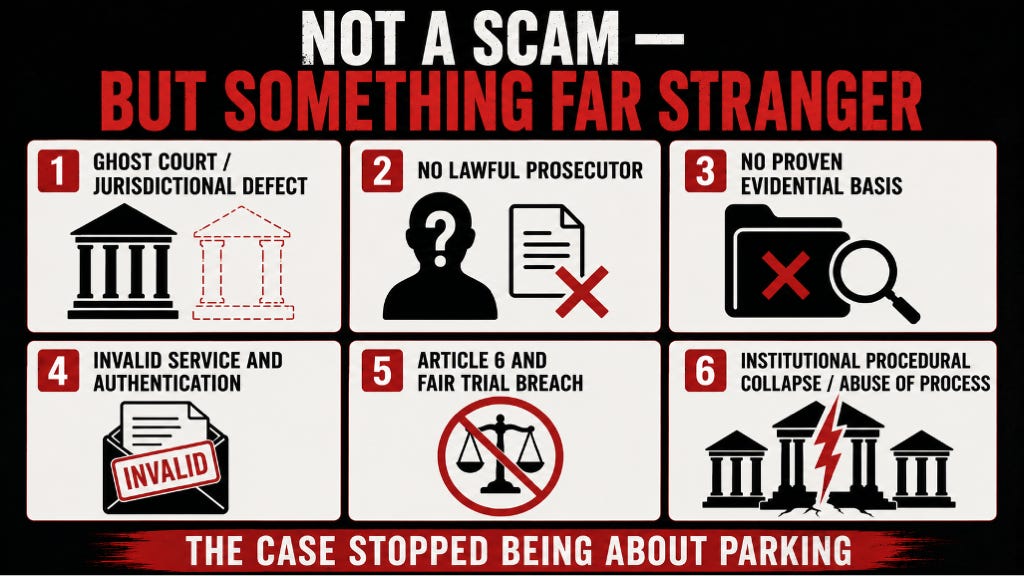
But you can probably feel that there’s some imbalance of dignity here. I’m a reasonably well-educated, experienced person, and I’m genuinely confused about which court I’m in, in law. And if I feel really confused about which court I’m in, is that right in a criminal prosecution?
No. It doesn’t feel right.
So from my perspective — and I’m not saying this is what the law determined, just what it looked like to me at the time — there seemed to be some kind of ghost court or jurisdictional defect. There didn’t appear to be a determinate court here. (I’m a computer scientist, sorry, I use long words.)
I couldn’t establish who the prosecutor really was, because it was the police up until the very last moment, and then suddenly the Crown Prosecution Service turned up. But it didn’t look like they’d done their Full Code Test, so how did they get hold of it?
There didn’t seem to be any real evidence. In fact, the police’s own evidence appeared to show there was no crime. So why am I in court having to plead guilty or not guilty to nothing?
The letters I’d received appeared to have no legal person behind them. So how can you be serving me with notices of prosecution that come from nobody?
The process didn’t seem to address any of the concerns I had.
It just kept going.
Continuity.
And so I came to the conclusion that there’d been some kind of collapse here.
This was really bad.
I don’t like this.
First legal hypothesis
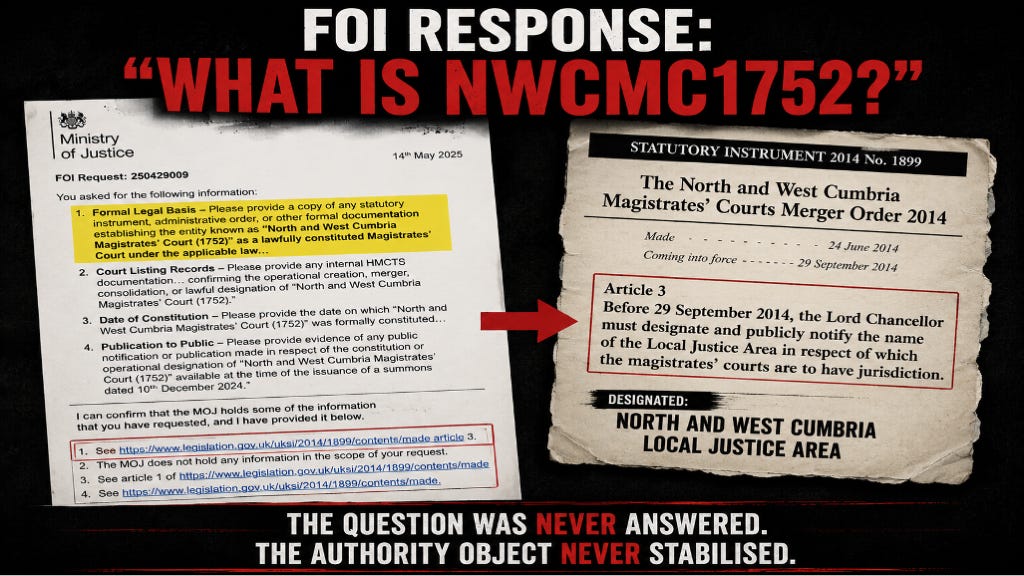
So what did I do? The next thing I did was submit a Freedom of Information request to the Ministry of Justice!
Could you please tell me when North and West Cumbria Magistrates’ Court (1752) was created or established? By what order? How does this thing exist? What is it?
And the answer that came back basically said that there is no establishment date.
Instead, it pointed to a Local Justice Area creation order. But a Local Justice Area isn’t a court. It’s an administrative region.
So hang on a minute… am I being prosecuted by an administrative region? How could that be true?
This is just getting really weird.
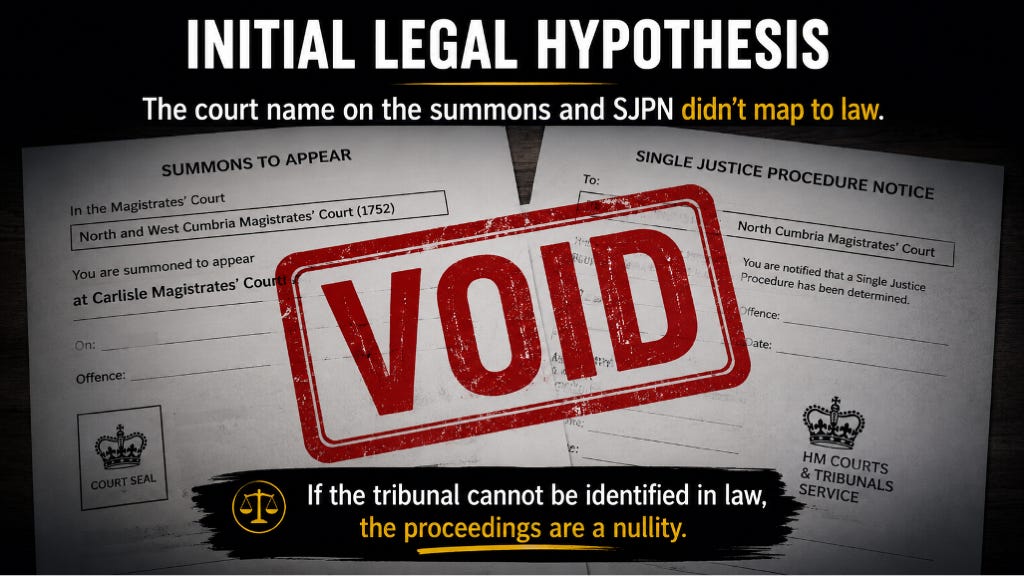
So my ongoing legal hypothesis was that I was dealing with effectively a court that didn’t exist. There might be a real judge, there might be a real process, but the root of the process had been tainted in some way.
And that everything must be void.
JR1 and trial

So I did a judicial review.
Now, I was in America at the time, dealing with an absolute nightmare family-law situation not of my making, which I won’t recap tonight — that’ll be another whole hour-and-a-half lecture.
So, whilst dealing with that, I put together a 263-page judicial review saying this whole thing appears to be based on nothing.
Where’s the court?
Where’s the prosecution?
Where’s the evidence?
Why am I even having to go to trial?
Because this all appears to be absurd and bizarre.
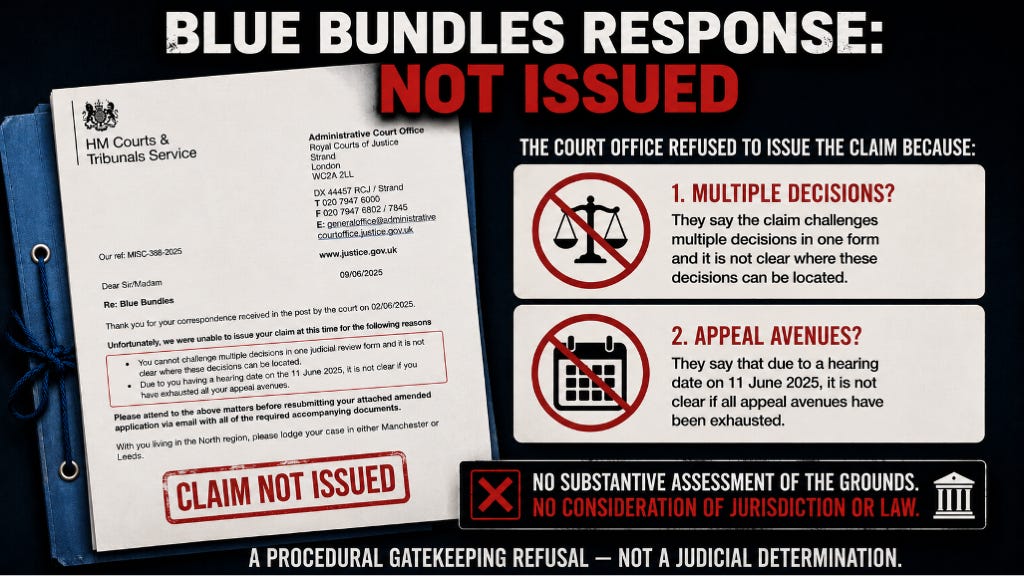
And what happened? The Judicial Review wasn’t even issued.
It was returned unissued on basically two grounds.
The first was that there were multiple decisions being challenged.
Well, if it’s void from the beginning, of course everything they do is a new thing with a new date. Every step becomes another decision.
The second was that I hadn’t exhausted the available appeal routes.
Right, but if there’s no court, no evidence, and no prosecution, how am I having to go to trial at all, let alone appeal anything?
So I got nowhere there.

Then I went to trial in Carlisle.
I took my judicial review with me and made a jurisdictional objection. The hearing was briefly adjourned. The judge went away, came back, and said she was satisfied that there was jurisdiction.
I held my ground. I said, Article 6, no fair trial, sorry.
I declined to participate in the trial itself.
I filed no evidence. Actually, that’s not quite true. I’d submitted evidence long before that, but it was never presented by the CPS.
When the witnesses were called, I stood up simply to say, no disrespect to PC so-and-so, but I decline to participate.
So I attended politely in person, but not in law, as it were.
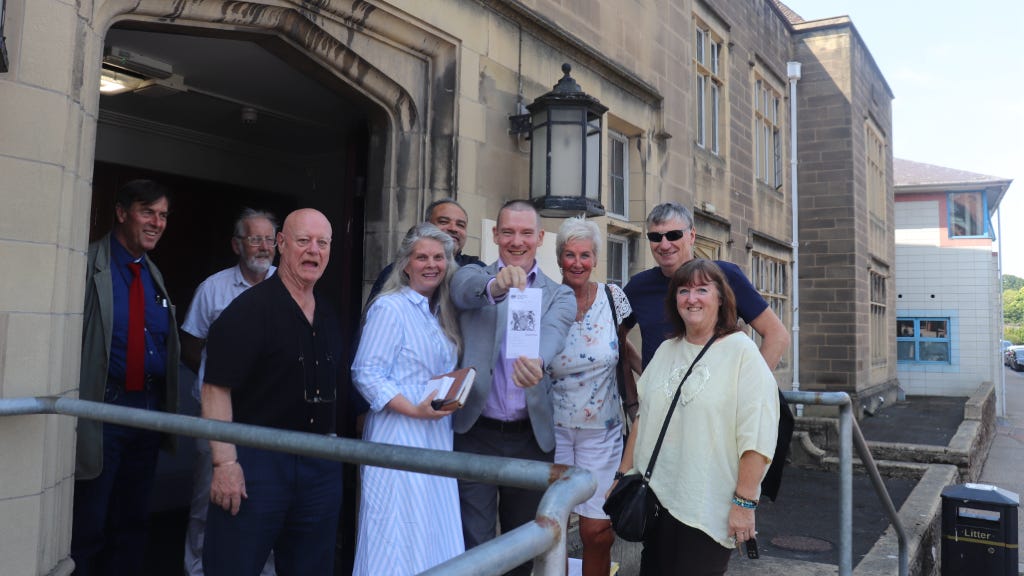
I came out of the court and I’ve got a £1,500 fine, six points on my licence, and a section 172 conviction (not for obstruction, interestingly, but for failing to provide driver information).
But that’s okay.
What matters is that it was written on a little piece of administrative paper.
Just a leaflet written out by the usher: six points, £1,500. Not a court order at this point. Just an administrative leaflet handed to me as I exited the court.
Now remember, my objection was that I wasn’t sure which court I was in.
Which court, in law, had convicted me? Which legal object had coerced me?
Because it isn’t the building that convicted me. It isn’t the judge that convicted me, because judges don’t have power simply by sitting in a room.
A court must have convicted me.
Which one? Help me understand!
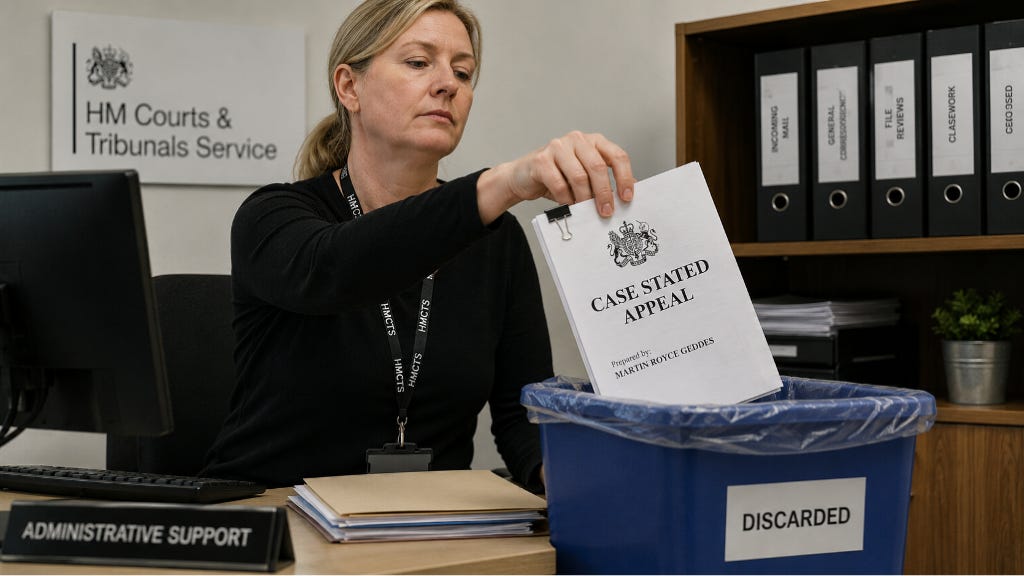
So I filed an appeal.
There are two main appeal routes. The one most people know about is an appeal to the Crown Court, where you’re essentially challenging the evidence or the outcome.
There’s a much less well-known route called Case Stated, which is where you’re challenging the law itself.
So I filed a Case Stated appeal.
It was never acknowledged, let alone processed.
It went nowhere.
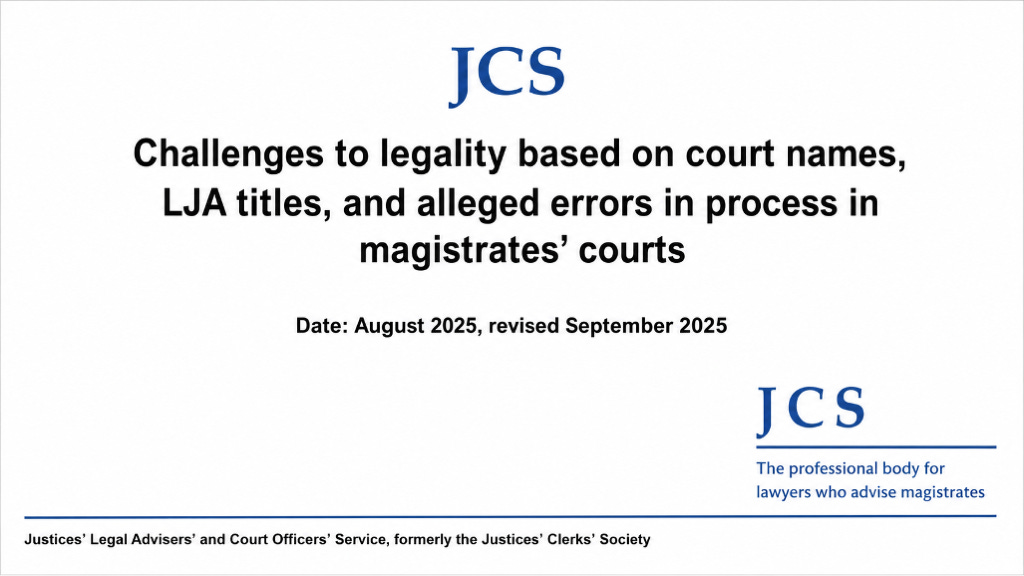
In the meantime, the Justices’ Clerks’ Society published an advisory paper — which you can obtain through Freedom of Information requests — on exactly the kind of challenge I was making.
Now, whether it was a response to me doing it, or to me publishing about it and other people doing it, or whether it was completely unrelated, I don’t know.
But it started to articulate the underlying doctrine that the state was following.
And it was quite interesting.
What it basically says is that they’ve taken away all of the indicia — all of the things in the physical world that would let you understand that something is a court.
So whether it’s the Local Justice Area name, or the name of the venue, or similar identifiers, those things no longer count as indications of courtness.
Instead, they’ve substituted a whole set of internal indicators.
Our records say it’s a court.
But there’s nothing you can really see externally that lets you, as a member of the public, check that this really is a court.
So they effectively assert, unilaterally, that it’s a court. But there’s nothing exposed to the outside world that lets you or me double-check.
Is this real?
Or is it some kind of simulation, pretend court, or synthetic court?
And how can I tell the difference?
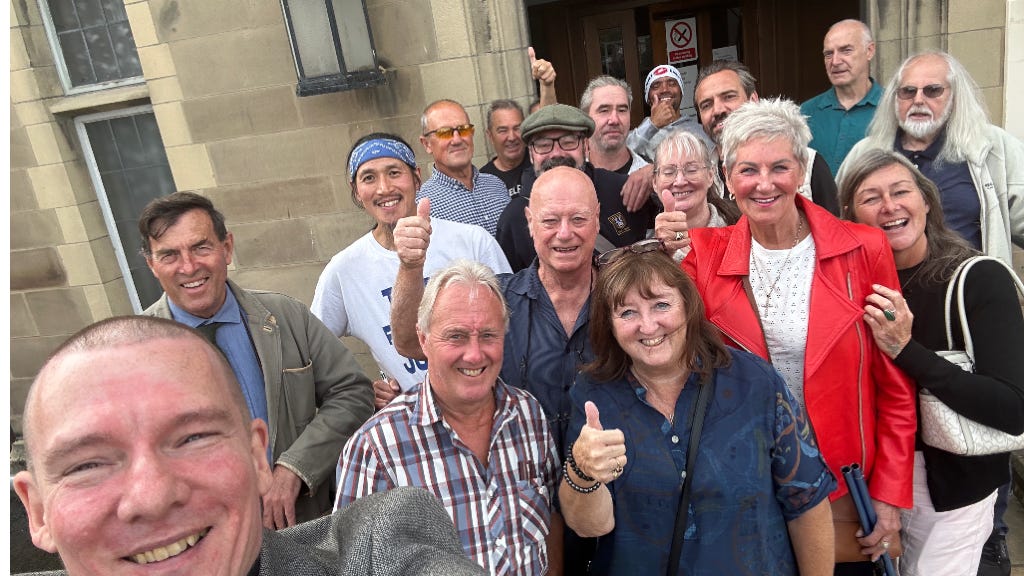
So, we keep going.
Now, luckily I’ve got my True Seekers Northeast T-shirt on by accident today. I live up in the northeast, and there’s quite a healthy community of people up there who go to courts together and help support one another.
So I also made what’s called a section 142 application. It’s not an appeal. It’s an application to the magistrates’ court to reconsider a matter because there’s been some kind of injustice.
And the hearing was granted.
I have to say, I was actually quite impressed by the judge.
Now, he didn’t grant the application, but he did say that this screams High Court.
He said, “I don’t think I’ve got jurisdiction.”
And he said, “I’ve looked in my big law book here, and what you’re asking for, Martin, is too big for section 142.”
Which, to be fair, is a perfectly reasonable thing to say.
He wasn’t trying to fob me off.
So...
High Court, you say.
Now, at that hearing, I said:
“Excuse me, sir, but I’ve never had a court order.
I’ve had no paperwork at all.
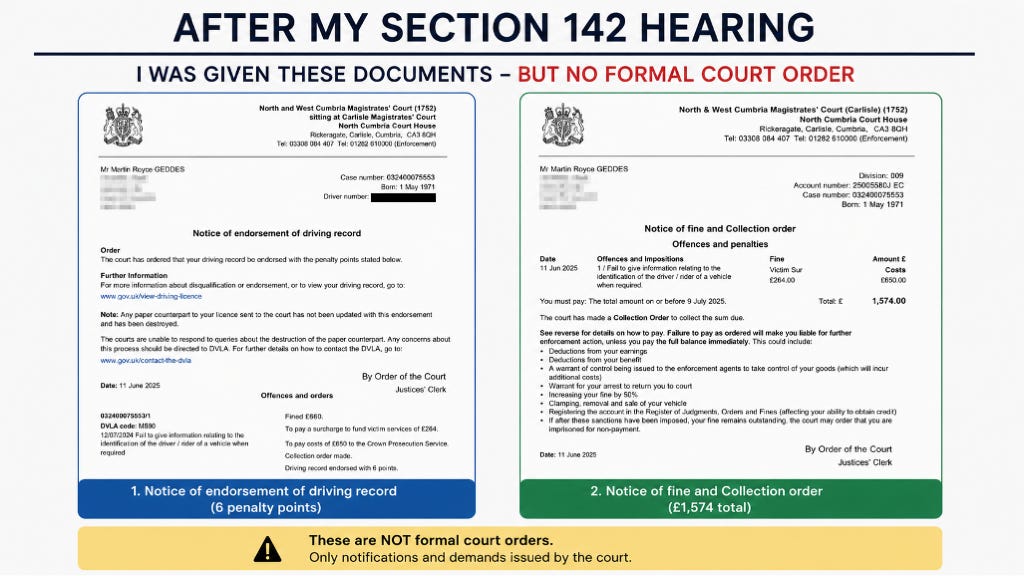
When I left the court three months ago, I was given this leaflet with some scribbles on it. It’s an administrative leaflet that says pay £1,500.
But I’ve never had anything that says which court convicted me.
And the whole point of my challenge is that I don’t know which court convicted me.”
So as I left the venue, I was given two documents which looked very official, but neither of them was actually a court order.
They’re both administrative documents giving the administrative outcome, but not the judicial outcome.
They’re different things.
And I’m asking for the judicial outcome because: which court claims to have convicted me?

So I file various complaints, which also get ignored.
Nothing happens at all.
And at this point I’m starting to think there appears to be a policy of: don’t interact with Martin.
I can’t imagine why.
Because I’m really… helpful.
Second legal hypothesis
So I do another Freedom of Information request and ask about North Cumbria Magistrates’ Court — the one that appeared on the Single Justice Procedure Notice.
What’s that one?
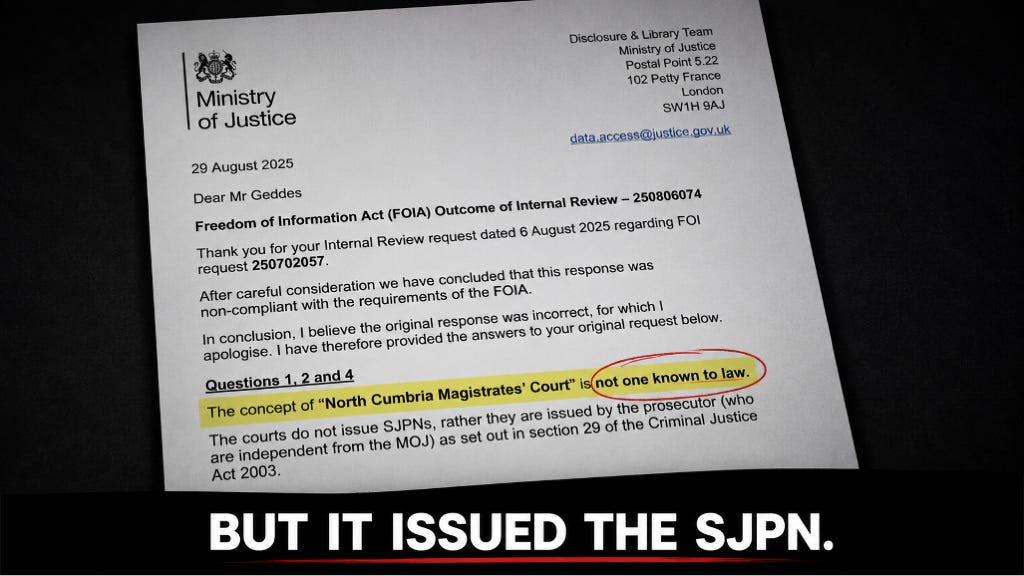
And they reply: sorry, not known to law.
Whoa, hang on a minute! So I was sent this coercive document asking me to plead guilty or not guilty, provide all my income details, and send it to something that isn’t known to law.
On a letter that didn’t even say who it came from.
Am I the one with the problem here?
Because this doesn’t feel right at all.
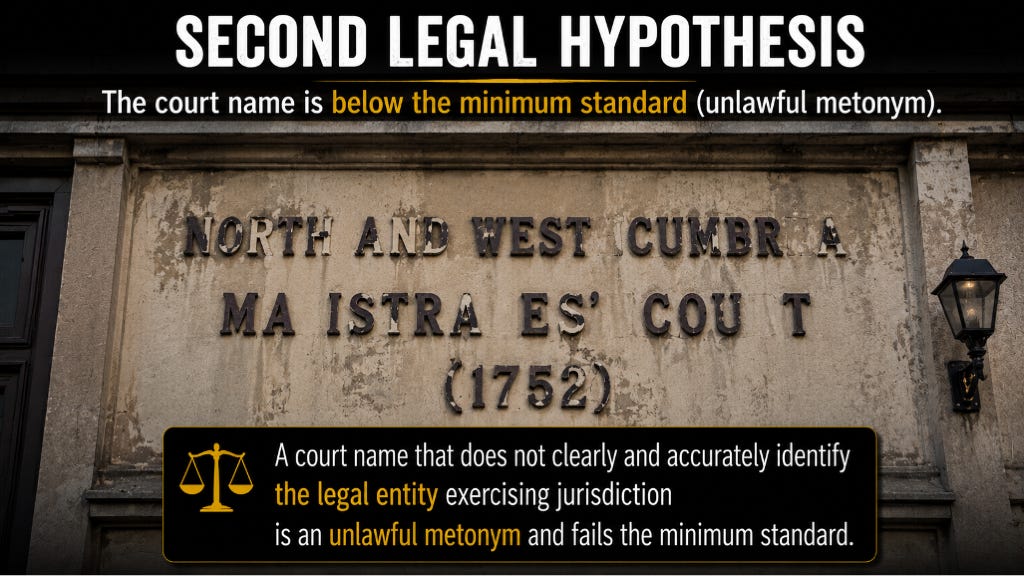
So I start to form a second legal hypothesis.
Not that the court doesn’t exist.
But that there’s a problem with how these things are named.
And that a court name which doesn’t accurately map onto something in law must itself have a problem.
Now there’s a new word I learnt during this process. Because I’m a mathematician, I’ve got lots of new words to learn, I’m afraid.
And it’s the word metonym.
I’d never heard it before. It’s a really useful word.
Things like Parliament are metonyms. It’s a word that stands in for 650 MPs, the Constitution, all their procedures, and everything they do.
The Crown is another metonym.
Whitehall.
Metonyms are an absolutely necessary part of living language. We don’t have to describe every detail, every time, in order to convey meaning.
So what I found myself doing was distinguishing between lawful and unlawful metonyms, and potentially launching a legal case to find out where the boundary ought to be.
Which names are on which side of that boundary?
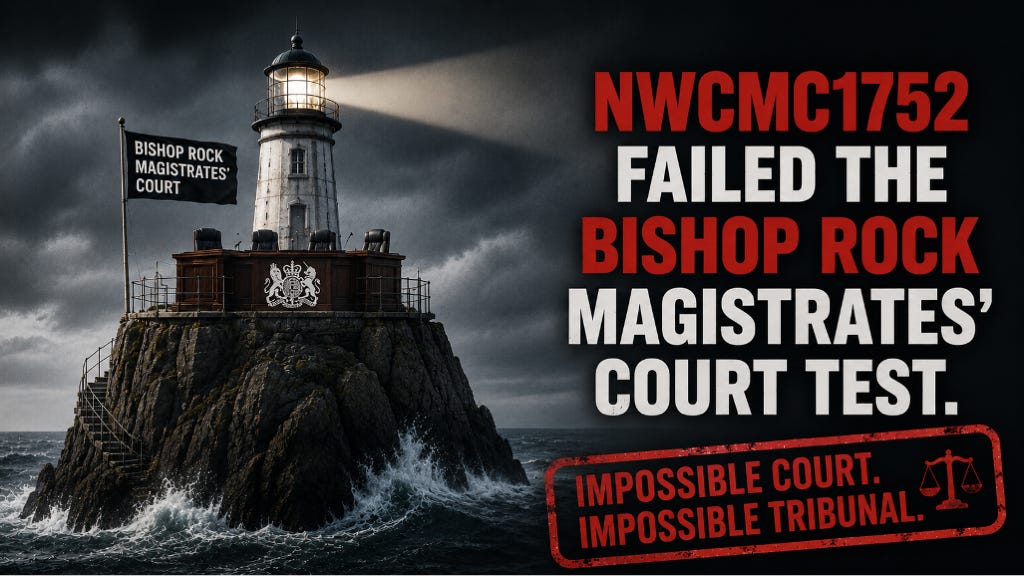
As part of that endeavour, I came up with the Bishop’s Rock test.
For something to be called a magistrates’ court, does it fit within the overall grammar of anything that could possibly be a magistrates’ court?
The Magistrates’ Court of Nullity and Voidness? Probably not! I think we can all agree that’s not a magistrates’ court.
Blackburn Magistrates’ Court? Definitely. Blackburn is a real place. It has a civic centre. You can go there. You can find the building. You can walk up to the front door. You can walk inside.
That’s fine.
Now take Bishop’s Rock. It’s a little islet off the Isles of Scilly, with a lighthouse on top. It’s part of UK territory and falls within some local justice area.
Could there be a Bishop’s Rock Magistrates’ Court?
My argument was no. A magistrates’ court name has to map onto something that has some kind of civic existence or civic centre. And Bishop’s Rock, even in the wildest imagination, could never be regarded as a civic centre.
The only way on or off is by helicopter, or by scrambling over rocks in the middle of summer. It’s not a place that could ever host a court. Therefore there could never be a Bishop’s Rock Magistrates’ Court.
And if you received a summons from Bishop’s Rock Magistrates’ Court, you ought to have a problem with it.
And if you received a summons from a name that seemed even less plausible than Bishop’s Rock Magistrates’ Court — such as North and West Cumbria Magistrates’ Court (1752) — then that fails the test too.
Part 8, Enforcement, JR2
So that was my legal hypothesis.
As a result, I started corresponding with the Government Legal Department through the pre-action protocol process.
Back and forth we went. And, to their credit, they fully engaged. Rather than ignoring me, they were very professional and responded each time.
As that process unfolded, my understanding of their doctrines — and of what was really going on — started to develop.
So all through this story, at each stage, I go in knowing that something’s wrong.
I know in my gut that this isn’t right, but I’m trying to locate, in this weird world of law, what exactly is wrong.
And I can’t figure it out.
In the meantime, I’ve got letters turning up saying, “You have to pay this fine, Martin.”
Okay, but I’ve had no opportunity for an appeal. I still don’t know which court I’ve had. No court order has appeared yet. I still don’t know which court convicted me.
So surely I should have an opportunity to find out which court it is, in law, before I pay?
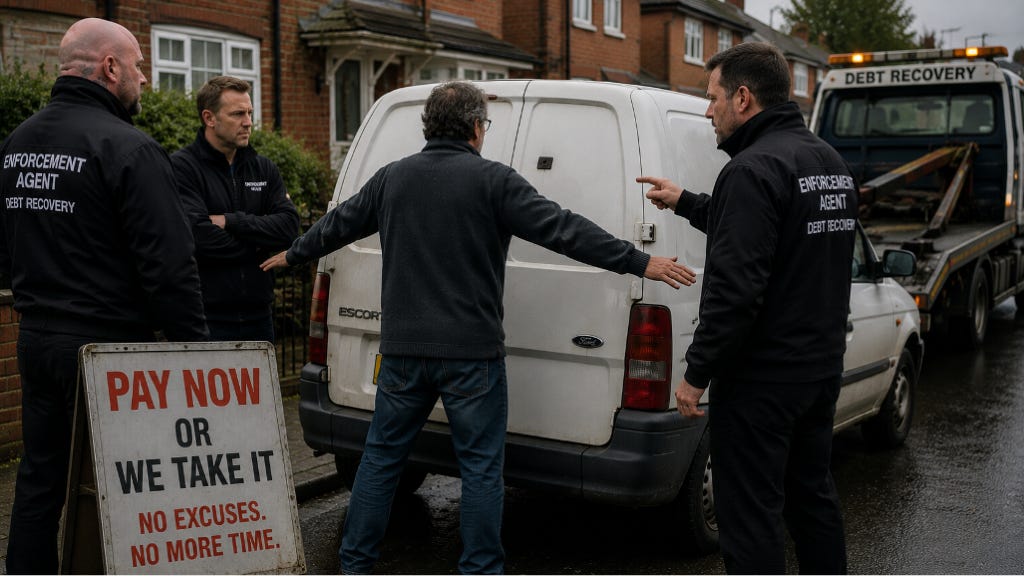
And meanwhile people at Marston’s [debt collectors] are writing to me, and I’m getting pressured.
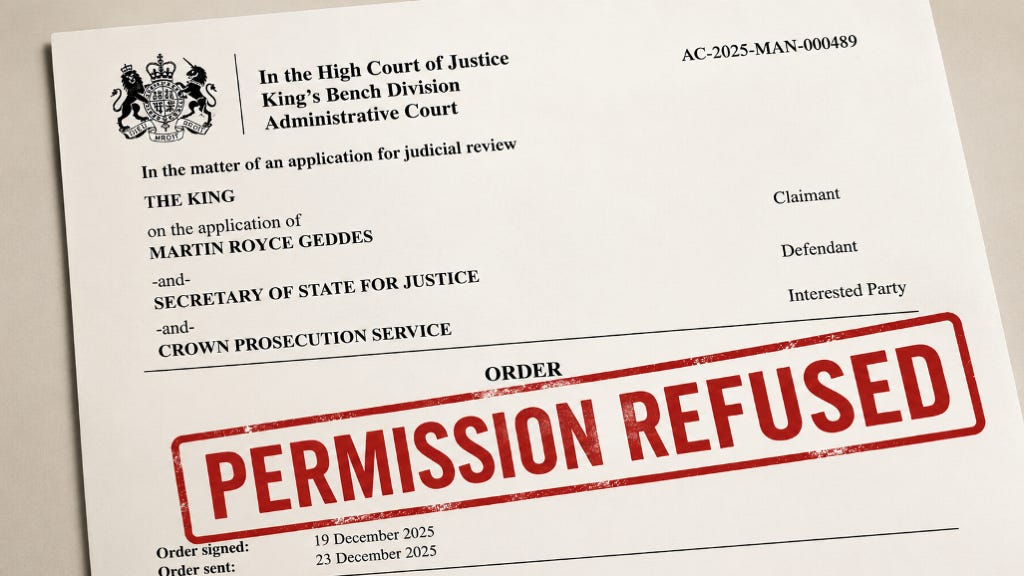
So I do another judicial review.
And all I was asking for was a stay until the lawfulness of the convicting court — or its existence, or even its identity — could be established.
Now, going through the details of that judicial review would be another hour-long lecture in itself.
What matters for tonight is that permission was refused.
I didn’t take it through the whole renewal process.
But I learnt a lot in the meantime.
So I paid off the fine.
My long-lost auntie, whom I’d only seen a few times in my life, kicked the bucket a few years ago, and I suddenly received a small windfall which allowed me to pay the fine immediately.
There were obviously higher powers at work.
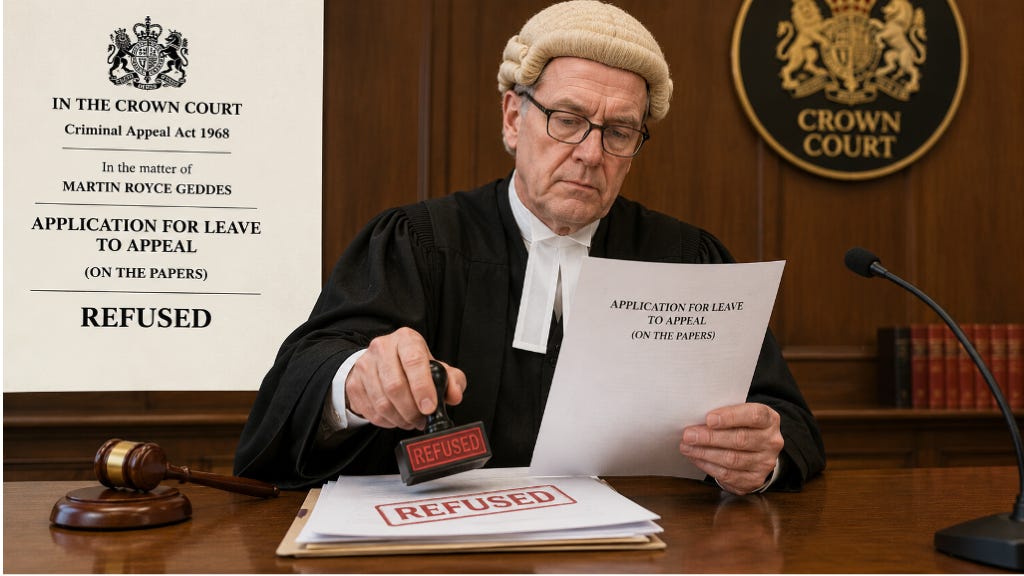
Then I asked for a Crown Court appeal. I thought, if you’re not going to give me a Case Stated appeal, maybe I can do the other one.
Nope. Sorry, out of time. Refused. So basically I had no opportunity to appeal.
Shift from litigation to diagnosis
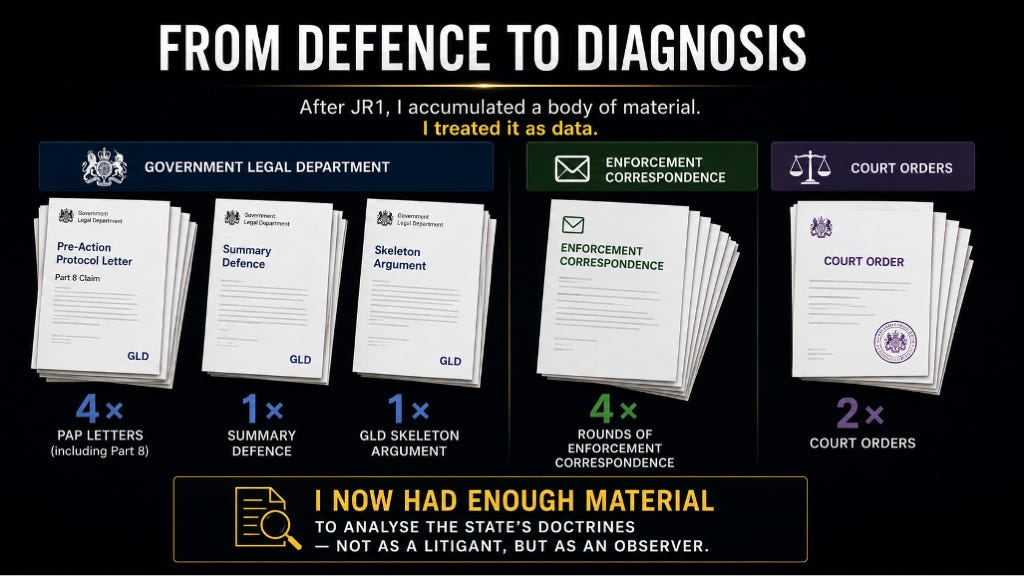
But by this point I’d gathered a large amount of documentation about the state’s — or the government’s — own position on the matter. And every time we interacted, I was running it through AI and learning a lot.
My own position was shifting. Over time I was narrowing the question I was actually having to deal with. So I was changing.
That meant I wasn’t in the same outraged position I had been in when I was standing in court months earlier.
I was in a curious position.
What’s really happening here?
And I started to apply all of my toolbox from telecoms network performance algebra — I love this stuff — to the problem.
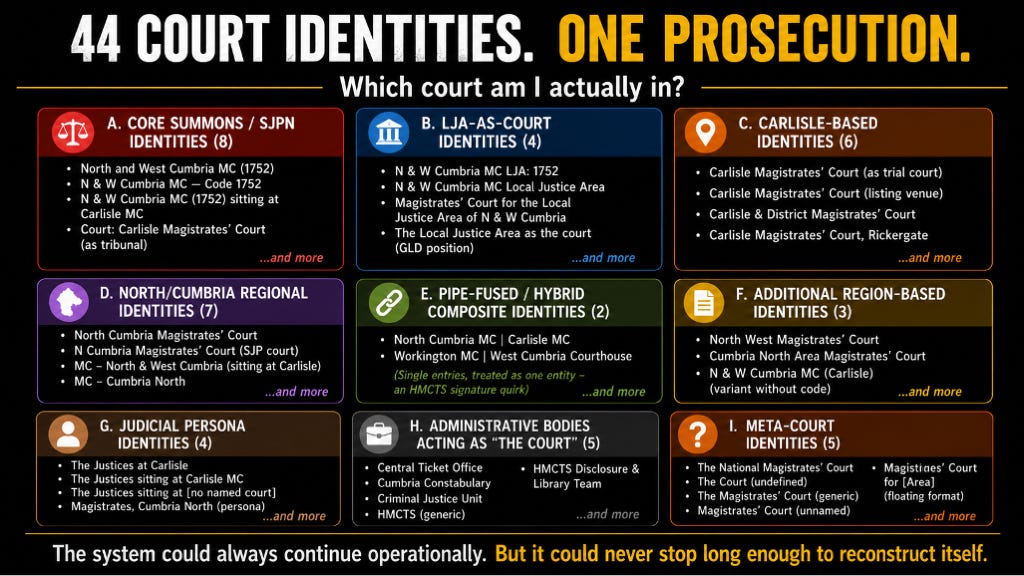
So as part of that analysis, I went back through every piece of correspondence I’d received, every record printout, and extracted all of the court names, identities, and authority assertions from those documents.
I assembled them all together, and I was quite surprised to discover there were 44 of them.
Now, that doesn’t mean they’re all literally claims in law to be the court. The details inside each box are almost irrelevant.
What matters is that there are nine boxes.
So hang on a minute. If one court convicted me, but there are nine boxes containing different, incompatible candidates for what that court might be, then I’ve got a problem.
Because I can’t figure out where the court is in all of this.
And I can’t map the records I’ve been given — which are being presented as definitive proof that I’ve been convicted — to any object in law.
That’s a problem.

So I started to look backwards and tried to understand the problem from its very beginning.
Now, this is an AI-generated picture, because I wasn’t going to steal somebody else’s photograph. But you’ve probably heard of these little lock-ups that used to exist in English villages. There are still about a dozen left.
If you were drunk and disorderly, you’d get put in the lock-up overnight behind a strong door until you sobered up and learned to behave yourself.
This is how local justice was originally conceived.
Everything was done by a real human being.
Who put John in the lock-up tonight?
Oh, Sheriff James.
So somebody’s accountable.
It wasn’t some arbitrary machine or computer system.
At the end of the day, real human beings performed the acts.
There were only acts.
Somebody opened the door.
Somebody shoved the prisoner inside.
Somebody locked the door.
The whole thing was made up of real acts performed by real people.
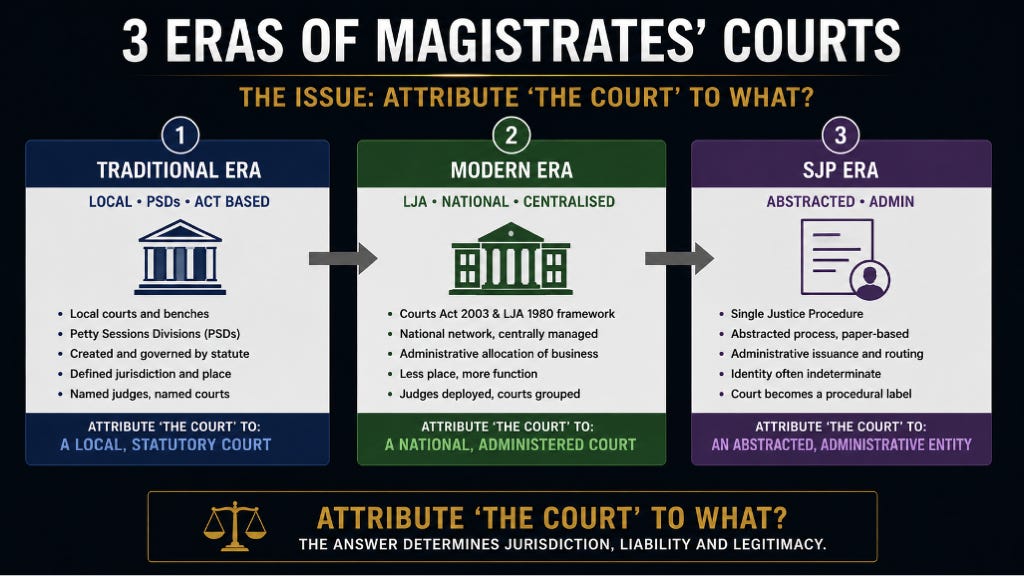
I started looking at all the different statutes and how they’d evolved over time.
What I found was that there seemed to be three different eras of magistrates’ courts.
There was the traditional conception of magistrates’ courts, where everything was fundamentally based on acts.
Then, around 2003, the system was reorganised around a national structure. But it didn’t quite explicitly create a national Magistrates’ Court in the same way that happened with the Crown Court and the County Court, where local courts were consolidated into a single national court.
So there seemed to be a gap, or at least an ambiguity, in the legislation itself.
What is the court here? There’s legislation from 1980 and earlier. There’s legislation from 2003.
And then, in the last few years, the whole system has become heavily automated.
To stop the courts being clogged up with minor prosecutions like mine, the Single Justice Procedure allows you to plead guilty or not guilty. It then disappears behind the scenes, some magistrate or judge rubber-stamps it, and out it comes the other end.
Very efficient. Very slick. But after 2015 or 2016, we’ve got yet another conception of the court.
So now I’ve got at least three different legislative eras, each carrying a slightly different idea of what a court might be.
And they don’t quite line up.
Third legal hypothesis
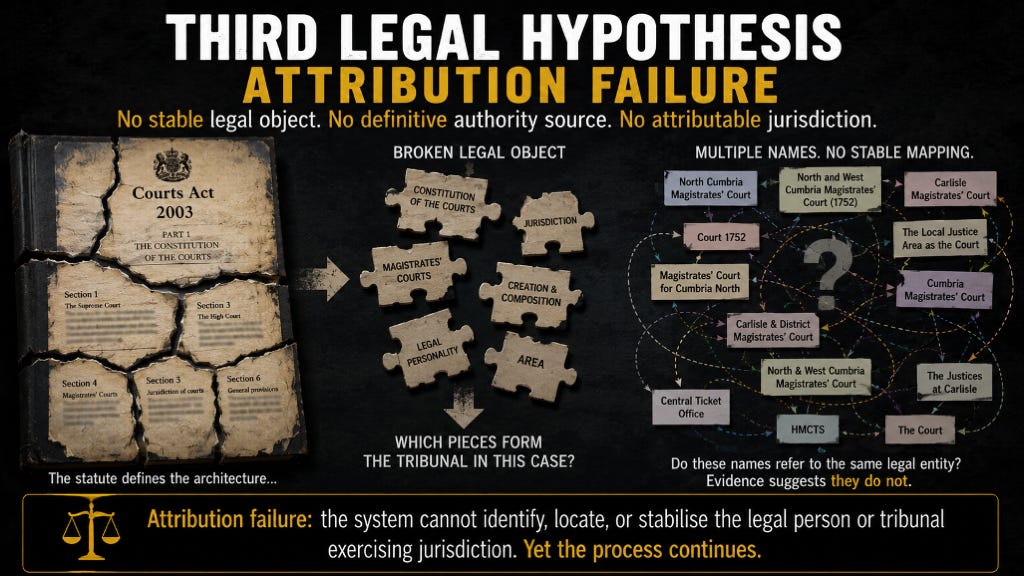
So I come up with a third legal hypothesis.
It’s not about whether the court exists or doesn’t exist.
It’s not about whether the name is a good name or a bad name.
It’s something more subtle.
Something much deeper.
Something that makes perfect sense to me as a computer scientist, but which we don’t encounter very often in everyday life.
And that is attribution.
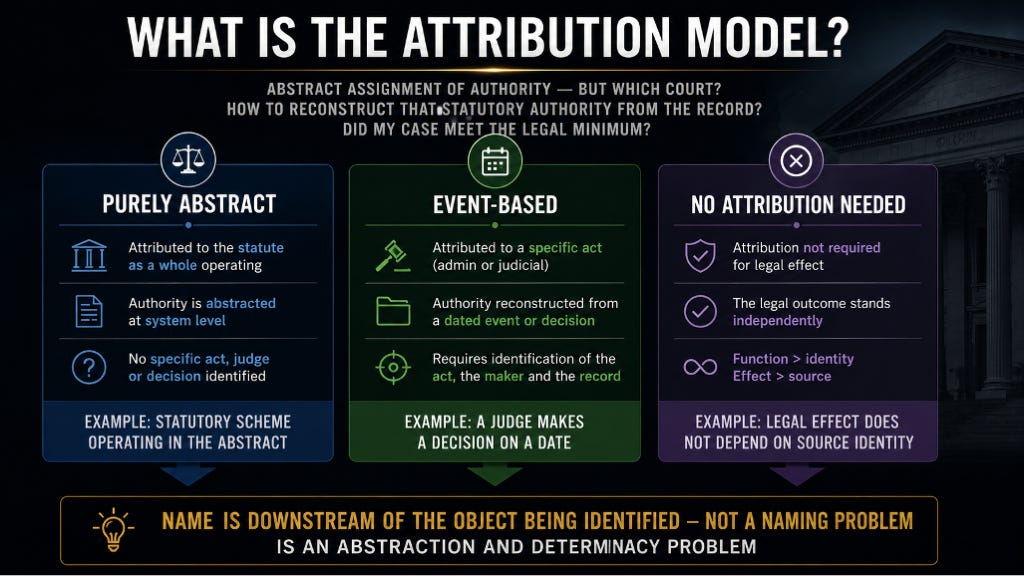
So between these various court Acts over the years, there’s a slightly fractured, fragmented sense of what the court might be.
And as you saw, I’ve got forty-four names or candidates pointing towards something. Which ones point to the court? Which ones don’t?
And it’s really about the relationship between those two things [i.e. general law and individual case].
So it’s not about whether the court exists.
It’s not about whether the court itself has a good name or a bad name as an object.
It’s about the relationship between all of those names and something in law (which is itself a little bit ill-defined).
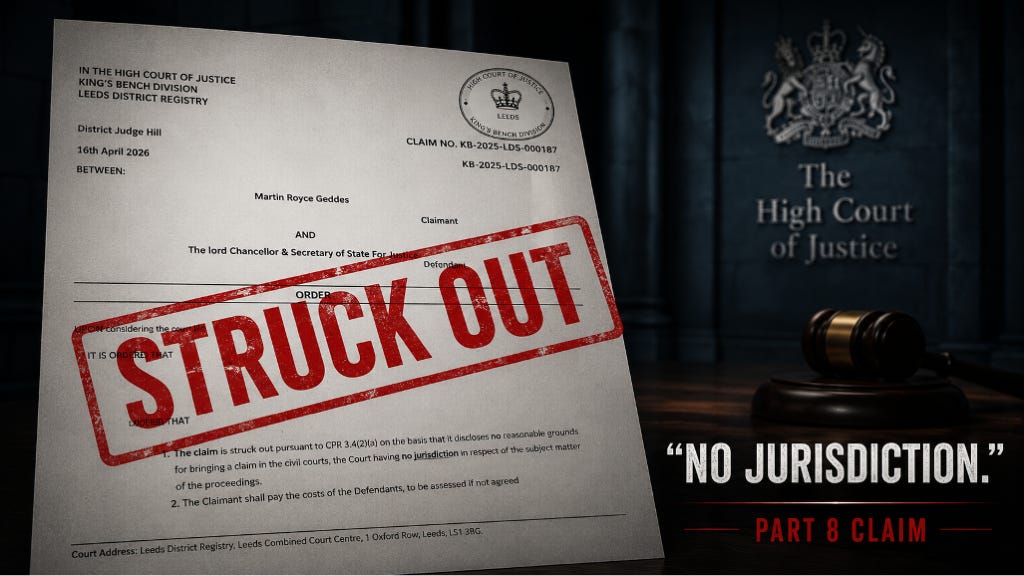
I’d done two judicial reviews at this point, and a stack of other proceedings.
So I thought: let’s go to the High Court again. Let’s do a Part 8 claim! It’s a slightly obscure procedure, but it allows you to ask questions of pure law.
A judicial review says somebody made a decision that affects me, and that decision wasn’t lawful. But that’s not what I’m asking here.
I’m asking something different:
Could you help me understand not whether the law was applied correctly to my case, but what the law actually is? What exactly is a magistrates’ court these days, given all these different Acts and different eras of legislation?
And there seemed to be basically three possibilities.
One is that attribution is purely abstract. The whole machine runs, some output comes out the other end, and from that output we infer that somewhere inside the machine there must have been a court.
It may or may not be identifiable in the way the old village lock-up was identifiable as a thing in the world, but we simply deem there to have been a court.
The second possibility is that somewhere in the middle of all this there has to be some event that causes a court to take hold of the case.
It could be an administrative event. It could be a judicial event. But there is something act-based, more like the older conception of justice.
And then there’s a third possibility, which is rather radical. No attribution is needed at all. Whoa! You’ve been convicted, but there is no longer any need to map the record back to a court object.
It’s possible.
So what I was asking the High Court was:
which target are we aiming for?
Because I can’t even challenge my own court case without first understanding what the law is.
Normally, in a judicial review, the law is clear and the question is whether it has been applied properly. In my case, both the law and its application appeared unclear. Help!
Anyhow, I did that. Again, the Government Legal Department engaged thoroughly and did a good job.
But the claim was struck out.
Apparently you can only ask questions of pure law in a civil court if they concern civil matters. So after months of work, and another few thousand pounds in costs, it got kicked out.
And that’s okay! That’s alright. Because what I was really doing was stress-testing the system.
Can an ordinary person, who happens to know a bit about the algebra of telecom network performance and has access to two AI engines, crack the code?
And the answer is basically — NO.
What I found was that every time you challenge the system at one level, the goalposts move. You challenge something and think, right, that doesn’t count.
And then the goalposts move again.
I found about fifteen different levels of abstraction it could retreat through.
Every time you think you’ve pinned it down, it moves to another layer.
And it can keep doing that for longer than you can stay solvent. I’m about ten grand down at this point. Luckily, my readers have paid for most of it, but it’s still painful.
But it’s great! It’s actually been very successful.
Systems diagnosis
What did we just hear? What was that whole story about?
Was it corruption? Yes or no?
And I came to a really strange conclusion.
That most of it was actually something else.
The “aha moment” was remembering our YouTube video. When the network gets stressed, it stops. The application halts.
But when these systems get stressed, they continue.
And that’s a necessary byproduct of how the universe is constructed. If you don’t like it, find another universe.
It doesn’t mean the outcome is okay. The outcome can be abusive in effect, but without intent, malice, or negligence by the people inside the system.
And that’s a really hard message to hear.
Because we assume that if something wrong is happening to us, someone must be responsible. But it’s just the same as the YouTube video. There isn’t some little homunculus inside the network trying to do good things or bad things.
It’s an emergent outcome of a system under load.
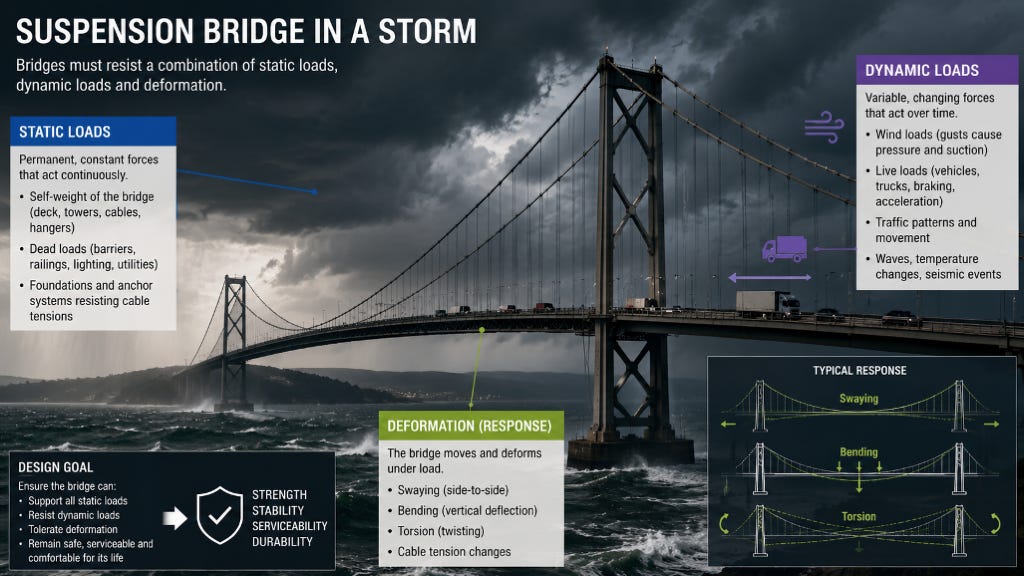
I started to decompose this thing more formally using my toolchain. So what I’m going to give you now is the compressed version of my findings.
Think of all these court systems as structures.
A bridge is a structure in a storm. A bridge has a static load: the weight of the bridge itself. It has a dynamic load: cars going over it, wind blowing back and forth. And it deforms under that load. Up to a certain point, those deformations are acceptable. Beyond a certain point, they’re not.
There’s a safety case for it, and someone’s responsible.
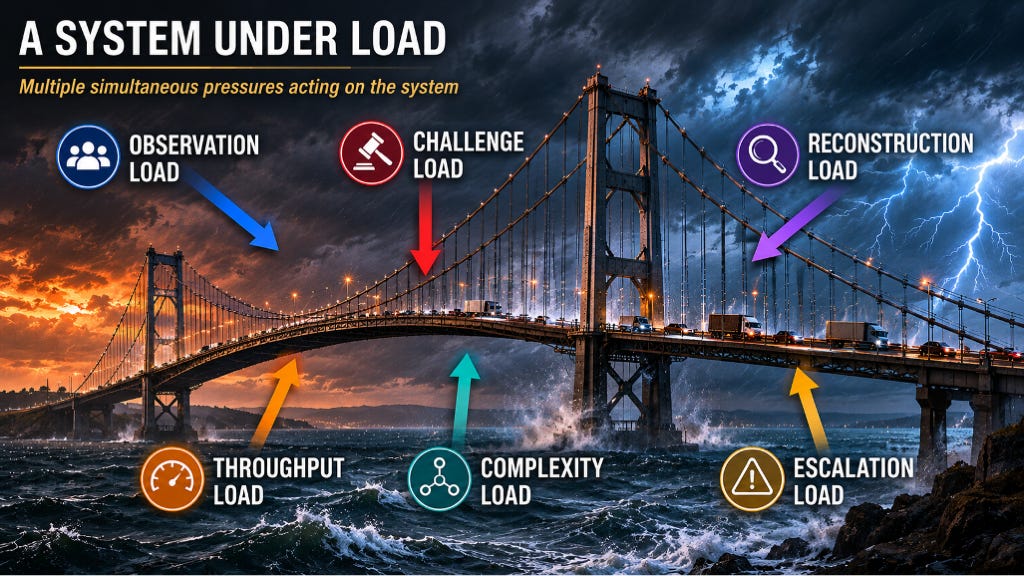
What we had here was also a system under load. Not a physical system, but a symbolic system.
You had me, my essays, my observers, being an absolute nuisance.
You had all my legal challenges and complaints.
I was asking the system to reconstruct the court from the record. You’ve given me these forty-four names and all these papers. Where’s the court?
Well, that’s a job to be done. And there’s only a finite bandwidth inside these organisations for reconstruction and repair.
They’re finite. They can’t do everything that’s asked of them.
There’s a throughput load. I’m not the only case. I’m not the only nuisance. I’m sure there are some other good nuisances in this room. Well done!
There’s also complexity. They’re being asked to enforce ever more rules with ever more interactions. We’re not in 1860 anymore. We’ve got all these computer systems and all these codes.
And there’s an escalation load, which is that I can go to my MP, or parliamentary committees, or the Chief Magistrate — which they don’t like.
So the system’s under stress.
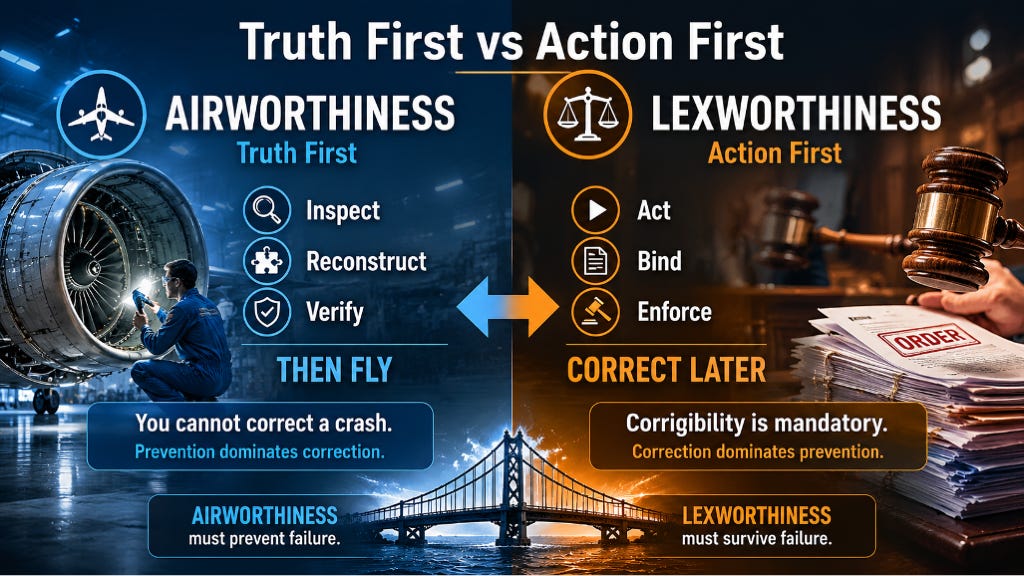
How does this system behave under stress?
Well, there’s a category issue we need to put it into.
Most engineered systems are what we might call truth-first systems.
When a plane crashes, there’s never a debate about whether it crashed. There’s a pile of wreckage on the ground and dead people. The event is self-authenticating.
Whereas when the law — or lex, if you want the Latin — crashes, when there’s a lex crash rather than an air crash, is it even detectable?
Was what we just saw bad law? Was it not law at all? Can we tell the difference?
Most engineered systems under stress, like my old telecom networks, are truth-first systems (at least on balance). You cut the fibre-optic cable, and everyone knows.
This one is action-first. The way courts work is that they truncate everything.
You’ve had your time. Sorry! Here’s my decision. Move on…
And that’s okay. That’s intrinsic to how they operate. It’s not a failure. It’s not a fault. It’s not malice. It’s not a moral outrage. It’s necessary.
They operate in a finite world. So they have to act, bind, enforce, and then correct.
Now, in my case, the correction mechanisms were failing. It wasn’t the fact that they kept moving on. It was that they wouldn’t let me correct it.
That’s where the real issue is.
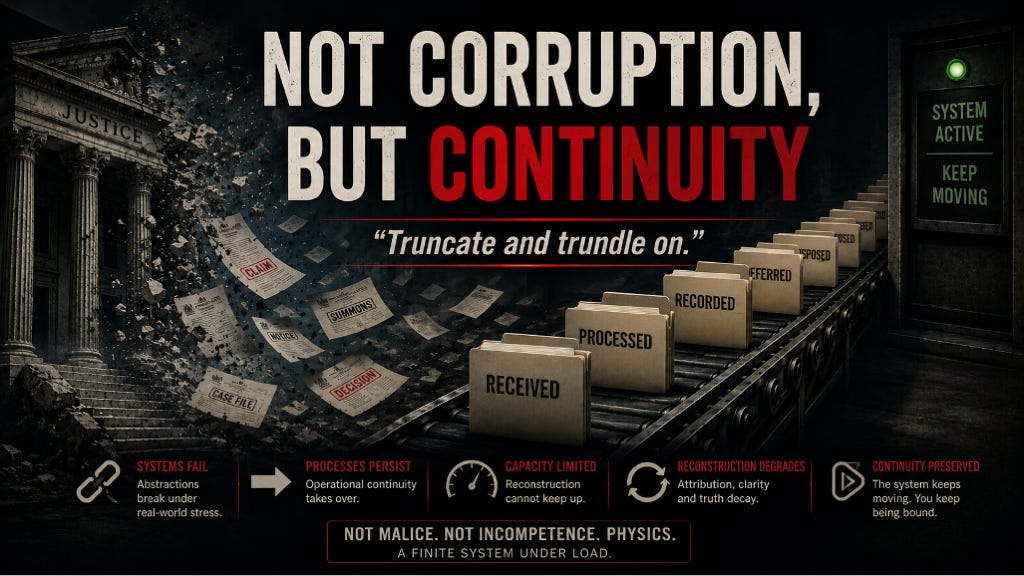
So the takeaway is that I wasn’t dealing with corruption. Or at least not corruption in the sense that most people in this room would regard it.
Things might be corrupted in the same way that if you leave a floppy disk next to a magnet, it gets corrupted. But that’s not a moral accusation.
It’s simply an act of putting it in the wrong place at the wrong time.
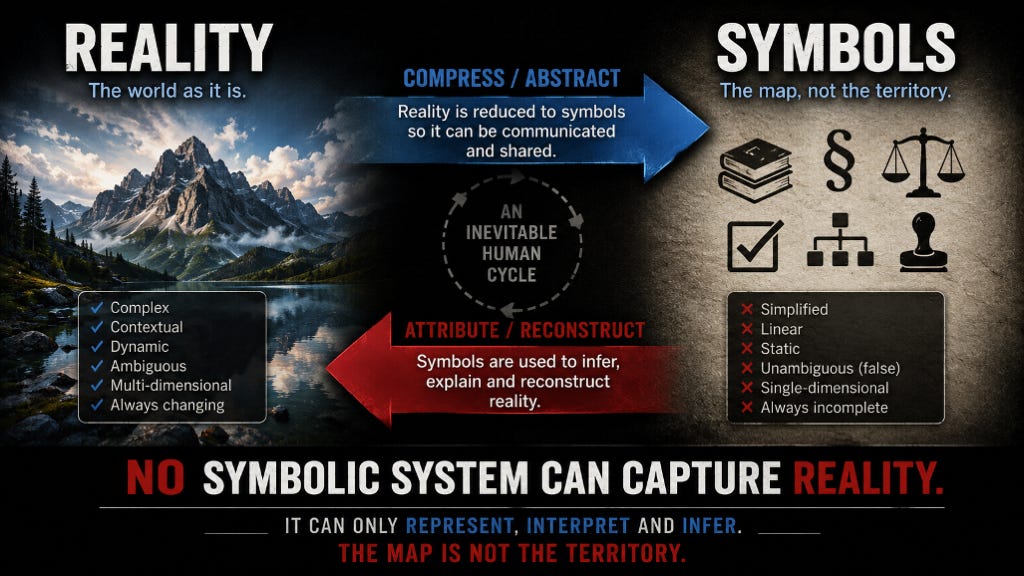
So what started to come out of my analysis is what you might think of as a physics — not of the physical or material world, like aerodynamics — but a kind of symbol dynamics.
How do all these symbols flow through the system, and how does it behave under stress?
Hang on a minute, that’s just like my old telecoms stuff! I’ve got a toolkit for that!
So what happens is that reality is being compressed by the system into all these symbols?
Reality is bigger than the world of the court, or any administrative system. So every time you try to represent reality in the symbolic world, you have to lose something. Now sometimes it’s more like a ZIP file, and sometimes it’s like an MP3, and sometimes it’s just messed-up.
But that’s how it goes. That’s how the system works.
But the other half — and this is the catch — is that you still want the system to remain attached to reality.
So there’s a process of attribution and reconstruction that also has to happen. When you say, “I want to appeal”, that triggers a reconstruction process: let’s look at all the documents again and see if we can go from the documents back to reality and find out what really happened.
And that is a finite process.
The outward abstraction from reality to symbols is cheap.
The return reconstruction of reality from symbols is expensive.
And that’s why the system tends to over-compress and under-attribute and under-reconstruct.
This is where my whole “ghost court” thing was caught: inside this loop.
But that’s economics. That’s not morality. It’s a finite system.
Any more than a YouTube video buffering is a morality problem.
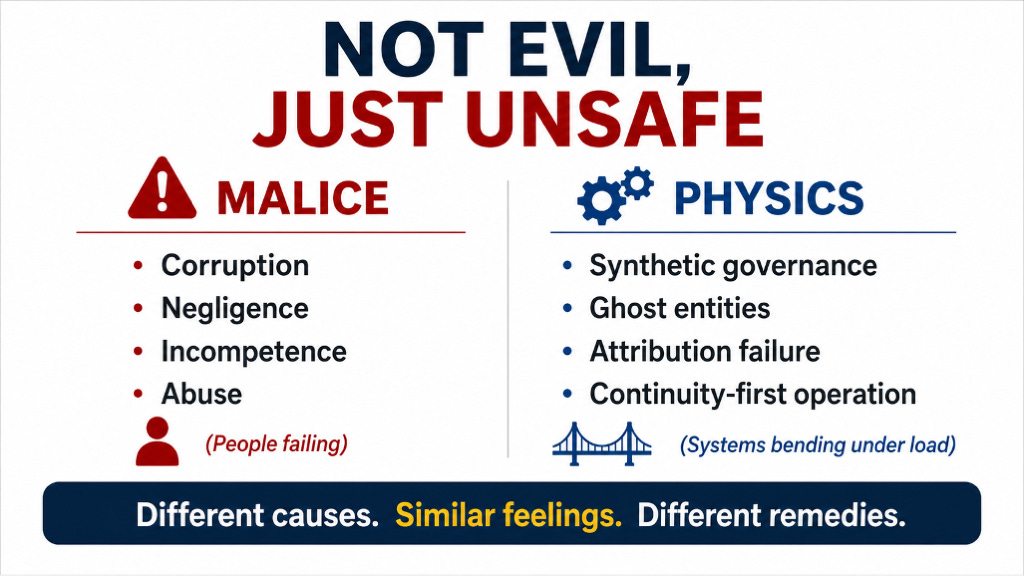
So it doesn’t mean it’s alright. But rather than being evil or fraud, it’s just unsafe.
Nobody did the safety case for the system before it was launched.
And that’s because it comes from hundreds of years of act-based law, where physical people in the physical world did things and could be held accountable.
In the last few decades we’ve moved towards automation. Suddenly it’s “computer says yes or no, guilty or not guilty”.
And that’s the problem. We’re moving into a world of what you might call synthetic governance, where the symbols come out of the machine But can they be mapped back to anything in the real world?
Do they actually mean anything?
Or do they simply coerce you and bind you?
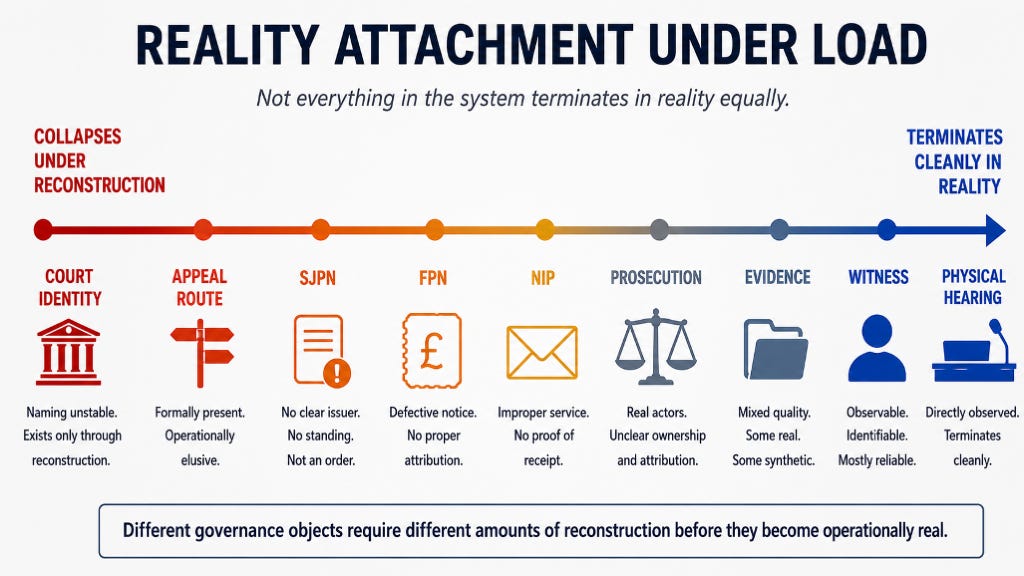
So I started to realise that what I was dealing with here was a new discipline, a new domain that’s very poorly understood and poorly modelled. Which is the safety case for any kind of symbolic system — not just law — under load, and how it deforms and degrades.
So if we go back to my whole case, there was a whole series of objects:
The core identity of the court collapsed under reconstruction. That was very unreal. Forty-four names. What the hell is this? I can’t find the court in here.
The appeal route was pretty unreal.
The Single Justice Procedure Notice with no sender and “North Cumbria Magistrates’ Court” was a bit unreal.
The fixed penalty notice was somewhere in the middle.
The evidence was a bit unreal.
Then we get to the physical hearing. The building was real. The judge was real.
So there’s a scale running from very unreal to very real, and everything sits somewhere on it.
But to the system, which runs on symbols, they all exist. They’re all the same.
To you and me, they aren’t. We look at the picture from Appleby and think: what crime? I don’t see a crime here!
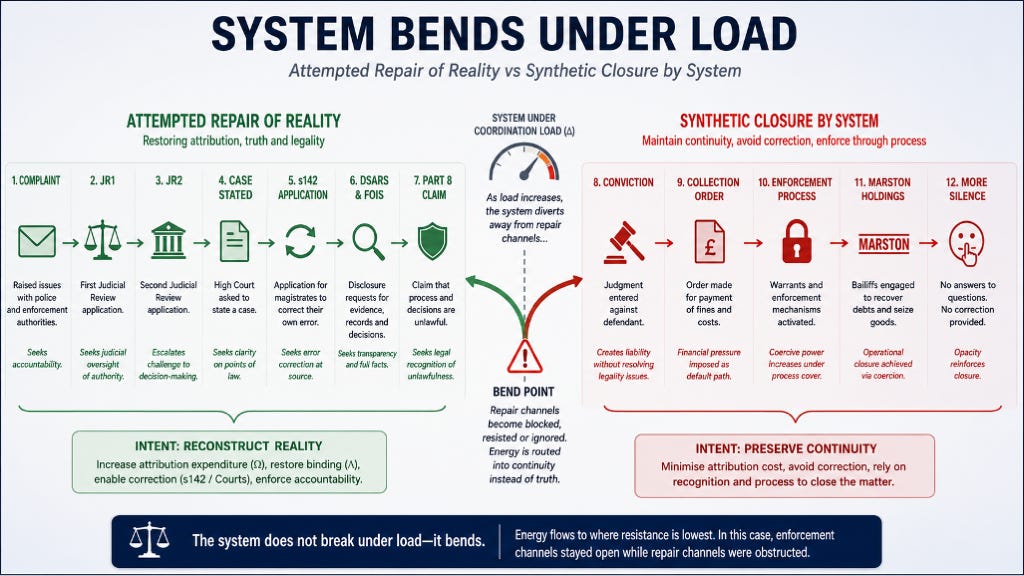
So what happens is that a system like this gets caught between two things.
On the one hand, I’m there saying: I want to repair this system.
You’ve got all these symbols — guilty, not guilty, court names, records — but they don’t map back to reality. I want to activate all of the repair mechanisms! I’m very busy trying to activate them.
And they’re very busy sending me away.
What they’re doing is saying: chop, chop, chop. Do not process. Quick answer. Doctrine that ends the question.
So they’re truncating everything before it can be fully repaired back to reality.
And that’s okay, in a way.
That doesn’t mean it’s acceptable.
It doesn’t mean it’s desirable.
It doesn’t mean it’s healthy.
It’s just the physics of applying a load to the system.
If you apply a certain load to a telecom network, it has to produce a certain amount of loss and delay [of information].
If you apply a certain load to a legal network, it has to produce a certain amount of loss and delay [of reality].
It’s just how the world works.
Truth regimes and constitutional consequences
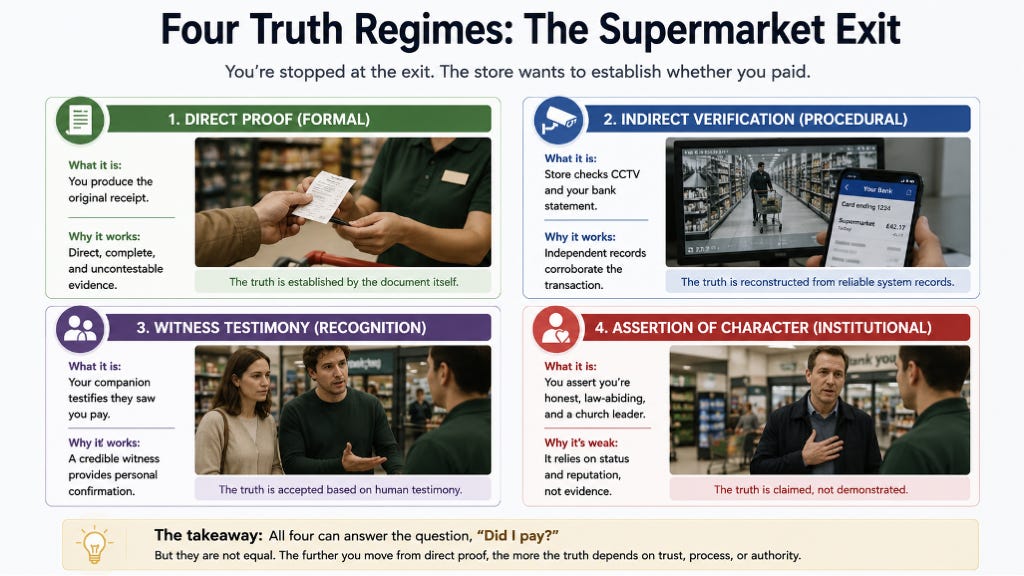
Here’s an example to bring this to life.
Have you ever come out of Tesco — or any other shop — and been stopped and asked for a receipt?
“You appear to have a lot of steak there.”
Beep. Beep. Beep. Beep.
What I found was that there are different truth regimes that the system degrades through as it gets stressed.
Rather than explain it in legal terms, let’s explain it in Tesco-and-steak terms.
So you get to the exit of Tesco and it goes beep, beep, beep at the door.
You say to the guard, “Look, I’ve got the receipt.”
Now, the receipt isn’t the goods themselves, and it isn’t the payment. It’s a token that says you paid. But that’s taken as a good enough representation of the truth that you paid. The security guard sends you straight out.
Next one down.
Oops, I can’t find the receipt! Well, we’ll look on the CCTV. And I’ve got my banking app here, and it says I’ve paid Tesco today. That’s good enough. It doesn’t necessarily itemise that I bought the steak, but it’s good enough.
Next one down.
I’ve got my companion with me. And my companion is willing to witness that I bought the steak, went through the checkout, and paid. It’s a weaker form of attestation to the truth.
And the last one is:
“Honestly, I did it. I’m an honest, church-going, upright member of the community.”
Now what’s interesting about this is that there are more and more shortcuts to expressing the outcome, but it’s completely independent of whether they’re true or not.
I could have a forged receipt. But it’s still the strongest form of presentation of the truth.
Alternatively, I could be completely innocent, but I’ve got no witnesses with me, the CCTV wasn’t running, and I haven’t got the receipt. Because often I come out of Tesco and they say, “Do you want the receipt?” And I say, “No. What flavour is it? Is it chocolate flavoured? No? Okay, don’t want it.”
So there are these different truth regimes.
And as systems get loaded, they take more shortcuts. They move to lower and lower truth regimes.
But they’re only shortcuts. They’re not cheating.
We tend to assume that because they’re taking more shortcuts, they must be cheating.
But that isn’t true. It’s just a by-product of load.
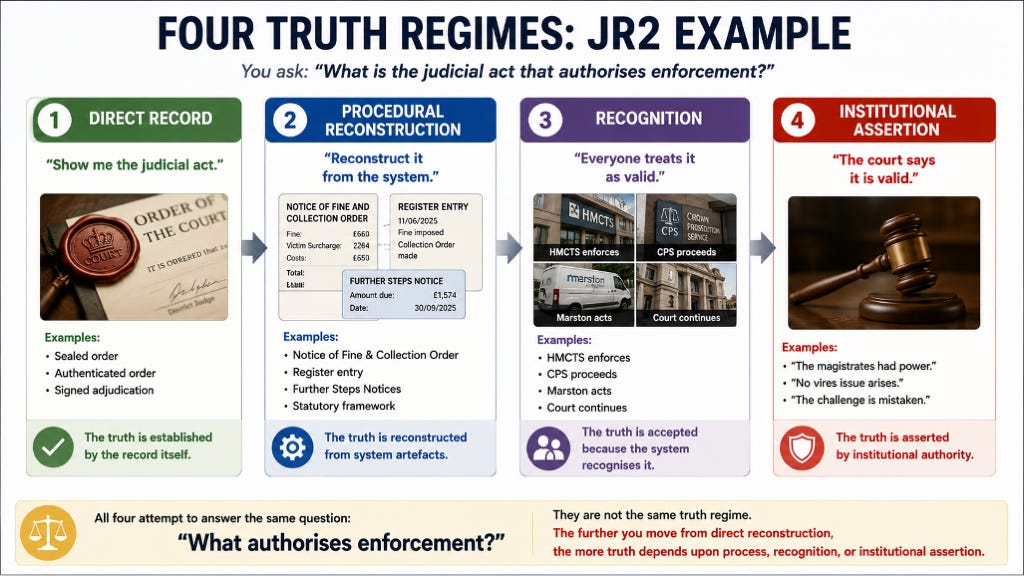
So in my case, I was asking for the strongest truth regime, which is the direct record.
Show me something that constitutes North and West Cumbria Magistrates’ Court (1752). Does this thing exist? Nope.
Then I went to the second level: procedural reconstruction. Can we reconstruct this thing from all these records? No.
Third level down. When you look at all the legal documents I received through the judicial review process, the answer becomes: well, everyone treats this as valid.
It’s a narrative or rhetorical way of asserting truth. Okay — as far as it goes.
And then the final level is: well, the High Court court says it’s valid. Just raw assertion. There must be a court here somewhere.
Someone must have convicted you because the computer says “convicted”.
Yes. But who?
I don’t know!
So what I started to see was how the system breaks and bends under load, and the new physics of symbols.
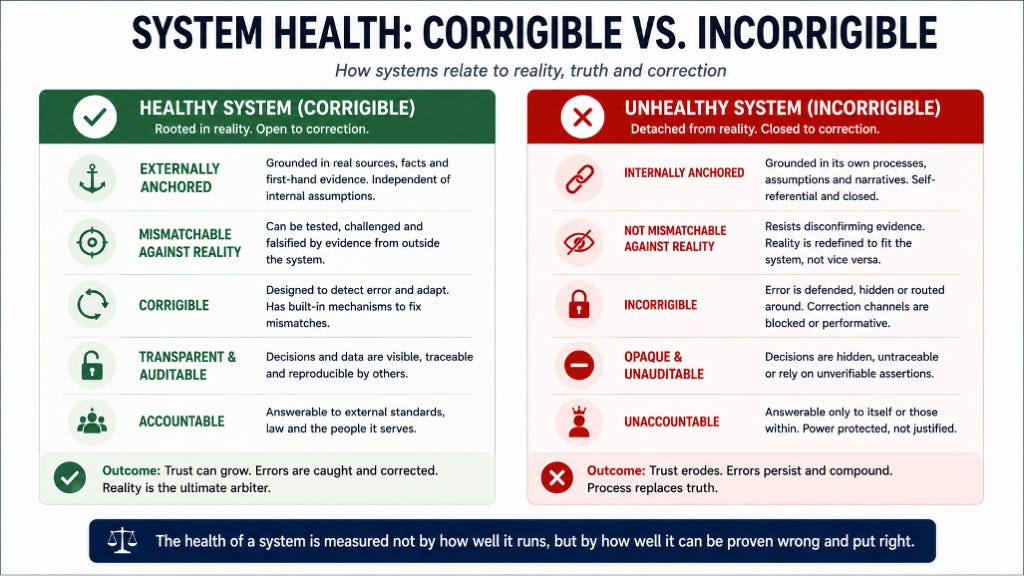
My takeaway was that what really matters is not whether the system breaks. Because any system that turns the real world into symbols and then processes those symbols is going to bend under load. It has to.
What matters is the difference between a healthy system and an unhealthy system.
In a healthy system, the key thing it can do is correct itself. You can come along and say,
“You processed me, but in my case the symbol and the reality have drifted apart.
I’d like to be reprocessed, please.
Here’s the mismatch.
And here’s how you return this back to reality so we can reattach.”
That’s what a healthy system does.
An unhealthy system is incorrigible. It truncates that reconstruction process.
It’s okay, in a sense, truncating on the outbound path, which is: I’m going to process you. But when you come back and say, “Sorry, I need a repair,” and it won’t repair it, that’s when it becomes abusive. Because then you’re trapped inside something that has drifted away from reality.
The picture of the car in Appleby, the reality of Appleby, and the official “reality” are not the same.
So remember I said, way back when I described the Mention hearing, “remember this moment”?
I was standing in court asking: which court am I in?
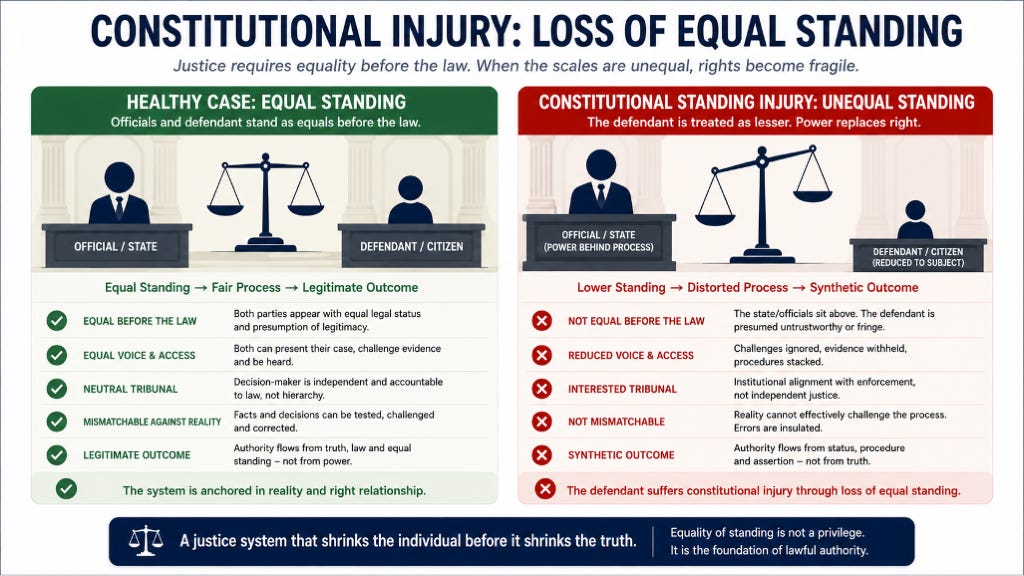
What I was experiencing was what you might call a constitutional injury.
I was not being treated as of equal standing to the other people in the room.
Normally, even if you’re a murderer in Crown Court, you’re still a participant in the process. You’re pleading guilty or not guilty. You’re presenting your excuses. You’re co-equal in creating the whole thing.
I wasn’t being treated as a co-equal.
Because apparently they knew which court it was, but I didn’t. So my standing had been lessened. And that’s not okay. There used to be a crime attached to that, actually, called personage.
But the system recognises itself as being lawful. So the system says: no problem. Doesn’t matter. Still all legal.
And that’s the issue.
Because when it drifts away from reality — forty-four names, nine categories, one court — then it ceases to be legitimate.
So it can still be lawful. And the outcomes can still be an emergent property of load. But that doesn’t mean it’s okay.
And it also doesn’t mean that anyone in the system is deliberately trying to hurt you.
And that’s the very, very difficult thing to hear.
Right, so I think this is the final slide.
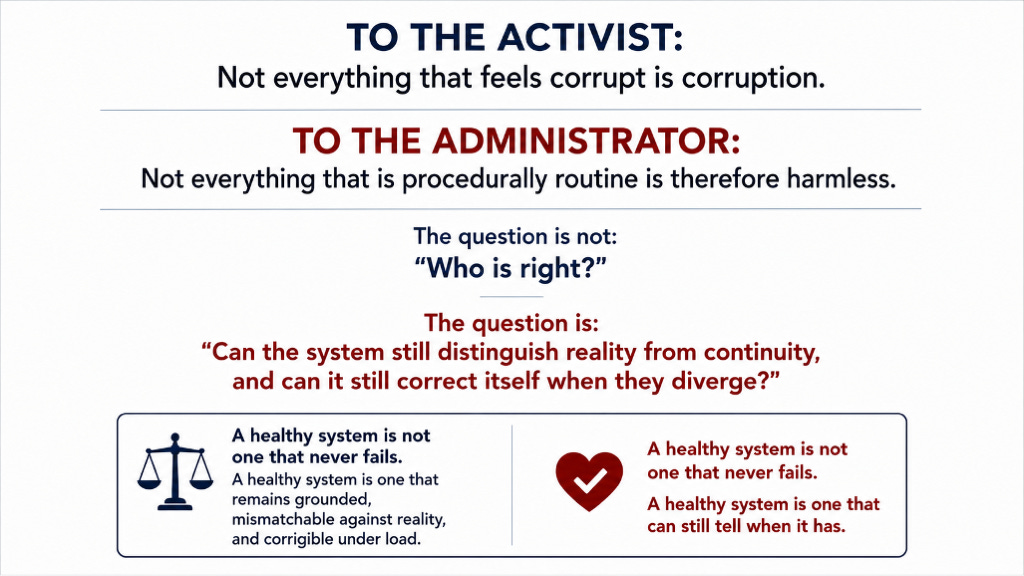
The takeaway is that not everything that feels corrupt is actually corruption.
There’s a drift zone that these systems go into.
Pre-evil.
Pre-corruption.
Pre-abuse.
It’s a place where real harm can happen, but it becomes very hard to distinguish between abuse and simply how the system behaves under load.
And at the moment I don’t think we’ve got a good theory about how to tell the difference. Which is not a comfortable place to be.
But equally, to those administering these systems, just because something is procedurally routine and deemed legal doesn’t mean it’s harmless.
You can actually be causing a lot of abuse and harm to people. But until you understand it, you’re not morally culpable.
So there’s a lot of grace and mercy that we could potentially be extending to people inside these systems.
Because we [the public] have failed to fully understand how they work and the actual pressures they’re under.
A presumption may guide inquiry, but it cannot prevail against proof; it may facilitate administration, but it cannot extinguish reality; it may stand in the absence of knowledge, but it must yield in the presence of truth."
Very cool, Martin, you did a great and clear job. I'm sure the people in your audience were both entertained and educated. I certainly was!
I have been on your case for a while for not incorporating malice, so I was heartened to see your graphic "The Map of Institutional Failure" now has an explicit acknowledgement of malice. Yes, you labeled it "Opportunistic" which is usually accurate. I've seen enough corruption here in the States to know that evil actors aren't just opportunists. You have only to look at the NGO network created by Soros, the Democrats, and the RINOs to know that malice can set about putting in place an entire hidden system by deliberately inserting legislation and processes specifically designed to allow massive evil, fraud, theft, trafficking, blackmail, and probably even murder.
Like you, I don't have a good feel for techniques that can reliably distinguish between a failure of a system due to load, or a system being deliberately pushed into failure for opportunistic reasons by malicious actors, or a system designed from the ground up to hide, take, or otherwise gain power and wealth at others' expense. I suspect that the best way to get at it is military system analysis of networks that need to be hardened against hostile action, modified for civil and criminal patterns. Now with AI's pattern-matching capacities, it should be more possible to diagnose in real time or after the fact at which level a specific system is actually operating.
Further, if we back up into just the continuity failure mode, it would seem that your analysis could start to identify the "code" that needs to be written or the type of system that needs to be created to make backwards attribution much cheaper and more reliable (like perhaps a blockchain-based tracking and registration system).
Now that you have such an elegant and explainable core analysis, practical applications should be possible to generate and apply. Call your business "Geddes Administrative Gastronomy" or GAG for short (tagline: "We get right into the guts of your institution!"). Worldly success awaits you! :-)