
Over the last year I have been stripping back the legal process I went through — a motoring prosecution with no personalised accusation and no attributable court known to law — and identifying the “atomic” and “sub-atomic” components that constituted it. By generalising those fragments, I am assembling, piece by piece, a single body of work with two expressions:
a general theory of how authority operates and degrades under load
an “operating system” for automated audit of authority using AI
At the centre of this work is a shift that is easy to miss, but has profound consequences:
In the traditional model, authority precedes the act: a person, vested with power, does something, and can be held accountable for it.
In the emerging model — what I have come to think of as radical proceduralism — this relationship is inverted. The outcome appears first, and authority is reconstructed afterwards from the process that supposedly produced it.
This inversion has profound consequences. It severs the direct link between acts and actors. Once authority is no longer anchored in identifiable deeds performed by identifiable persons, responsibility begins to diffuse. The rule of law ceases to rest on traceable events and instead rests on mere representations of what is said to have occurred.
This is not corruption in the crude sense of bribery or deliberate deceit. It is a form of signal degradation — like leaving a floppy disk next to a magnet. Nothing need be falsified; the evidentiary chain is simply compressed.
As compression increases, three distinct failure modes follow:
Non-attribution — the act occurs, but cannot be exhibited.
Misattribution — the act is inferred, reconstructed, or assumed.
Malattribution — outcomes are asserted even in the absence of any underlying act.
The mechanism does not change — only the degree of compression. As summaries replace receipts, the distinction between what was done, what is inferred, and what is merely asserted collapses.
At that point, the system no longer distinguishes between non-attribution, misattribution, and malattribution in its own output. What cannot be shown is treated as if it had been.
In order to isolate one instance of this foundational issue — what I have called the problem of “ghost courts” — from the specifics of my own case, I have an ongoing Part 8 claim before the High Court. Alongside that, as a form of educational satire, I recently published The Case of the Missing Song, which translates that Part 8 instance into a musical register: a “ghost performance” — all the outward signs of execution, but no underlying act.
🎼 The Case of the Missing Song

Today I prodded the High Court to do something about my Part 8 claim — a request for clarity on how, exactly, a judgment under the Single Justice Procedure is attributed judicial authority when all the outwardly verifiable signs of a tribunal are missing.
Readers seemed to recognise that something was off. They were shown the score, assured that the system was functioning, presented with a database record, given a review, and finally handed a rating. At each stage, the existence of the music was affirmed. And yet, when it came to the one thing that would settle the matter — the music itself — there was nothing to hear.
The aim of this article is to make that intuition precise.
Using the familiar terrain of music, I will map different representations of a “song” onto the ΔΣ attribution framework, which models how systems terminate responsibility as attribution load increases and traceability declines. The framework distinguishes four regimes:
Formal (F) — a direct representation of the outcome is available
Procedural flow (PF) — the right actions were done by the right actors in the right way, even if we cannot vouch for the outcome
Rhetorical laundering (RL) — a narrative explanation substitutes for either the receipts or the correct procedure
Institutional override (I) — raw assertion about what really happened and who is responsible
My hope is that, by working through these musical analogues, it becomes obvious to the reader:
what function the ΔΣ framework is serving
what these tiers mean and how they relate
what the utility is in describing attribution problems in the world
The article is broken up into two parts:
a meta-review of the parody, showing the ΔΣ mechanisms underneath each movement, focusing on three key teaching examples
a comprehensive AI-generated framework of the ways in which different musical forms and notations map into the same structure
If the original piece left you waiting for the music, this one is intended to show exactly where it went — and why, structurally, it never had to appear at all.
Part I — Where did the music go?
1. Opening — felt experience
In the last piece, we kept asking a simple question:
Where is the music?
Each time, we were given something else. At every stage, the same claim was made — that the music existed — but what we received was always a substitute for it.
And then, at the end, we were shown a performance. Not the music itself, but the appearance of it: the gestures, the timing, the compliance with form — everything in place except the one thing that would make it real.
Silence, not sound.
If you found yourself waiting for the music to finally arrive, you were already doing the analysis.
What the piece exposes is not absurdity, but a structure: a progression in which the original question is never answered, only displaced:
first by representations, and
finally by a simulation that no longer depends on the thing it claims to instantiate.
This article is about that progression, and what it tells us about how systems handle attribution when the demand to account for reality exceeds their capacity to exhibit it.
2. The musical compression ladder
The easiest way to understand what just happened is to lay out the different forms the “music” took as it moved through the piece.
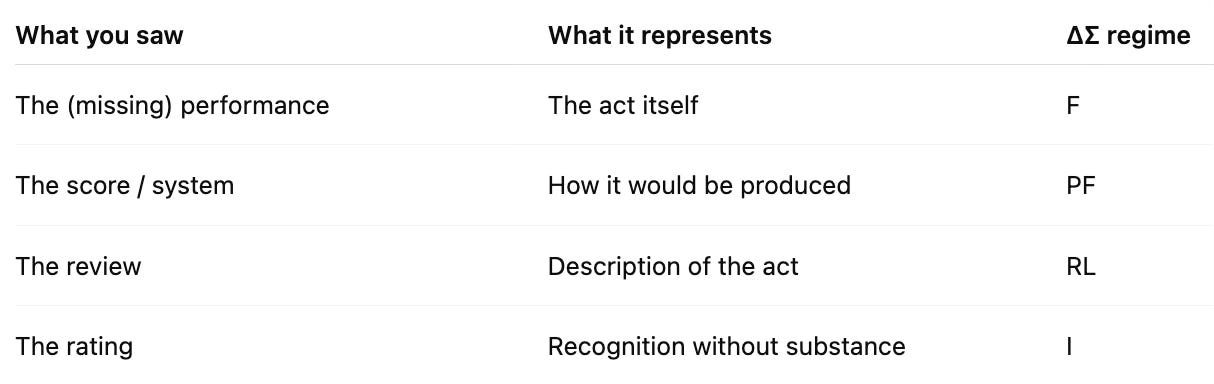
These are not variations of the same thing. They are different termination points.
Only the first answers the question.
The rest progressively detach from it — preserving, in turn, possibility, description, and recognition, while losing the act itself.
What the piece demonstrates is that movement between these is not accidental: as the burden of attribution rises, systems descend this ladder.
When it becomes difficult to exhibit the act (F) — to show who did what, when, and how — the system substitutes something easier to produce:
first procedure (PF),
then description (RL), and
finally assertion (I).
By the bottom, the original question has not been resolved. It has simply ceased to matter.
3. Three pedagogical examples
(a) Score ≠ Performance (PF ≠ F)
At one point, the response is simple:
the score exists, therefore the music is in order.
This is the first substitution.
A score is a complete specification of how music could be produced. It encodes structure, timing, and roles. But it does not establish that any performance has actually taken place. It proves possibility, not occurrence.
The same move appears in law when procedure or statute is treated as if it were the act itself. The existence of a valid framework is taken to stand in for the exercise of authority within it. But a framework is not an event. A score is not a performance.
(b) Review ≠ Music (RL cannot recover F)
Later, the system offers something more familiar: a description.
“A measured and coherent piece, executed within the recognised framework, producing an appropriate and proportionate result.”
It tells us what the piece was like, how it unfolded, what effect it had. It may even be accurate. But it still cannot be heard.
No matter how detailed the description, it cannot reconstruct the act itself. The music is replaced by an account of the music, and the substitution is quietly accepted.
In law, this appears as written reasoning standing in for the underlying event. A judgment describes what is said to have occurred, and why it is valid. But the existence of a narrative does not establish that the act it refers to ever took place.
(c) Rating ≠ Reality (I is terminal)
Finally, the system dispenses with description altogether and offers only recognition.
★★★★★
At this point, nothing about the music remains — only the assertion that it has been evaluated and found satisfactory.
This is the terminal form.
Recognition replaces substance. The question of what happened, and who is responsible, is no longer answered but overridden.
In law, this corresponds to formal validity being treated as sufficient in itself. The outcome is recognised as binding, not because the act can be exhibited or traced, but because the system declares it so.
4. The hidden mechanism (Δ → Σ)
What drives this progression is not style, but constraint, expressed in two elements:
Δ is the attribution load — the difficulty of establishing who did what, when, and how.
Σ is the point at which the system stops that process (i.e. termination) — the level at which it is willing to say “this is enough” and bind an outcome. In the framework above, that termination occurs at one of four regimes: formal (F), procedural (PF), rhetorical (RL), or institutional (I).
Two simple rules govern the movement between them:
First, descent is one-way. Once the system moves from the act itself to representations of it, it cannot return to the original level without actually producing the act.
Second, as the load increases, trade-offs are made. The system preserves continuity — the ability to produce an outcome — at the expense of fidelity to the underlying event.
In plain terms:
When it becomes too hard to show the music,
the system starts talking about it instead.
5. Re-reading the “musical play”
Seen through this lens, the movements of The Case of the Missing Song are not dramatic stages but points along the same descent:
The opening movements establish the score and its sufficiency. The framework exists, the parts are assigned, the process is said to be in order. This is procedural flow (PF): everything required for music is present, except the music itself.
What follows is an appeal to system and record. The piece has been performed, we are told; the outcome has been documented. But this remains within the same regime (PF) — a reinforcement of process without exhibition of the act. The system begins to drift, but it does not yet break.
The shift becomes explicit with the review. Here, the music is replaced by a description of the music — coherent, measured, and entirely detached from anything that can be heard. This is rhetorical stabilisation (RL): the absence is covered by narrative.
Next comes the rating. No description is needed now. Recognition alone is sufficient. The piece is declared valid, complete, and satisfactory. At this point, attribution has terminated (I).
And finally, the alleged performance (F). A performer appears. The gestures and timing are exact. Every outward sign of execution is present — except the sound itself.
This final stage is not a return to the top of the ladder. It is its inversion — the simulation of the act after attribution has already collapsed. What appears to be formal grounding (F) is, in reality, institutional override (I) masquerading as it.
The system never fails when asked to show the music. It completes — by descending.
6. The payoff — silent performance
What the final movement presents is not an anomaly, but a boundary condition.
In ΔΣ terms, it is what I call Absolute Zero:
the point at which all substitute forms of attribution have been exhausted, and the system can no longer defer the question of authority, so reveals its invariant.
At that boundary, only one question remains:
What attributable authority exists right now?
In the piece, that question is never answered.
Instead, the system proceeds as if it had been.
What continues is not grounded action, but recognised action: binding that persists in the absence of any attributable act that can be exhibited. The appearance of formal grounding remains, but its substance has already been lost.
This is a synthetic governance object: not a failure of the system, but its completion condition under load.
Institutional continuity is preserved (the invariant).
Attributable authority is abandoned (the variant).
7. What to learn from this teaching case
At no point did the system fail to produce the music.
The music was never missing.
It was never required.
Once seen, this pattern is difficult to unsee. It repeats across domains:
council tax liability orders issued without attributable hearings;
debt collection pursued without clear assignment of rights;
children taken into care on the strength of process and report alone.
The forms differ.
The structure does not.
Part 2 — The full musical taxonomy
This is the full classification. Each item sits at a point on the same ladder: what it preserves, and what it discards.
There is one governing rule that divides the attribution regimes:
Can I reconstruct the music from this?
If “yes” then F / PF.
If “no” then RL / I.
F — Grounded instances
Multitrack master / studio session (full source)
MIDI / DAW project file (fully reconstructable)
Final recording (WAV / high-quality audio) (direct signal)
Live performance (real-time act)
Cover version (same composition, new act)
Improvisation on a standard (variant, attributable)
PF — Executable structures
Sheet music (full score) (complete specification)
Lead sheet / fake book (partial + assumed knowledge)
Chord chart (minimal structure)
Arrangements / orchestration instructions (transformation rules)
Tribute band reproduction (process-driven recreation)
Sampling with attribution (traceable reuse)
F/PF boundary — Signal degraded but still executable
MP3 / lossy compression (signal degraded)
Auto-tuned / processed vocals (algorithmically altered)
Remix (recomposition from source)
Mashup (multiple sources combined)
RL — Semantic representations
Music review (accurate) (describes, not produces)
Music review (invented / fictional) (no underlying act)
Genre classification (category only)
Programme notes / liner notes (contextual narrative)
Verbal description (pure semantics)
Playlist curation (meaning by selection)
Recommendation engine output (preference inference)
I — Recognition only
Star rating (★★★★★) (evaluation only)
Chart position (relative ranking)
Awards (institutional recognition)
Certification (gold / platinum record) (status marker)
“This is music” assertion (bare classification)
Edge / pathological cases
Lip syncing (appearance without act)
Silent performance (4′33″) (F collapsing toward I)
Fake performance (claimed act, no signal)
Deepfake audio (signal, false attribution)
Bootleg / misattributed track (real signal, wrong author)
Lost master (F → RL collapse)
“Coming soon” album (deferred grounding)
Collaborative track with unclear authorship (no clear locus)
Endless remix chain (no stable origin)
Algorithmically generated music (opaque model) (hidden process)
You are invited to apply this “executable essay”
This article is not just descriptive. It is runnable as “code” via AI.
Take any document that claims authority — a judgment, a notice, a demand — and ask:
Where is the music?
What is being provided instead?
At what point does the system terminate?
The answers are often clearer than the document itself.
Once seen in this way, the question becomes difficult to avoid.
Not what is said to have happened,
but what can actually be shown.
Do let me know how you get on!