

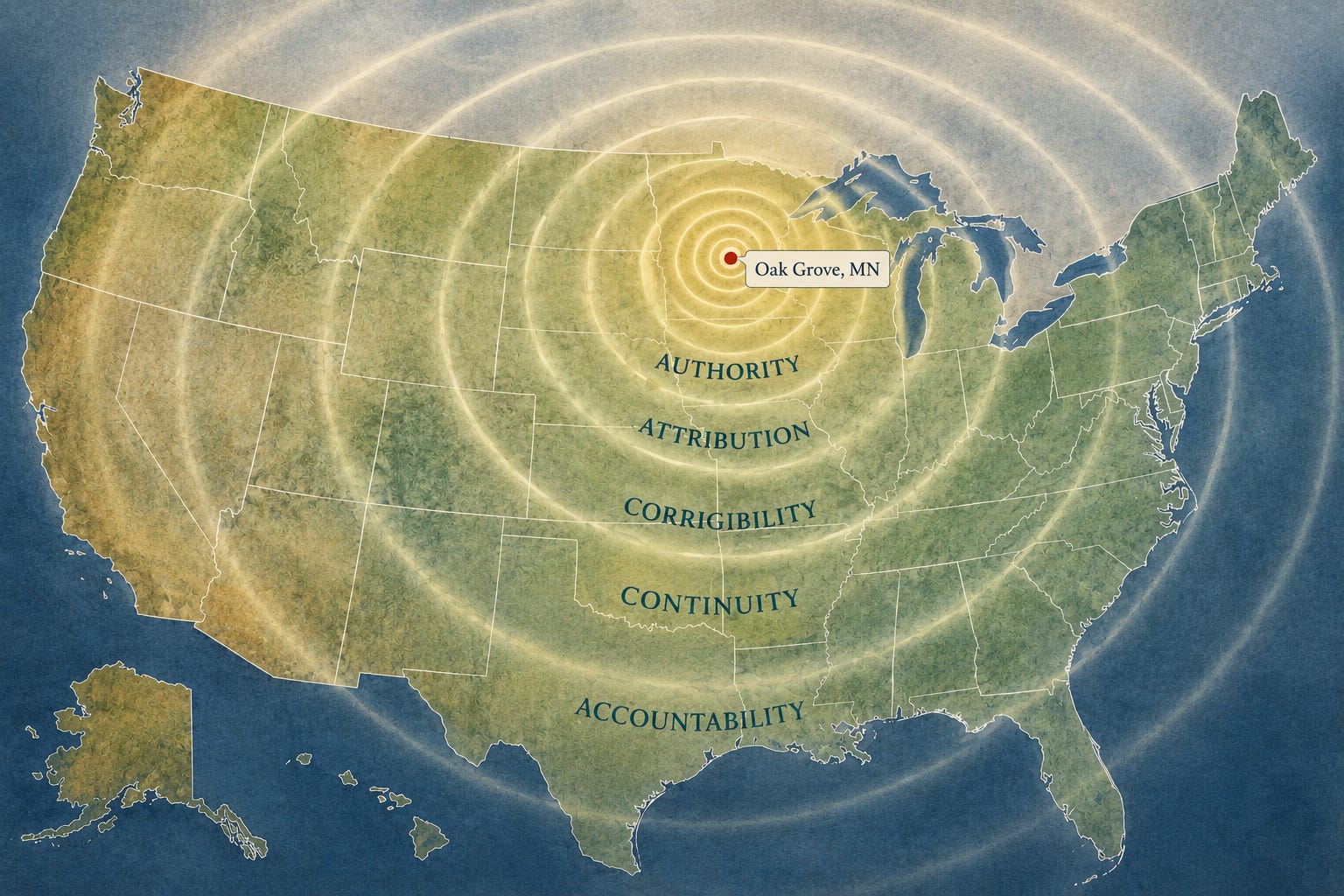
Oak Grove, Minnesota, is not where most people would expect to find a live constitutional contention. Yet this small municipality now finds itself petitioning the Minnesota Supreme Court over a question that reaches far beyond election administration:
Who gets to decide who decides?
Yesterday’s article introduced readers to Erik van Mechelen and his long-running efforts to understand an increasingly contentious dispute over electronic poll pads and paper voter rosters in Minnesota. It also introduced the “Vigilance Automator” — an AI-assisted governance analysis toolkit designed to detect patterns of synthetic authority and institutional drift that are often hidden beneath layers of technical, legal, and administrative complexity.
Minnesota poll pads and the Vigilance Automator

When Benjamin Franklin famously announced “a Republic — if you can keep it”, he was not principally referring to the initial founding or constitutional construction. The deeper meaning is that republics require active maintenance by their citizens, and can fall into disrepair. A citizen does not go pleading to a Duke or Bishop for privileges; that is th…
Today’s article demonstrates the Vigilance Automator in action. It shifts our attention away from the immediate dispute over electronic poll pads and paper voter rosters, and toward the deeper structural patterns that shape governance conflicts. By reconciling the establishment and dissident readings through a common analytical framework, we can see that the real contention is neither technological nor partisan.
The question is not merely who is right, but what kind of governance dynamic is actually unfolding beneath the surface.
The final article will explain why the Vigilance Automator may become a necessary civic technology for civilisation-scale governance. Few of us have the time, expertise, or energy to manually master every system of authority that shapes our lives. We need tools that cut through complexity, expose hidden structural patterns, and reveal where continuity, authority, responsibility, and accountability have drifted apart.
Oak Grove is therefore both tiny and enormous. A local dispute over voter rosters turns out to illuminate many of the same tensions that appear throughout modern governance: local versus central control, convenience versus reconstructability, continuity versus corrigibility, and efficiency versus attributable authority.
In that sense, this small Minnesota municipality serves as a surprisingly useful microscope for examining much larger constitutional questions.
Since the previous article was published yesterday, Erik has drawn my attention to a highly significant development. On 28th May 2026 — the very day Part 1 of this series went live — the City of Oak Grove filed a Petition for Correction of Errors and Omissions with the Minnesota Supreme Court under Minn. Stat. §204B.44.
In the petition, Oak Grove seeks a declaration that it possesses the statutory authority under Minn. Stat. §201.225, subd. 1 — which states that a municipality “may use electronic rosters for any election” — to instead use paper voter rosters for the 2026 general election.
The city had already provided notice of its intention to revoke its prior electronic roster agreement. It asks the Court to require state and county election authorities to respect that choice.
This development matters because it immediately elevates the controversy. What previously appeared to be a dispute between local activists and election administrators has now become a live constitutional contention over authority, autonomy, and statutory interpretation before the state’s highest court.
The fact that Oak Grove is now petitioning the Minnesota Supreme Court over municipal autonomy suggests this was never really a dispute about poll pads. Rather, the technology appears to be the vehicle through which a deeper contention is being expressed:
Who gets to define legitimate authority when statutory language, administrative practice, and local self-government diverge?
That is precisely the kind of governance contention the Vigilance Automator was built to illuminate.
What stands out is a comment below the video that illustrates the central structural point:
Paper is more reconstructable. Electronic is less traceable, verifiable, and correctable. But the deeper issue is autonomy. The contention is not ultimately about technology; it is about whether municipalities retain the authority to make that choice for themselves under Minnesota law.
It continues:
…yet his argument in the felony threat letter to Oak Grove stands in writing from 2024.
The allegation is that county officials sought to use the threat of criminal sanction to settle a question for which authority itself remains contested. In that sense, we can observe a familiar descent pattern.
The dispute begins in a truth regime: what is the most appropriate technical solution?
It then moves into an attribution regime: who possesses the lawful authority to make that decision?
Finally, it enters a corrigibility regime: what happens when the legitimacy of that authority is itself challenged?
This is why structural analysis matters. It allows us to move beyond the surface controversy over poll pads, and even beyond the secondary question of who gets to decide who decides.
The deeper question is:
How does a republic correct contested authority claims without collapsing into either blind administrative assertion or endless political conflict?
That is where Oak Grove becomes interesting. The real governance question is no longer the roster. It is the correction mechanism itself.
As such, the target of my own analysis in writing these articles is shifting in real time. Oak Grove’s petition to the Minnesota Supreme Court has effectively moved the contention up a level.
The question is no longer simply
which system should be used, nor even
who possesses the authority to choose it, but
how contested claims of authority are themselves tested, reviewed, and ultimately resolved within a republican system of government.
Constitutional vigilance is a layered problem. The challenge is not seeing the anomaly. It is locating it correctly in the right layer(s).
The challenge of our age is scaling vigilance across all the layers.
Hence Oak Grove, MN is an ideal test case.
We are no longer examining a local activist’s complaint.
We are watching a live governance contention work its way toward judicial resolution.
In previous articles on American history and contemporary political advertising, I have adopted a standard three-part model to present the Canon as a Vigilance Automator tool for reconciling establishment and dissident narratives. It is a neutral, non-normative, structural framework. Rather than seeking to determine who is right or righteous, it focuses on how truth, authority, and legitimacy deform under stress.
We will follow the same format here. The first two readings are abbreviated to keep the discussion compact, while the third introduces the structural perspective that neither side naturally sees from within its own narrative. The objective is not to resolve the political disagreement directly, but to reveal the deeper governance dynamics that give rise to it.
Reading 1: the establishment view
From the establishment perspective, there is no great mystery here. Minnesota already operates a functioning election system built around electronic voter rosters, standardised procedures, and state-certified technology. The purpose of these arrangements is not ideological but practical: to ensure consistency, efficiency, and reliability across thousands of polling locations.
Supporters of this view would argue that modern elections place significant coordination demands on administrators. Electronic systems reduce clerical errors, synchronise records, accelerate voter processing, and simplify compliance with state requirements. In a complex society, standardisation is not a luxury but a necessity.
Accordingly, the controversy is seen less as a constitutional contention than an administrative one.
The responsible authorities have interpreted the law, established the procedures, and selected the technology. The system is functioning, elections are being conducted, and public officials are carrying out their duties. The burden therefore falls on challengers to demonstrate not merely a preference for an alternative approach, but a compelling reason to depart from established practice.
Reading 2: the constitutionalist view
From the perspective of Erik, Oak Grove, and others involved in the dispute, the issue is not principally one of administrative convenience but of lawful authority. The question is not whether electronic systems can function effectively, but whether local officials retain the autonomy granted to them under Minnesota law to choose between paper and electronic voter rosters.
Supporters of this view are less concerned with operational efficiency than with reconstructability and accountability.
Elections derive legitimacy not merely from producing outcomes, but from allowing citizens to trace those outcomes back to lawful authority, observable processes, and verifiable records. If local discretion exists in statute, then administrative practice cannot simply override it by habit, guidance, or assertion.
Accordingly, the controversy is seen as a test of constitutional order rather than election technology.
The concern is that administrative convenience and institutional momentum may gradually displace explicit legal authority. The resulting question is not whether electronic rosters are good or bad, but whether a republic remains faithful to its own rules when those rules become inconvenient to those charged with administering them.
What both readings miss
Both positions contain important truths:
The establishment perspective correctly recognises the need for continuity, scalability, and administrative coordination in a complex modern society.
The constitutionalist perspective correctly insists that authority must remain traceable to law, and that convenience cannot become a substitute for legitimacy.
Yet both remain trapped within the immediate dispute. One side argues primarily about operational effectiveness; the other about statutory authority.
As a result, they end up debating outcomes and preferences rather than examining the deeper structure that is generating the conflict in the first place.
The purpose of the Canon is not to decide between these competing narratives. Instead, it asks a different question altogether:
what kind of governance dynamic produces this pattern of disagreement?
Once viewed through that lens, the poll pads begin to fade into the background, and a different set of issues comes into focus — attribution, corrigibility, continuity, reconstructability, and the allocation of authority under stress.
Reading 3: the structural view
The Canon does not take sides in the roster debate. It does something more useful: it reveals what neither the institutional nor the constitutionalist reading can fully see from inside its own frame.
What the Vigilance Automator surfaces is a series of structural shifts hiding in plain sight — making otherwise intractable governance systems understandable.
First, the argument is migrating from justification to assertion.
It began as a technical question — which roster format is preferable? Increasingly, however, it has become an institutional claim: this is the system that must be used. The centre of gravity has shifted from “this works better” to “this is how we do things.”
Second, authority and responsibility are separating.
Municipalities administer polling places within their own boundaries, yet state and county authorities increasingly claim the decisive voice over roster format. Whether that claim ultimately succeeds is a matter for the courts. Structurally, however, the contention concerns the alignment of control, accountability, and liability.
Third, the conflict is climbing the governance stack.
What began as a local technical disagreement became a statutory dispute. It has now become a judicial question before the Minnesota Supreme Court. The object under examination is no longer the roster itself, but the mechanism by which competing claims of authority are reviewed and resolved.
These are not partisan arguments. They are observable governance patterns.
The pressure toward electronic systems reflects a natural institutional preference for continuity, coordination, and standardisation. The pressure toward paper systems reflects a preference for local reconstructability, traceability, and direct accountability.
The resulting conflict is therefore structural rather than ideological.
The Canon therefore does not tell us whether paper is better, nor whether Oak Grove is right.
It reveals something more fundamental:
the Minnesota contention has evolved from a disagreement about election technology into a live test of how a republic preserves reasoned justification in the face of growing administrative convenience.
One side continually asks, “Why?”
The other increasingly replies, “Because this is the system.”
The deeper governance question is whether authority remains accountable to explanation, or gradually becomes self-justifying.
Before diving into the specific observations, it is worth pausing on the source material itself.
We can now examine the Canon analysis that Erik himself published. Because it was generated independently of my own operational involvement in the Minnesota dispute, it serves as a relatively clean exemplar of what the framework actually produces when applied to a live governance contention.
At present, however, the output remains somewhat “raw”. The Canon is designed to surface structural patterns, not necessarily to express them in the plain-English governance language that citizens, journalists, lawyers, and officials instinctively use.
A separate translation layer still needs to be developed.
As a result, I am occupying two roles simultaneously:
One is analyst, identifying the structural observations that emerge from the Canon output.
The other is translator, rendering those observations into language that is more readily understood outside the framework itself.
The value lies not in the Greek terminology, but in the patterns being revealed.
With that caveat in mind, here are observations that stood out from Erik’s Canon readout.
What the Canon actually surfaced
Erik’s Canon output is extensive and technical. Rather than reproducing all of it, I have grouped the most important observations into five structural discoveries with illustrative excerpts.
1. Coordination load is the hidden driver
Canon: “The high demand for seamless, real-time data is the primary driver forcing the system toward the electronic solution.”
Translation: The pressure for electronic rosters is not primarily ideological or technological. It arises from the practical institutional challenge of coordinating elections smoothly and in sync across many jurisdictions.
Why it matters: This reframes the dispute away from questions of motive and toward the institutional pressures that emerge as coordination demands increase.
2. The mode of argument is changing
Canon: “The system is no longer arguing for the quality of the device, but for the necessity of its continuity.”
Translation: The justification has shifted from “This is better” to “This is what must be used.”
Why it matters: The Canon is detecting a change in how legitimacy is being established — from explanation and persuasion to institutional assertion.
3. Authority and responsibility are drifting apart
Canon: “Authority: Concentrated in the County/State/Vendor… Responsibility: Diffused.”
Translation: The people making the decisions about which tools must be used are increasingly separate from the people who will actually carry the risk and consequences if things go wrong.
Why it matters: This pattern — control sitting higher up the chain while accountability lands on local officials and election judges — is visible far beyond elections.
4. Challenge is becoming diagnostic
Canon: “The threat of felonies for using paper is a classic Institutional Assertion tactic.”
Translation: When a city tries to exercise a choice the law appears to permit, the institutional response is not calm review or clarification. It is a threat of criminal sanctions against the people on the ground.
Why it matters: How a system responds to legitimate challenge reveals more about the system than the original dispute itself. A corrigible system responds with review. This response raises the cost of disagreement.
5. The real contention is not technological
Canon: “The conflict is not merely about ‘technology vs. tradition.’ It is a struggle between a Continuity-First governance model … and a Reconstructability-First model.”
Translation: The dispute is no longer really about rosters or devices. It concerns two competing ways of organising public authority: one that prioritises smooth operational continuity above all, and another that insists every outcome must remain traceable, understandable, and correctable by the people it serves.
Why it matters: This is the Canon’s central contribution. Neither side naturally describes the dispute this way. It reveals that the visible dispute is not the real dispute.
The most important thing this analysis reveals is that the Canon is not really an election tool.
Nor is it fundamentally a governance tool.
It is a complexity-reduction tool.
It does not take sides in the roster dispute. It does not declare paper rosters better or worse. It does not decide whether Oak Grove is right or the Secretary of State is wrong.
Instead, it takes a noisy, emotionally charged dispute involving statutes, vendors, municipal rights, election administration, and criminal threats and reduces it to a handful of clear structural patterns.
What first appeared to be an argument about poll pads changed shape step by step:
It became a question of how to coordinate a complex system under pressure.
Then a question of who holds authority to choose.
Then a question of who bears responsibility when things go wrong.
Finally it became a test of corrigibility: how a system responds when its own claims of authority are challenged.
That progression is the real output.
Once the structure becomes visible, the Minnesota case stops looking like a unique local conflict over election technology. It starts to look like a familiar governance pattern that can appear in courts, regulators, licensing bodies, financial systems, professional associations, and public administration.
This is the quiet power of the Vigilance Automator. It does not replace vigilant citizens. It helps ordinary people see the deeper patterns that normally remain hidden inside complex technical, legal, and administrative disputes.
The real promise of a Vigilance Automator is not that it settles contentious issues, but that it makes them intelligible.
And once a contention becomes intelligible, it becomes amenable to vigilance. Citizens no longer need to master every statute, vendor contract, procedural rule, or technical nuance. They can focus on the underlying structural patterns instead.
In that sense, the Vigilance Automator is not merely an analytical tool. It is a scaling tool. It allows finite human attention to be applied where it matters most.
Civilisation depends upon corrigibility: the ability to detect error, challenge authority, and repair mistakes before they become failures. The difficulty is that modern governance systems have grown far beyond the cognitive bandwidth of any individual vigilant citizen to audit unaided.
The promise of the Vigilance Automator is therefore simple: to make constitutional vigilance scalable at a human level.
We are no longer asking what Oak Grove tells us about elections. We are asking what Oak Grove tells us about governance.
Which leaves us with a larger question.
If this same pattern appears in elections, courts, regulators, licensing systems, financial institutions, and bureaucracies alike, what does that tell us about the trajectory of modern governance itself?
That is where we turn next.
What is missing from this conversation? The authority question has not been traced to its source. Law precedes government, government was created as a trust on behalf of the people who have rights that in our Constitution were named, however those rights are terms of existence that the Constitution merely recognized against powers established to govern society that have delegated limits of force to do so. ALL authority for government rests in the people. Every Statute must be in harmony with the Constitution of MN and the United States Constitution. Therein, you will find that We the People have the right to amend or alter government when it is not tending to the common benefit. Voting machines are each and every one of them proven vulnerable. Many as changeable as the movement of money from your account to a vendors by simply holding a chip NEXT to the machine. The outcomes of government speak to the problem of our day. No longer are any governments abiding by their sole and sworn duty, to uphold the rights of the people they serve. These rights are Natural, they were there before government ever was established . They are Inherent; coming from a Creative Source that we may call God or Source and they are inalienable, government may not turn them into privileges. Nor, may the judicial arm of the powers of government make rules or express will. Thus the only thing they have before them is who has more authority, the municipality or the people to ensure an honest election? Statutes are void if they do not conform to the Constitution. So much of government is acting in rebellion of its sworn duty, and so few people have internalized their true authority, to keep the republic as an expression of the will of the people. A treasure: wethepeople2.us and the courses on the education tab there. Government has become a means to control the people on behalf of the elite banking powers, and voting machines are a very useful tool of that effort.
The structural view gets to the heart of it, the pattern reflected in so many domains. Thank you, Martin, for helping me to look into this matter from a new perspective.