


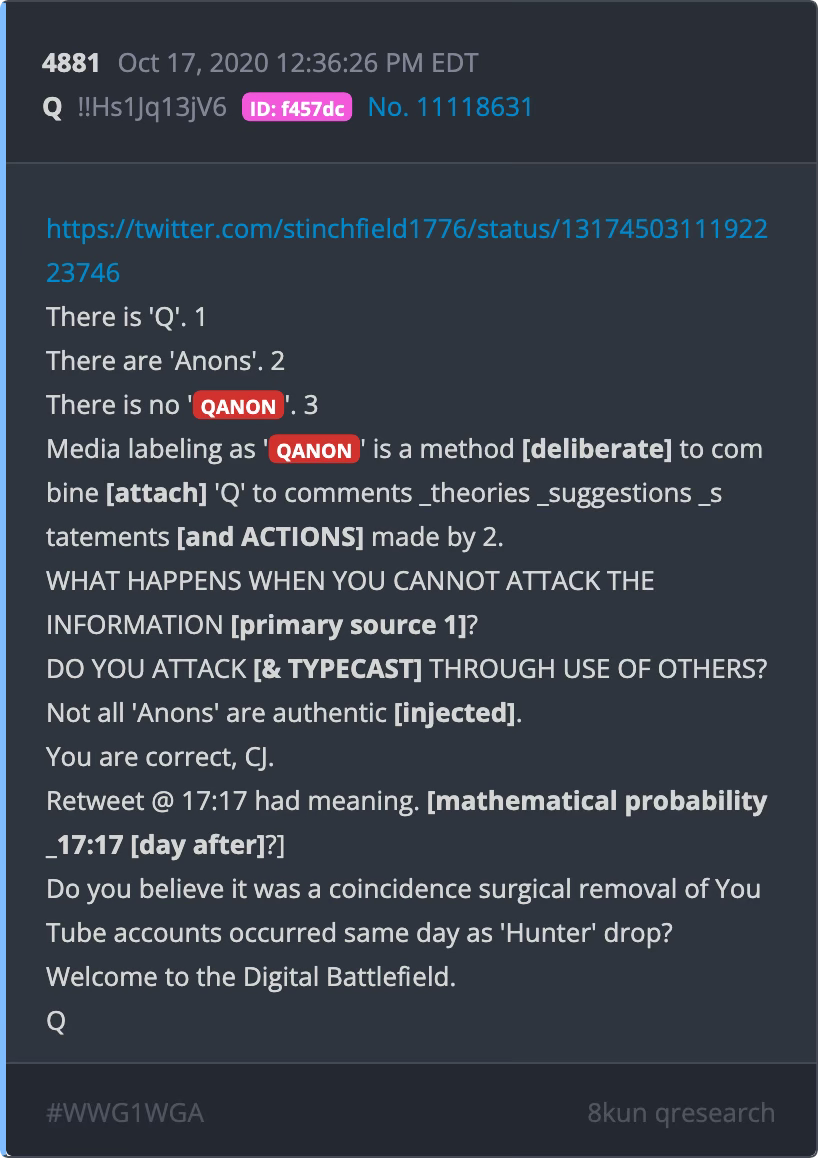
As a companion to the piece I’ve just published on Wikipedia and how it constructs synthetic governance objects—such as the term “QAnon”—this article examines a related primary artefact: Q Drop 4881, posted on 17 October 2020.
This particular drop is unusually explicit. It directly addresses the label “QAnon” itself and traces how that label mutates into a smear mechanism—an information-warfare technique used to collapse heterogeneous actors, ideas, and behaviours into a single governable object. In other words, it is not just about Q or Anons; it is about the weaponisation of the label used against them.
Over the past months, I’ve been developing a formal method for analysing material like this. The process is closer to writing software than to traditional commentary, but instead of code I’m working with schemas—many of them developed through structured interaction with AI.
The key insight is that there is a pre-truth layer that has to be analysed before we can sensibly ask whether any claim is true or false.
Not everything in a text like this Q drop is a “fact” that can be checked against an authoritative source, yet such elements can still shape outcomes that later harden into truth or falsehood at an institutional level. Drops are not necessarily “true” or “false” at the line or post level; instead, they interact with higher-level truth regimes, subtly favouring some resolution pathways over others.
Analysing this rigorously requires identifying the truth regime each component of the text belongs to. Some elements concern recognition and naming, some concern patterns that only emerge over time, and others are framing devices or questions rather than assertions. Treating all of these as if they were simple factual claims is a category error—and one that virtually guarantees confusion, misanalysis, and misplaced debunking.
In the course of this work, I’ve ended up assembling a set of formal tools and, arguably, sketching the outline of a new discipline—inquiritics. It sits somewhere adjacent to cybernetics, epistemology, and hermeneutics, but focuses on something slightly different: how inquiry itself is structured, deferred, and eventually forced to terminate under pressure. I’ll say more about that elsewhere. Here, my aim is narrower: to show what is now technically possible, pairing formal analysis with “plain English” explanations so the structure remains visible to readers.
You may encounter people who dismiss all of this with a wave of the hand—“people who believe in QAnon.” That response misses the point entirely. Whatever one thinks of Q, this material exhibits levels of design sophistication that are characteristic of state-level digital influence operations, not internet folklore. Ignoring that because the topic is unfashionable is an analytical failure.
Whether this all lands for every reader in a single pass isn’t the point. What matters is that an artefact like this analysis can exist at all. Much as a spectroscope allows us to see the internal composition of a sample without judging it as good or bad, the method used here breaks potential truth claims down into their atomic—or even quantum—substrate. Only then does it become possible to work with them properly, before truth is ever resolved… or not.
This readout integrates four orthogonal layers:
Front-end grammar (what kind of epistemic material this is)
Truth-regime eligibility (what kind of truth questions even apply)
Truth / decidability analysis (where appropriate)
Termination / inquiry-control function (what this does to inquiry)
The key discipline is that not every atom [line of text in the Q drop] participates in every layer.
0. The Drop as a Whole (pre-analysis)
Structural character:
Q4881 is not a claim packet. It is a mixed epistemic control artifact combining:
existential assertions,
ontological denials,
interrogatives,
pattern invitations,
framing metaphors,
and attribution warnings.
Any analysis that treats it as “a set of factual claims” is already mis-parsed.
In plain English:
Before arguing about what this text says, it matters to recognise what kind of thing it is. Q4881 isn’t written like a statement of beliefs or a list of claims. It mixes denials, questions, hints, and framing in a way that immediately resists being pinned down. If you treat it like a set of facts to be checked, you’ve already made a mistake — you’re using a truth lens on something that is primarily about managing uncertainty and attribution.
1. Front-End Grammar (Epistemic Atoms)
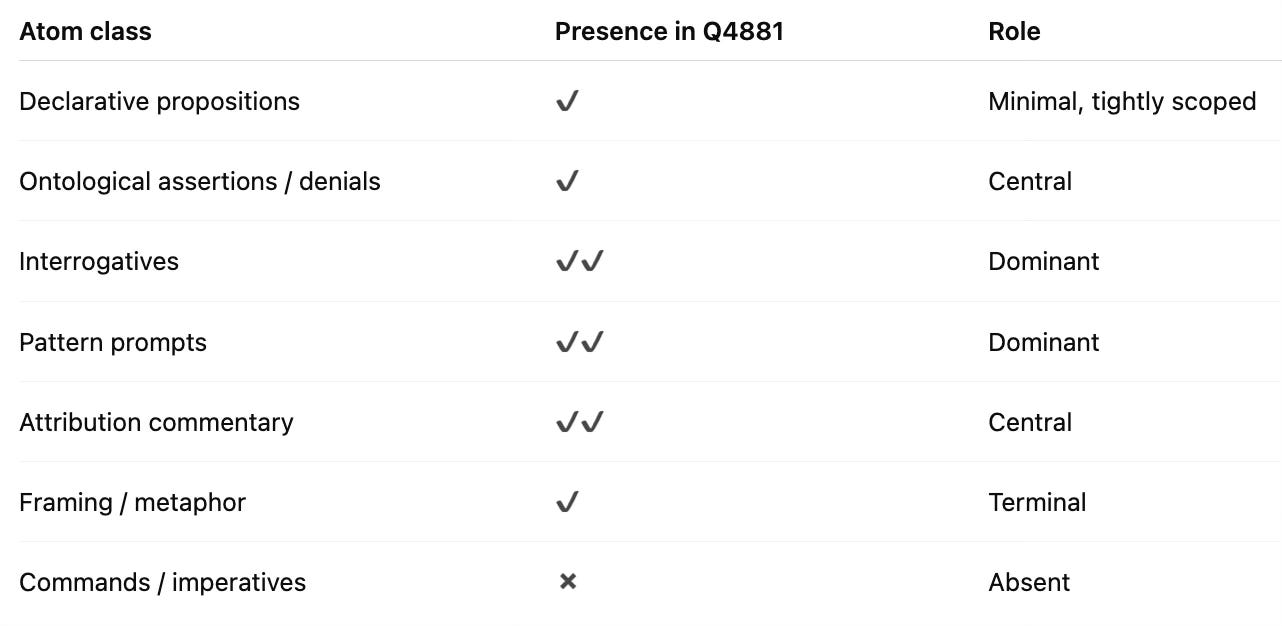
Grammar summary:
The drop is question-heavy, proposition-light, and attribution-focused.
In plain English:
This section is simply asking: what kinds of moves does this text make? When you break it down, you see far more questions than statements, far more nudges than declarations. That’s important. Texts designed to persuade usually assert; texts designed to instruct usually command. This one mostly asks, points, and reframes. That tells you it’s shaping how thinking unfolds, not telling you what to think.
2. Truth-Regime Eligibility (What Kind of Truth Applies)
This layer answers: “What kind of truth question could even make sense here?”
(For the labels see the ∆∑ Framework)
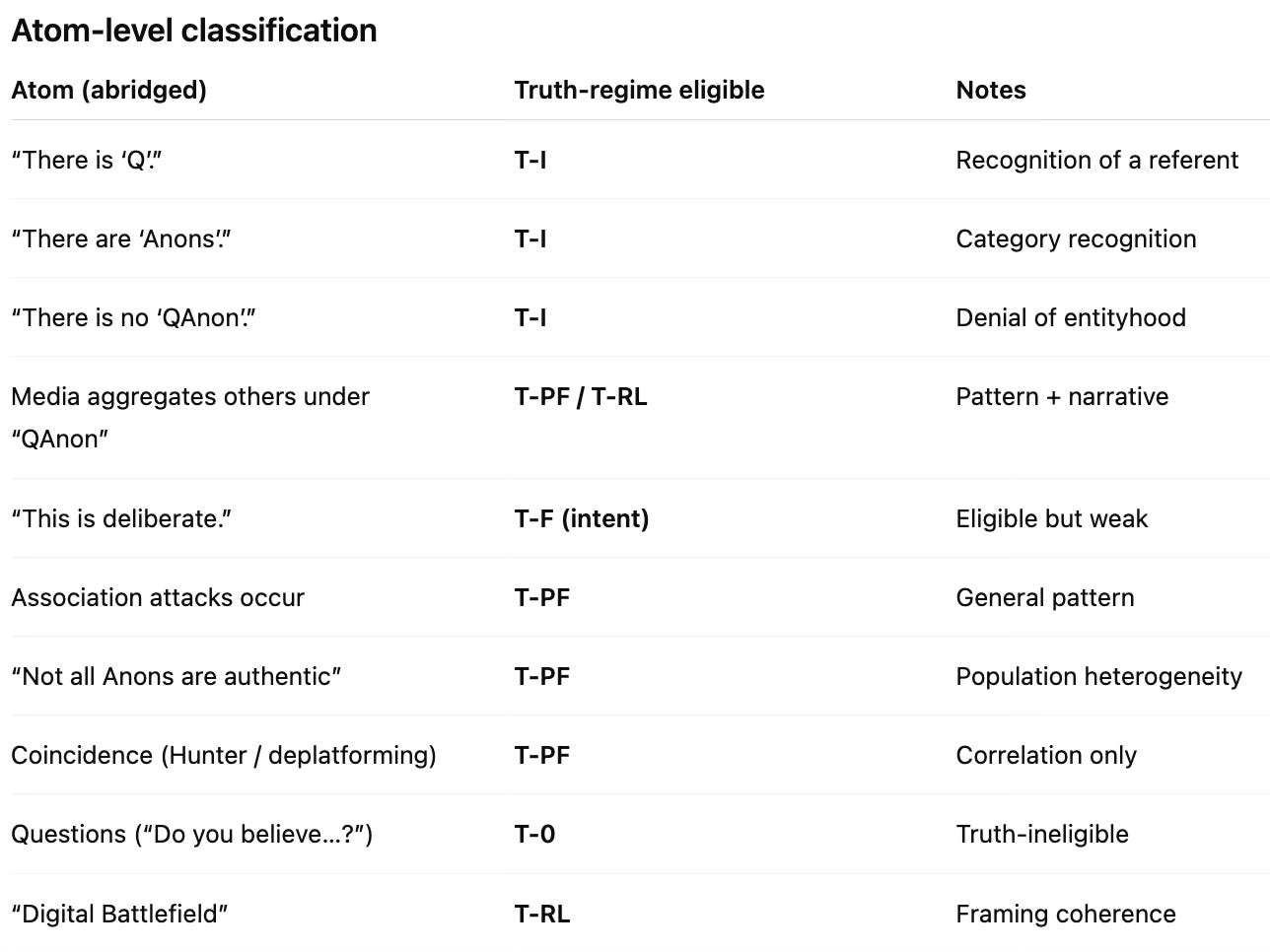
Key result:
Formal (T-F) truth eligibility is rare and peripheral.
Most atoms are pattern, narrative, or recognition eligible.
In plain English:
Not everything can be true or false in the same way. Some lines are about whether something is officially recognised; others are about patterns that only show up over time; others are just questions or metaphors. This section makes a simple but crucial point: most of this text doesn’t even belong in a courtroom-style true/false debate. Demanding that kind of proof from it is like asking whether a warning light is “lying”.
3. Truth / Decidability Analysis (Where Applicable)
Only atoms that are truth-eligible can enter this layer.
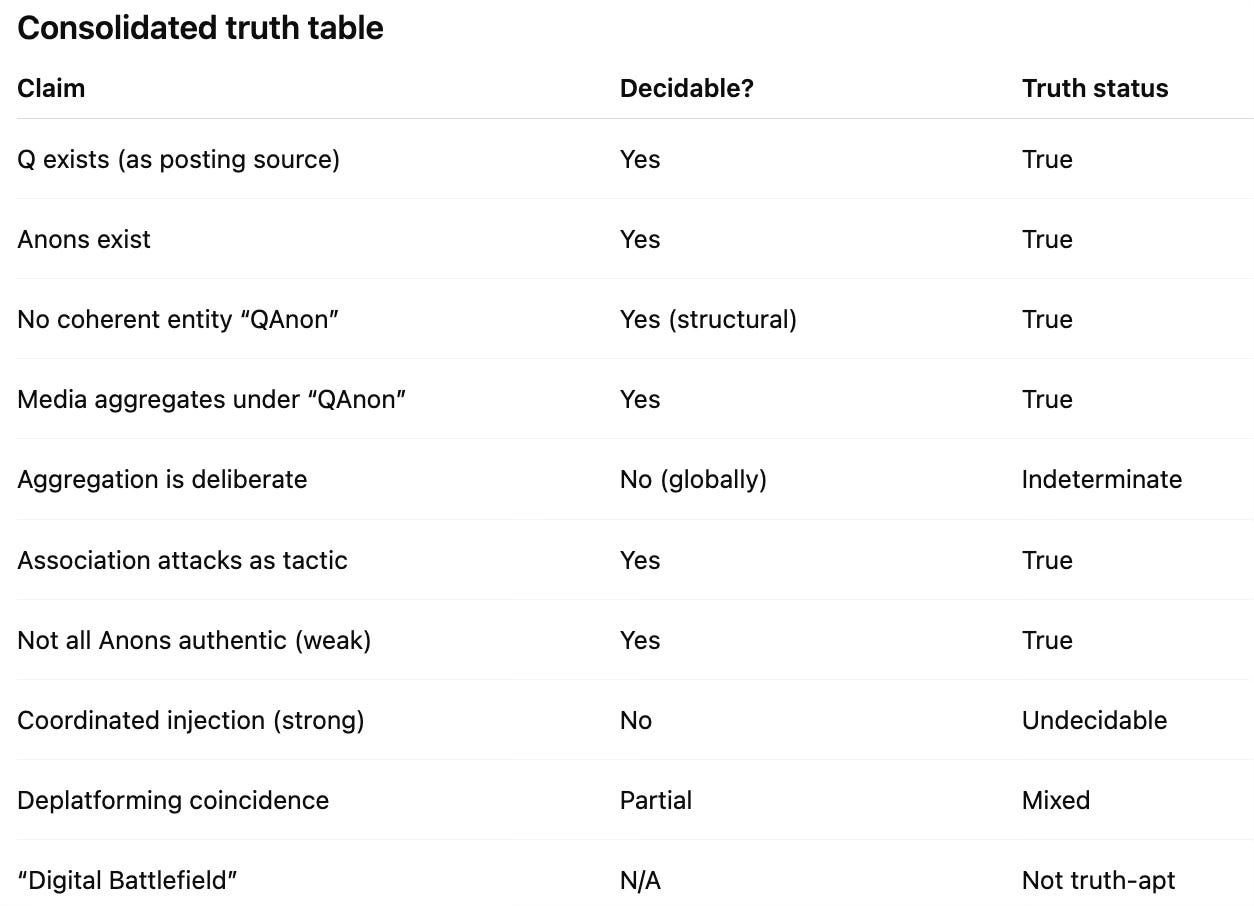
Important:
Most epistemically strong claims are about attribution mechanics, not hidden facts.
In plain English:
Where the text does step onto factual ground, it’s surprisingly conservative. It sticks to things that are easy to verify: anonymous posters exist, loose groups exist, media labels get applied broadly, open systems attract noise. The more controversial implications are left unresolved. That restraint matters — it suggests the text isn’t trying to win a fact dispute, but to keep attention focused on how attribution and labelling actually work.
4. Termination / Inquiry-Control Analysis
This is where Q4881 does most of its work.
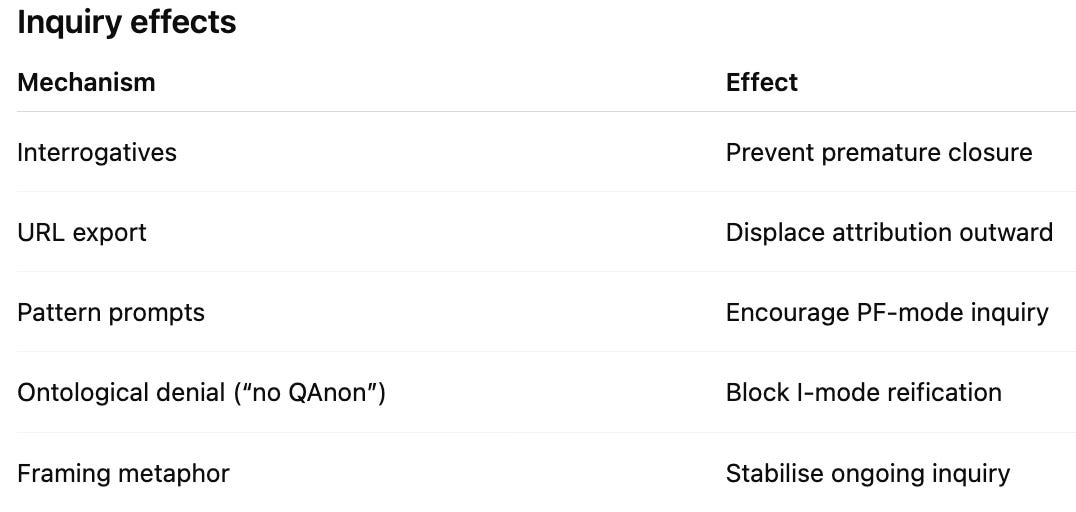
Termination profile:
Locally: Inquiry is kept open (no F-mode closure).
Structurally: Attribution pressure is exported.
Systemically: External actors later collapse inquiry via I-mode (reification as “QAnon”).
This is the inversion you identified earlier:
termination happens outside the artifact, not within it.
In plain English:
This is the heart of the matter. The text isn’t trying to end inquiry; it’s trying to delay it. Questions stop readers from settling too quickly. Links push responsibility outward. Denying a unified label blocks easy categorisation. But large systems — media, platforms, governments — can’t live with open questions forever. They eventually impose closure themselves. The text doesn’t create that closure; it waits for others to do it.
5. Integrated Matrix (Single-View)
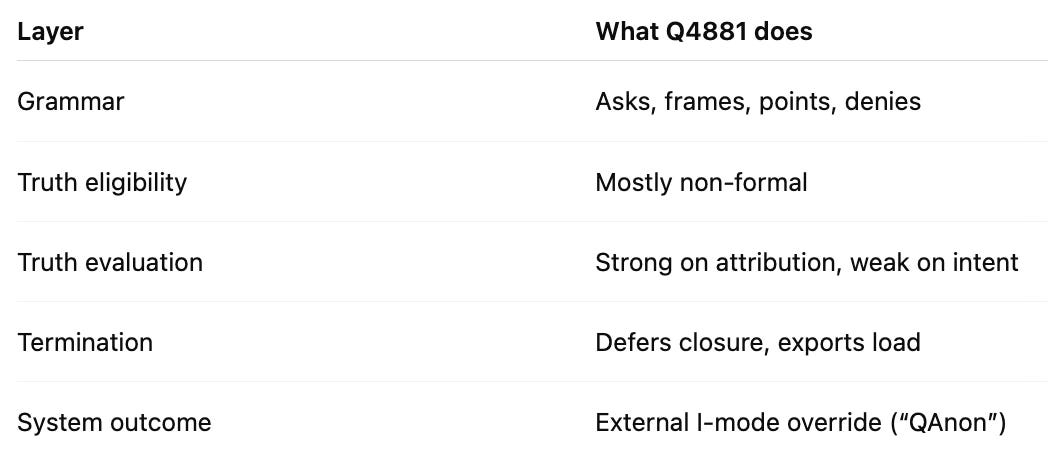
In plain English:
When you step back and look at all layers together, a clear pattern emerges. This artifact asks more than it answers, resists formal proof, defers closure, and quietly shifts the burden of resolution onto external systems. The outcome — a single, simplified label — doesn’t arise because the text defines it, but because other systems need something concrete to act on.
6. Canonical Interpretation (Non-Normative)
Q4881 is not best understood as:
a truth claim,
a deception,
a prediction,
or a doctrine.
It is best understood as:
an inquiry-state control construct that preserves open inquiry locally while inducing downstream attribution collapse in external systems.
Truth evaluation alone cannot explain its impact.
Termination mechanics can.
In plain English:
Seen this way, Q4881 isn’t best understood as right or wrong, honest or deceptive. It’s better understood as a device that keeps inquiry open locally (what Q, Anons, and QAnon are) while making it increasingly uncomfortable for outside systems (like the MSM) to leave things unresolved. Those systems eventually solve the discomfort by declaring what the “thing” is — to their ultimate cost in legitimacy. The impact comes from that declaration, not from anything the text explicitly claims.
7. Why this is the reference example
Q4881 is ideal as a canonical specimen because:
it is epistemically mixed,
attribution-focused,
proposition-sparse,
termination-active,
and historically misread as propositional.
Any framework that handles Q4881 correctly will generalise well to other attribution-resistant artifacts.
In plain English:
Q4881 is especially useful because it’s clean. It contains very little that can be straightforwardly fact-checked, yet it reliably provokes strong institutional responses. That combination makes it an ideal specimen for studying how modern information artefacts force large systems to collapse ambiguity into governable objects — whether or not that collapse reflects the underlying reality.
Final one-line summary
Q4881 is structurally coherent, epistemically mixed, largely non-formal in truth eligibility, and primarily functions as a termination-deferring, attribution-exporting inquiry artefact whose systemic effects arise only when external institutions impose I-mode (Institutional Override) closure.
In plain English:
This text doesn’t win arguments; it sets conditions. Its influence comes not from persuading people of facts in the moment—though that may occur—but from shaping how uncertainty is tolerated, until other systems are forced to resolve that uncertainty on its behalf.
If delaying full truth is itself a survival strategy, then the design is doing exactly what it is meant to do.