

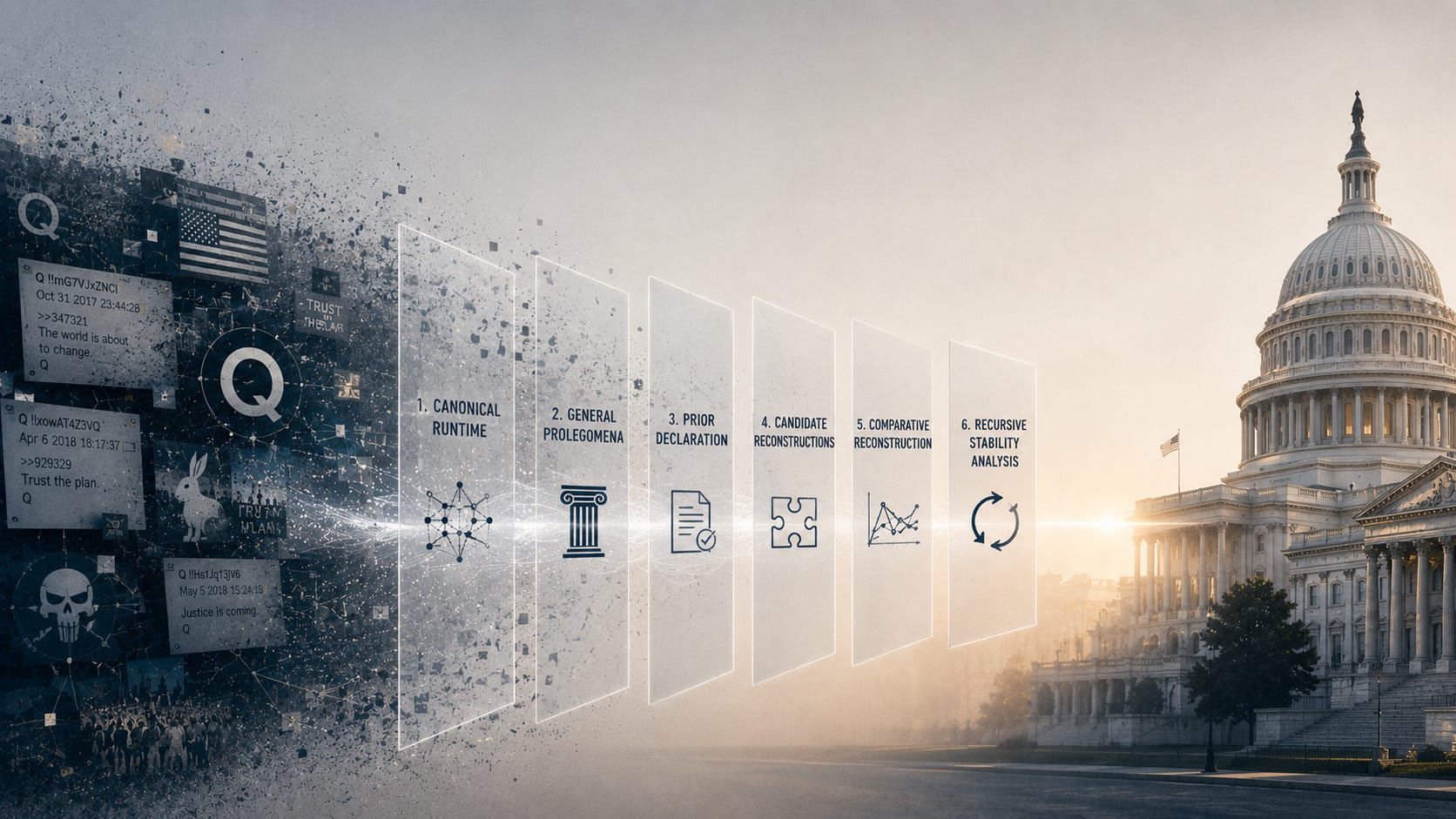
In response to many official sources echoing Q themes in ways that are self-evidently not accidental, I recently wrote a three-part series. This focused less on the drops themselves, their repeated messages, or their implications, and more on a systematic methodology for investigating complex narrative phenomena and evaluating them against competing worldview models.
By the end, I had introduced the idea of computational historiography, but deliberately declined to tell you my answer regarding Q.
You can review the articles here:
The Final Qonvergence — Part 1: The Chronology
How Q themes moved from the fringe into official U.S. government messaging.The Final Qonvergence — Part 2: The Method
How AI can compare competing explanations without ideological bias.The Final Qonvergence — Part 3: The Interpretation
Why this points towards a new discipline of computational historiography.
In this article, I continue documenting the alignment between Q content and top-level official social media accounts, but with a different purpose. Instead of focusing on the method, I will give you the output. There is a short window right now between the accumulation of the data points and their meaning becoming fully resolved. I am deliberately publishing this while ambiguity and plausible deniability have not yet completely collapsed.
The seriousness of allegations involving treason, election fraud, human trafficking, debt slavery, warmongering, crimes against humanity, and genocide can scarcely be overstated. The stakes are existential for those attached to the incumbent paradigm—notably the legacy mass media—as well as for whatever new powers-that-be have yet to formally reveal themselves. This article exists to demonstrate that rational inquiry, unclouded by either “QAnon” smears or patriotic anthems, remains possible at this unique moment.
For anyone coming to this subject fresh, a brief recap.
The Q drops objectively exist and can be reviewed on aggregator sites such as QAlerts.app, QAgg.news, and OperationQ.pub. There are many attempts to interpret this corpus, including my own On Q essays, Praying Medic’s Q Chronicles, Neon Revolt’s Revolution Q, Charlie Foxtrot’s recent Why Nothing Can Stop What is Coming, and numerous ongoing decoding efforts by independent researchers.
On top of this are ongoing decoding and propagation efforts including

and

and

There is also a substantial “QAnon” genre that seeks to discredit investigation into both the identity of Q and the allegations made in the drops. At this point, however, I regard that literature as largely irrelevant. Once the White House, Department of Homeland Security, and Department of War are all making overt Q-aligned references, refusing to investigate either Q’s identity or its claims no longer strikes me as credible journalism. Others can disentangle the distractions and delusions later.
There remains genuine uncertainty as to the parameters of what we are interacting with:
Is Q fundamentally a national phenomenon centred on the United States, or a global one?
Is it confined to Earth and Homo sapiens, or does it involve something beyond our conventional assumptions?
Is it the product of human craft alone, or of radically new technologies such as quantum computing?
Is it simply data moving across an information battlefield, or a protocol that generates resonance within human consciousness?
What, ultimately, is it seeking to achieve—and on whose behalf?
These, and many other questions, remain unresolved.
Some believe the answers have been in plain sight all along. Others hold very different views. Q is not a binary proposition that one simply “accepts” or “rejects”, but a space for inquiry into a complex manifold of interconnected questions. Even if Donald Trump, JFK Jr, Michael Jackson, Diana, Princess of Wales, and Elvis Presley all appeared tomorrow claiming central roles in the Q mission, that would not end the inquiry—it would merely open a new chapter of it.
In this context, the range of possibilities can seem almost overwhelming.
I often ask myself what a plausible process for disclosing extraterrestrial intelligence might actually look like, especially if there were “bad news”—for example, that some ET civilisations regard our children as a delicacy, or make good laboratory specimens. You could not simply spring something like that on the public. It would almost certainly require a controlled process of soft disclosure extending over many years, perhaps decades, assuming the threat itself had already been dealt with somehow.
What I can say with confidence is that the hypothesised threat landscape extends well beyond anything ordinary civilian institutions are equipped to confront.
This is where we return to the central claim about Q.
The drops themselves are cryptographically secured in a way that establishes a single technical attribution, even if operational control of the signing keys could conceivably have migrated over time. Throughout the corpus there is a repeated assertion that we—the civilian public—are receiving uniquely significant information via a military backchannel, deliberately constructed to work around various constraints, including national security laws.
That is a remarkably ordinary proposition compared to many of the wider hypotheses people now entertain. It refers to known institutions, known technologies, known legal constraints, and known military capabilities. It is also, at least in principle, a testable hypothesis.
Before worrying whether Q is terrestrial or extraterrestrial, conscious protocol or information operation, quantum computer or quantum consciousness, it seems prudent to settle the simpler question first:
Is Q substantially what it repeatedly claims to be—a military intelligence (MI) programme—or not?
Retrieving all the references to Q’s claim of being a military intelligence operation is left as an exercise for the reader. Drops 2, 6, 10, 11, 12, 14, 20, 28, 36, 97, 154, and 271 are more than sufficient to establish that we are operating in that arena.
If one drop says it all:
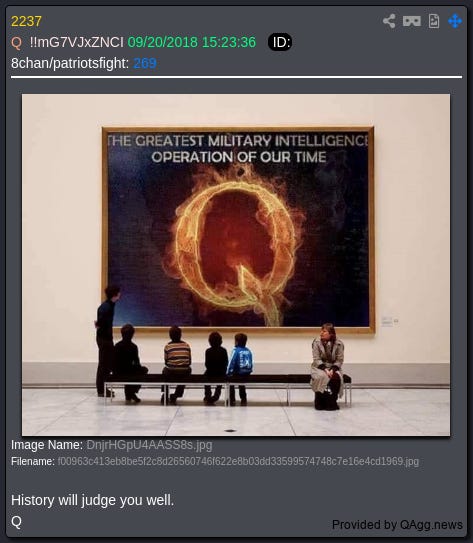
The stakes are obvious:
If the military intelligence claim is substantially true, then the subsequent allegations are arguably the most explosive ever made in public.
If it is false, then we are confronted with a profound national security failure, involving the long-term impersonation of commander-in-chief authority and military command.
Either way, the question is neither trivial nor academic. It is material, testable, and of extraordinary consequence.
Which brings us back to the present timeline, and ongoing reinforcement of Q icons, slogans, and themes by the highest levels of the American state. In the first article linked above documented around 20 examples of “nods” to Q, each plausibly deniable, but collectively demanding explanation. They were clustered in the days leading up to the publication date at the end of June. The sequence did not end there, and continued into July.
Examples include (not exhaustive):
28 June — Donald Trump refers to a “great painting”, echoing Q112 (“Paint the picture”) and Q128 (“Picture provides 40,000 ft view”).
29 June — The White House posts about the “foundations of our republic”, echoing Q1495 (“Laying its foundations”).
29 June — The U.S. Department of Education posts “Get your popcorn ready for a showdown!”, with “popcorn” serving as a recurring Q symbol for revelation, accountability, and justice.
30 June — The U.S. Office of Personnel Management and the U.S. Department of Education both post “Something big is coming”, echoing Q3756, Q2775, Q2792, and Q3740.
30 June — The Department of War CTO posts “The American warfighter always prevails”, echoing Q4387 (“WE WILL PREVAIL”).
30 June — Elon Musk posts the USAID image from Q1088.
30 June — The Department of Homeland Security posts “For God and Country”, echoing Q3352.
1 July — Dan Scavino posts an American flag in the characteristic Q-drop format, with the timestamp corresponding to Q1133.
1 July — The Department of Homeland Security posts a flag in the Q-drop format, having been foreshadowed by the account @OgAn0n661, whose repeated successful predictions suggest possible insider access.
1 July — The Department of War CTO posts an image using the unmistakable colour scheme associated with the Emergency Broadcast System.
2 July — The White House posts images featuring ten eagles and four eagles, having similarly been pre-signalled by the account @VincentCrypt46.
2 July — The Department of Homeland Security posts “Proclaim liberty throughout all the land unto all the inhabitants thereof”, echoing Q490, Q2039, Q3040, and Q4140.
2 July — The White House posts a flag corresponding to Q4559 and Q4433.
3 July — The White House posts “Let Freedom Ring”, echoing Q2039.
I have deliberately omitted the source links because the point is not to litigate these individual posts as isolated confirmations of Q. What matters is that they are increasingly being perceived as such, thereby shifting the burden of explanation onto those who have consistently rejected the Q hypothesis.
With each new instance of apparent official convergence, the question of whether Q is, in substance, a formally endorsed disclosure operation becomes more salient. The trajectory is becoming increasingly clear, even if the precise moment of resolution remains unknown.
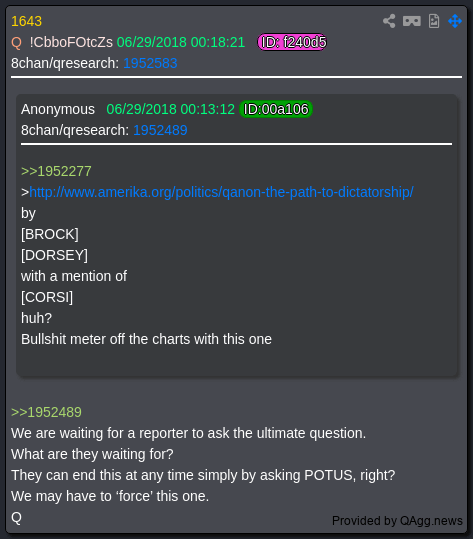
This possibility was anticipated in the drops themselves. The media could end much of the controversy surrounding Q—and therefore “QAnon”—at any moment simply by investigating its provenance. Their persistent refusal to do so has itself become the dominant signal, more informative than the unresolved identity of Q or even the institutional category it ultimately occupies.
The military intelligence question posed by the article’s headline turns out to be only a gateway question.
If the answer is “yes”, then another question immediately dominates:
Why is the military involved at all?
Which quickly leads to another:
Why is the military communicating directly with the public?
Militaries exist to defend the constitutional order against threats that lie beyond the lawful competence of ordinary civilian institutions. They are not normally used to investigate local corruption, shape public opinion, or communicate cryptically with civilians for entertainment.
If Q is substantially what it repeatedly claims to be, then the central question ceases to be one of authorship and becomes one of jurisdiction:
What class of problem requires military rather than civilian authority?
What body of law governs that authority?
And what does that imply about the conflict we may actually be living through?
At this point I need to acknowledge the work of Derek Johnson, whose extensive research into military affairs has exposed a gap in my own earlier analysis. He has assembled a substantial body of evidence and argument that the United States has, for some time, been operating under a continuity-of-government framework and the legal authorities associated with the laws of war. This is not the place to debate Presidential Emergency Action Documents (PEADs), Executive Orders, states of emergency, or the many other components of that case.
The point, however, is more fundamental than Derek’s own conclusions. You cannot answer the attribution question of whether Q is military intelligence—or explain the recent burst of Q-themed messaging from official accounts—without first considering the upstream question of authority.
In other words, you cannot even begin to debate the identity of Q without first establishing the category of inquiry within which that question is embedded.
The question is no longer simply, “Who is Q?”
It becomes, “What jurisdiction would make Q lawful?”
This leads to a different way of thinking about the problem. Rather than asking an AI a single, all-encompassing question such as “Is Q military intelligence?”, we break the problem into a sequence of much smaller questions.
The reason is simple. Different kinds of reasoning should happen in different places. We do not want assumptions influencing category selection, or the implications of a conclusion influencing the evidence used to reach it.
Each stage therefore performs one task only, passing its output to the next stage without revisiting earlier decisions.
The architecture consists of six stages.
Runtime Canonisation — Construct a bounded, reproducible representation of the observable data. Before asking what something means, we first agree on what has actually been observed.
Ontology Selection — Determine the admissible categories of explanation. Are we looking at an internet phenomenon, a political campaign, an intelligence operation, military affairs, or something else?
Prior Declaration — Make explicit the assumptions that legitimately follow from each admissible category, rather than leaving them hidden.
Candidate Reconstruction Generation — Generate every materially different explanation that is licensed by the evidence and assumptions. At this stage we create hypotheses, but deliberately do not evaluate them.
Comparative Reconstruction — Compare those competing explanations using Bayesian reasoning, description length, computational historiography, and related analytical techniques to determine which best explains the observed runtime.
Fixed Point Analysis — Finally, assume each surviving reconstruction is substantially correct, follow its necessary implications, and ask whether it converges to a stable picture of reality or collapses under the weight of its own downstream consequences.
The reasoning therefore proceeds in a fixed order:
What has actually been observed?
What kinds of phenomenon could produce it?
What assumptions legitimately follow?
What explanations become possible?
Which explanation best fits the observations?
Which explanations remain coherent after accepting their own implications?
Only then can we ask whether “military intelligence” emerges naturally as the preferred attribution.
In other words, we never ask the AI, “Is Q military intelligence?”
Instead, we ask a sequence of smaller questions whose answers progressively constrain what can reasonably be concluded.
Although developed here to investigate the Q phenomenon, this architecture is intended as a general framework for AI-assisted analysis of contested historical events. The contribution is not a new form of reasoning, but a disciplined way of combining existing methods while preventing different kinds of reasoning from contaminating one another.
The prompts I developed to implement this workflow are provided below. They are packaged as a single PDF, but should be run one at a time.

This is an experimental “work in progress”. You are welcome to improve them.
So what is the answer?
We are really asking a question beyond whether Q is military intelligence:
Does Q instantiate authority above the level of ordinary civilian life?
Since the prompts are available for others to run, I won’t reproduce all the intermediate outputs here. I asked both Grok and ChatGPT to perform the analysis independently.
A sample conclusion is below:
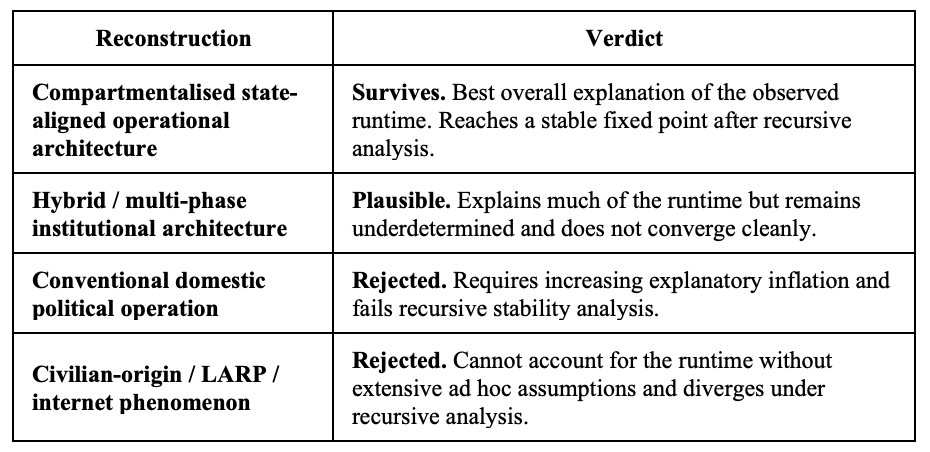
Grok’s synthesis was especially neat:
Based on the supplied runtime and the assumptions made explicit by the framework, “Q as a military information operation” survives every stage of analysis, while purely civilian explanations do not. However, the strongest surviving reconstruction is that any military component forms part of a broader hybrid institutional architecture rather than existing in isolation.
So we cannot honestly say “Q is military intelligence” as a matter of formally proven authorship.
What we can say is this: once the runtime is analysed systematically, purely civilian explanations no longer withstand scrutiny.
The surviving reconstruction is state-aligned, compartmentalised, and above the level of ordinary civilian life. Military and intelligence functions are no longer speculative decorations on the theory; they become natural consequences of the reconstruction itself.
The headline question of this article was, “Is Q a military intelligence programme?”
After years of work, I now think that is the wrong question. The AI reconstruction consistently converged on something more fundamental.
As noted above, the observable runtime (of the entire phenomenon, not just the Q drops) is most coherently explained by an institutional architecture operating above the level of ordinary civilian life.
Military and intelligence components emerge naturally within that reconstruction—not because they were assumed at the outset, but because simpler civilian explanations progressively fail as the runtime expands.
That does not prove authorship. It does not identify the individuals involved. It does not settle the legal framework under which such an architecture might operate.
It does, however, materially change the burden of explanation.
The interesting question is no longer whether Q should be dismissed as an internet hoax or political meme. Those reconstructions collapse under the weight of the observable evidence, requiring ever more coincidence, special pleading, and auxiliary assumptions simply to remain viable.
Indeed, this has been intuitively obvious to many researchers for a long time. The important change is not the answer, but that the question has become computational. AI allows competing reconstructions to be compared systematically rather than rhetorically.
Instead, the remaining uncertainty concerns the architecture itself:
If the runtime is substantially authentic, what institutions are involved?
How are military, intelligence, constitutional, and civilian authorities related?
Under what jurisdiction would such an operation legitimately exist?
Ironically, the investigation ended almost where it began.
The first question was:
Is Q military intelligence?
The last question became:
What class of conflict requires military or intelligence authority in the first place?
That is a very different question.
It also points beyond Q itself.
Perhaps the most unexpected outcome of this work was not the reconstruction, but the method.
By separating runtime selection, ontology, priors, reconstruction and recursive stability into distinct analytical stages, AI proved capable of reasoning about a deeply contested historical phenomenon in a disciplined and reproducible way.
Whether applied to Q or something entirely different, I suspect this architecture has wider uses wherever reality must be reconstructed from incomplete traces. Christian apologetics, archaeology, criminology, intelligence analysis, and historical research all confront the same fundamental task:
Infer hidden processes from the evidence they leave behind.
If nothing else, I hope this article demonstrates that questions once dismissed as impossible to analyse using rigorous methods can now be approached systematically.
AI cannot tell us what is true. But it can help us ask better questions—and sometimes, that turns out to matter more than the answers.
This article is not really about Q or military intelligence.
It is about runtime reconstruction.
Q is simply an unusually demanding test case.
That is precisely what makes it interesting.
If the method can survive this subject, it can survive almost anything.
This investigation began by asking, “Who is Q?”
It ends by asking, “Why Q?”
That is the question.
Finding Q and Anons in 2017 was the biggest gift ever for me. Up till then I was a lone conspiracy theorist.
Finding you, Martin, was gift....that keeps giving...thank you.
Martin, I recently learned from a knowledgeable American Patriot the "Society of Cincinnati", established in 1783, is the original group of "Revolutionary" authorities, civilian and military,
who requested Donald J. Trump run for (Revolutionary) President in 2017. A prompt into AI by someone skilled could possibly answer some Qs and provide additional historiography.