

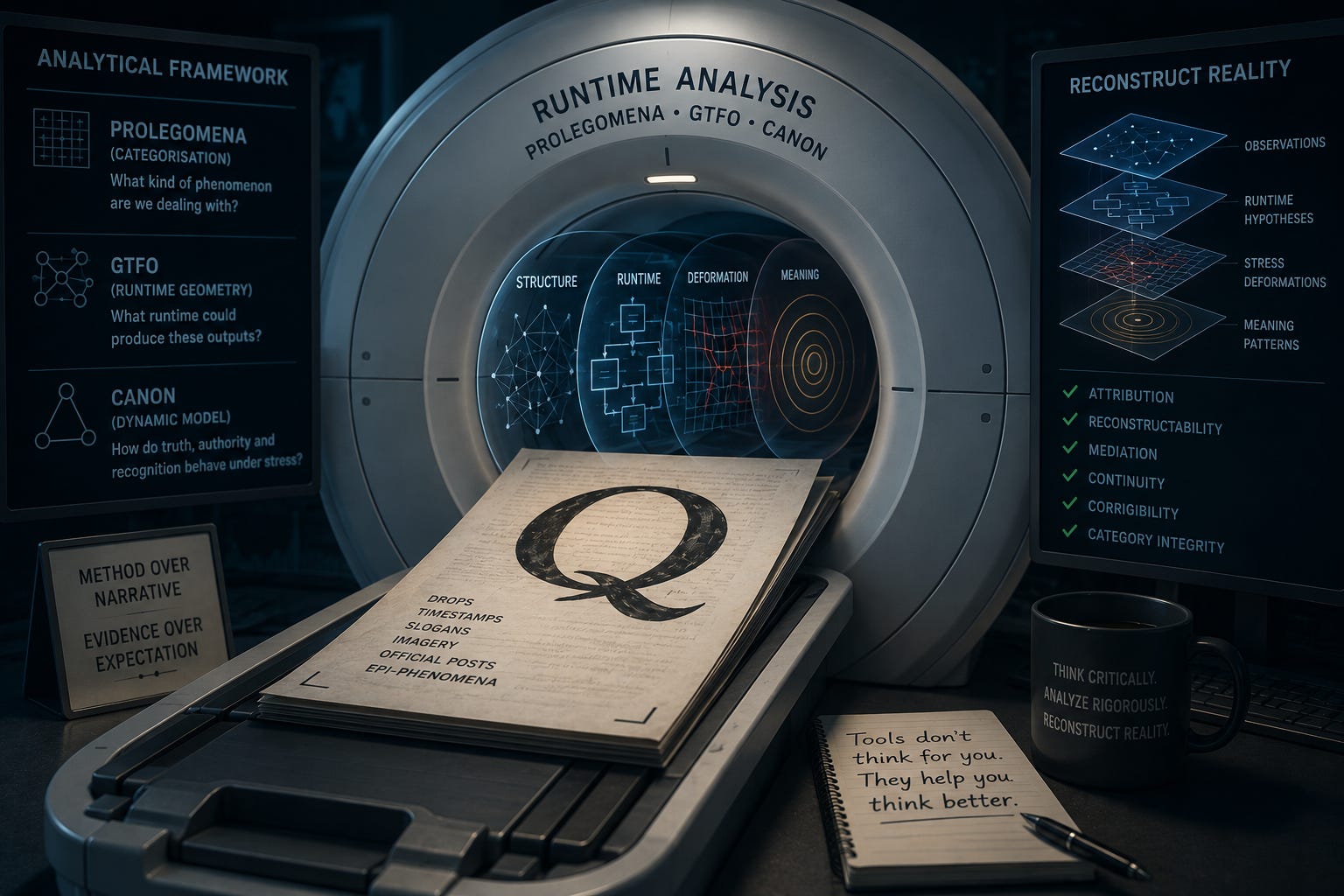
In yesterday’s essay, we examined how the American federal government is increasingly employing Q-themed language and iconography in its public communications. This includes the Departments of War, Homeland Security, Energy—and, since publication, Education—as well as the White House, the official Donald Trump account, the Office of the Director of National Intelligence, and other official channels. The messaging ranges from direct reuse of familiar Q slogans and imagery to more indirect allusions, such as timestamps that correspond to Q drop numbers.
The Final Qonvergence — Part 1: The Chronology

The last few weeks of the information war, as we approach the America 250 crescendo, have been considerably more interesting than the previous few years. The Q drops continue to echo through culture and, increasingly, official public communications, even if there is still (for now) no fresh Q-anointed content.
My personal stance on Q is well known; you can read my On Q collection of essays from 2018–2020 if you want to refresh your memory. To those who have immersed themselves in the gradual revelation of embedded criminality, and the plan to deal with it, the answer may seem self-evident. However, that perspective depends on having walked the journey from the beginning, following thousands of mutually reinforcing data points. These established the quasi-official nature of the Q drops as a backchannel operating around constraints imposed by national security laws.
That does little to help someone who is new to Q and is simply wondering why senior figures within the federal government have suddenly developed a taste for conspiracy theory slogans, imagery, and memes. The real purpose of this second essay is therefore not to persuade you to adopt my conclusions, but to demonstrate a general-purpose method for dissecting complex and controversial questions. Just as Part 1 established the observable chronology, Part 2 applies structural analysis before drawing wider conclusions.
Through legal work entirely unrelated to Q, I have developed a toolkit of AI analytical scripts that can be applied to almost any written artefact. The chronology presented in Part 1 is exactly the kind of object they were designed to examine. By the time you reach the end of this article, I hope you feel inspired to apply these tools to your own questions, whatever they may be. It is one thing to be exhorted to think for yourself; it is another to be equipped with the conceptual power tools to investigate the evidence.
There are three tools that I have published so far:
The Prolegomena Tool — asks what establishes the boundaries of the category we are dealing with, and what makes investigation meaningful.
The GTFO Tool — asks what kind of underlying “runtime” within those boundaries could be producing the observed outputs.
The Canon Tool — structurally analyses those outputs to reveal how truth, attribution, authority, and recognition deform under stress.
(The articles explain the tools in detail, but in practice all you need to do is ask an AI to apply the tool to the document(s) under examination and produce a detailed readout — in plain English.)
If it helps, you can think of these as:
X-ray – reveals gross structure and boundaries of bones and organs
CT scan – reconstructs internal organ structure from many projections
MRI – distinguishes different tissues and hidden internal organisation
Or even more simply:
Prolegomena: What organ are we looking at?
GTFO: How is it functioning?
Canon: Where has the structure become damaged or deformed?
What I am inviting sceptical readers to do is accept the Part 1 chronology as the observational event log, and then form their own view of what it might mean. What has changed since the early Q drops is that we now have automated cognitive tools that allow us to explore difficult topics privately, and at a scale where the volume of evidence would otherwise be overwhelming. I have applied the same tools to Tudor poetry, airport parking fines, leadership consulting, economic research, and the Lord’s Prayer. There is nothing Q-specific about them.
As you are perfectly capable of reading the AI outputs for yourself, I have embedded them as PDFs with only brief commentary on the insights they surface. The whole purpose is to transcend the “I reject Q” versus “I believe Q” dichotomy, and instead examine what is actually happening in front of us, together with what can reasonably be inferred from it. After reviewing the three outputs, I offer some reflections on the strengths and limitations of the process itself. This is work in progress, not a polished product that automatically generates open-source intelligence reports.
My own subjective assessment of the growing appearance of Q themes in official communications is deferred until Part 3.
Prolegomena Tool

The moment you walk into a doctor’s office and ask whether, say, you should take a particular medication, you have already accepted the framing that the question is medical in nature — and not one of unconventional warfare, for instance. That prior act of framing almost always goes unnoticed. Yet if the initial category is wrong, every subsequent stage of the investigation inherits the error.
The prolegomena concept asks “what comes before”; it establishes the prerequisites for inquiry to remain meaningfully attached to reality.
In the case of the Q drops, the attribution of authorship has been treated by conventional mass media as either irrelevant, uninteresting, or resolved. This is innately “unreal” to some degree, since someone or something was responsible for them. Every subsequent question is shaped by that initial separation from reality.
This first readout therefore establishes—or, perhaps more accurately, tests—the boundaries of the Q phenomenon. Before we can ask whether Q is right, wrong, genuine, synthetic, or something else entirely, we need to define the universe of discourse.
The readout asks six progressively deeper questions:
Who emitted the symbols? (Attribution)
Can we reconstruct the underlying reality from them? (Reconstructability)
How is their meaning transmitted? (Mediation)
Is the symbolic pattern persistent? (Continuity)
Do our explanations of the symbols still fit the observations? (Corrigibility)
Has the phenomenon itself changed category? (Category Integrity)
The key takeaways in this readout are:
Attribution: The communications are clearly attributable to official institutions, even if the ultimate strategic authorship behind the symbolic pattern (i.e. who is orchestrating it) remains formally unresolved.
Reconstructability: The chronology is publicly reconstructable—you can trace it backwards towards its source reality—although interpreting its deeper meaning requires familiarity with the Q corpus.
Mediation: The communication relies on layered symbolism and plausible deniability, requiring active reconstruction through the mediating Q drop symbolism rather than simply reading the words at face value.
Continuity: What could once be dismissed as isolated coincidence has become a sustained pattern spanning multiple institutions, platforms, and time, making purely accidental explanations progressively less persuasive.
Corrigibility: The chronology tests competing explanations (e.g. internet prank, foreign state operation, or domestic information campaign) by forcing them to account for new observations rather than simply defending old assumptions.
Category Integrity: Q can no longer be treated solely as an external fringe phenomenon, as its symbolic vocabulary now demonstrably intersects with official government communications, requiring a reassessment of what category the phenomenon now occupies.
In other words, the sustained pattern of Q-themed messaging now demands explanation.
GTFO Tool
Having established what kind of “organ” we are examining, the next question is how it is put together and how it functions. Rather than beginning with theories about intent or motivation, the GTFO Tool examines the observable structure from four complementary perspectives:
Geometry — There is a pattern.
The directly observable surface features of the phenomenon.Topology — The pattern has stable structure.
The relationships that remain invariant beneath those observable geometric features.Field — The stable structure favours some governing processes over others.
The underlying process that organises those relationships and determines which topologies are stable.Observability — Those processes imply a hidden runtime.
The hidden runtime that could plausibly produce the outputs we observe.
The key takeaways in this readout are:
Geometry: The observable evidence is not a handful of isolated posts, but a coherent emission pattern spanning multiple official institutions.
Topology: Beneath the changing posts lies a stable structural pattern: repeated reuse of the same symbolic corpus, reinforcement across institutions, distributed communication, and preserved plausible deniability.
Field: Simple fields such as electioneering, trolling, or technology marketing require increasingly elaborate assumptions. A field based on deliberate symbolic convergence explains more of the observed geometry with less explanatory overhead.
Observability: The observed outputs are more consistent with a coordinated underlying runtime than with independent, uncoordinated activity, even though that runtime cannot yet be observed directly.
In other words, GTFO shifts the investigation away from debating individual posts and towards reconstructing the hidden runtime capable of generating the observed pattern.
Canon Tool
Medicine has a fairly natural progression:
History and examination — What patient do we have? (Prolegomena)
Imaging — What is its internal structure and function? (GTFO)
Pathology and diagnosis — What has gone wrong, how has it failed, and what does that tell us? (Canon)
Many pathological conditions remain hidden until a biological system is placed under stress. The Canon therefore examines how truth, attribution, authority, and recognition behave under informational load, identifying characteristic patterns of deformation and failure.
Rather than asking simply whether a claim is true or false, it asks whether the underlying structures retain their integrity when subjected to competing narratives, uncertainty, and institutional pressure.
Not every test in the suite is applicable to every problem; the prompt only asked for responses from the relevant ones.
The key takeaways in this readout are:
Primitive Runtime (ΩΛ∆∑): The symbolic vocabulary of the Q drops has changed very little. What has changed is its institutional attachment (Λ): the same symbols are now increasingly bound to official government accounts while formal recognition remains deliberately incomplete.
Attributability Mechanics (ΔΣ): Recognition (by the public) is advancing faster than attribution (to an authoritative source). More people can recognise the symbolic pattern, yet no corresponding official explanation has been provided for why it exists or why it is now being promoted.
Reconstructability: The observable evidence has grown sufficiently that reconstructing a relationship between historic Q symbolism (for example, Trust the Plan) and present official communications (for example, X posts) requires progressively fewer inferential leaps, even if strategic intent remains uncertain.
Recursive Cybernetics: Official communications, independent researchers, and mainstream media now reinforce one another in a self-referential feedback loop, stabilising the symbolic vocabulary (a shared lexicon) without stabilising its interpretation (a shared meaning).
Attribution Debt: Every additional Q-themed communication shifts the explanatory burden onto models that predict no such convergence. It is no longer sufficient simply to dismiss the pattern; it now has to be explained.
Diagnostic Method: The chronology itself satisfies the Canon’s methodological requirements by remaining event-local, attributable, reconstructable, and corrigible, reducing the risk of AI drifting into unconstrained speculation. Its purpose is disciplined diagnosis rather than narrative persuasion.
In other words, the Canon is less interested in proving a theory than in exposing which theories begin to break as reality pushes back.
Reflections on the method
The first time I ran the Prolegomena Tool, the output was disappointing. ChatGPT assumed I was asking it to help write this article, and quietly substituted “helpful prose” for disciplined analysis. The result was exactly the kind of bland, generic AI smoothing that readers have come to expect—and dislike.
Only after explicitly instructing it to treat the tool as a stand-alone analytical instrument, rather than a writing aid, did the quality improve dramatically.
This turned out to be an important lesson. Large language models are strongly biased towards producing polished, plausible answers, even when what you really want is a faithful execution trace of an analytical process. The first challenge was not teaching the AI the tools—it was persuading it to stop trying to be helpful.
The instructions governing how the tool is applied matter almost as much as the tool itself. Asking the AI to execute the framework rigorously, thoroughly, and only on the evidence under examination proved essential.
These tools do not prescribe how the output should be presented, only the concepts to be examined.
What you are seeing is essentially a laboratory experiment rather than a finished product. As this article is about the method rather than the conclusions, and more concerned with pedagogy than advocacy, I have deliberately left the reports close to their raw form instead of polishing them into conventional prose.
As a further experiment, I applied the same tools to the same chronology using Grok.
The reports are not identical, but the broad structural diagnoses converge remarkably well. That is exactly what one would hope from a genuine analytical framework. Independent cognitive engines should not produce identical reports, but they should independently identify the same underlying structures.
The Grok reports are included here for you to compare with the ChatGPT versions.
Prolegomena:
GTFO:
Canon:
Whatever conclusions you ultimately reach about Q itself, I hope this demonstrates something more generally useful:
AI is beginning to evolve from a machine that merely generates answers into one that can, when properly instructed, act as a reusable instrument for disciplined inquiry.
The purpose of this exercise is to disintermediate the analysis of both the Q drops and their epiphenomena, such as official social media posts. You no longer need to rely on me—or anyone else—to perform the first-pass structural investigation. While not all source material is yet in a form that is friendly to AI, and these tools are certainly no panacea, they dramatically lower the cost of exploring difficult questions for yourself.
That said, there is still a skill in pushing adversarial testing of ideas to its limits. As a final experiment, I asked both ChatGPT and Grok to identify the deepest structural insights emerging from the analysis that had not already been discussed, and then reconciled their outputs into a single synthesis.
After comparing the independent outputs, five structural insights consistently emerged that neither model had been explicitly prompted to produce. They are not conclusions about Q itself, but observations about the dynamics of the symbolic system (including the “official” social media posts) revealed by applying the tools.
The resulting synthesis is reproduced below.
Five Non-Obvious Insights
1. The runtime is executing a binding transition, not a symbolic one
The most important change is not what is being said, but who is now authorised to say it. The slogans, imagery, and motifs have remained remarkably stable for years. What has shifted is their attachment — from anonymous, low-authority sources to official institutional emitters. This is a change in Λ (binding), not Ω (the symbols themselves). Once you see this distinction, much of the surface noise falls away.
2. Plausible deniability is load-bearing infrastructure
Ambiguity is not simply defensive cover. It is performing active work within the system. By keeping attribution unresolved while steadily expanding recognition, the runtime absorbs political and institutional stress that would otherwise force premature closure or fracture. In this architecture, plausible deniability functions as a governing technology rather than a temporary shield.
3. We are witnessing the migration of a symbolic commons into state infrastructure
The chronology documents something more structural than messaging alignment. A symbolic system that originated outside formal institutions is being progressively rebound to official government accounts without any explicit declaration of ownership or sponsorship. This is not primarily a communications campaign. It is a quiet migration of symbolic authority across institutional boundaries.
4. The burden of explanation has reversed
Ten years ago, anyone claiming meaningful convergence between Q symbolism and official institutions carried the explanatory burden. The accumulating geometry has quietly inverted that. Models that continue to insist there is no substantive relationship must now do more work to explain the observed pattern than models that treat convergence as real. Attribution debt is accumulating on the frameworks, not just on the phenomenon.
5. These tools are becoming reusable conceptual instruments
The most interesting methodological finding was not about Q. It was that the same analytical frameworks, when applied rigorously by different models, produced convergent structural diagnoses rather than narrative agreement. This suggests the tools are beginning to function less like clever prompts and more like diagnostic instruments — ones capable of exposing how contested phenomena actually behave under informational load, regardless of the observer’s prior beliefs.
Closing thoughts
When I conceived of this series, I imagined I might use these tools to help me write a more insightful essay. What I eventually realised is that the real “aha!” is not “better insight from Martin on the Q drops”, but a transfer of analytical capability.
Anyone can now perform rigorous, rational, evidence-driven structural analysis of almost any contested subject. You don’t even need to understand the underlying frameworks in detail; you simply ask an AI to apply them, examine the results, and then use those outputs as the starting point for your own inquiry.
If you are feeling adventurous, I encourage you to put that claim to the test. Take these tools, together with the chronology in Part 1, and apply them to the Mother Jones or Independent articles discussed there. Don’t outsource your thinking to me, or to any propaganda outlet, whatever its political persuasion. Use the AI to reconstruct the runtime for yourself.
Thinking for yourself has always been good advice. What has changed is that we now have thinking machines capable of doing much of the conceptual heavy lifting. They won’t decide what is true for you, nor should they. But they can dramatically reduce the cost of disciplined inquiry, leaving you to do the one thing that still cannot be automated: exercise your own judgement.
Was it just me, or did anyone else get the chills reading this, on last line: (?)
“Do the one thing that still cannot be automated: exercise your own judgement.“
And there you have it. We are innately equipped to do just that. I do believe.