

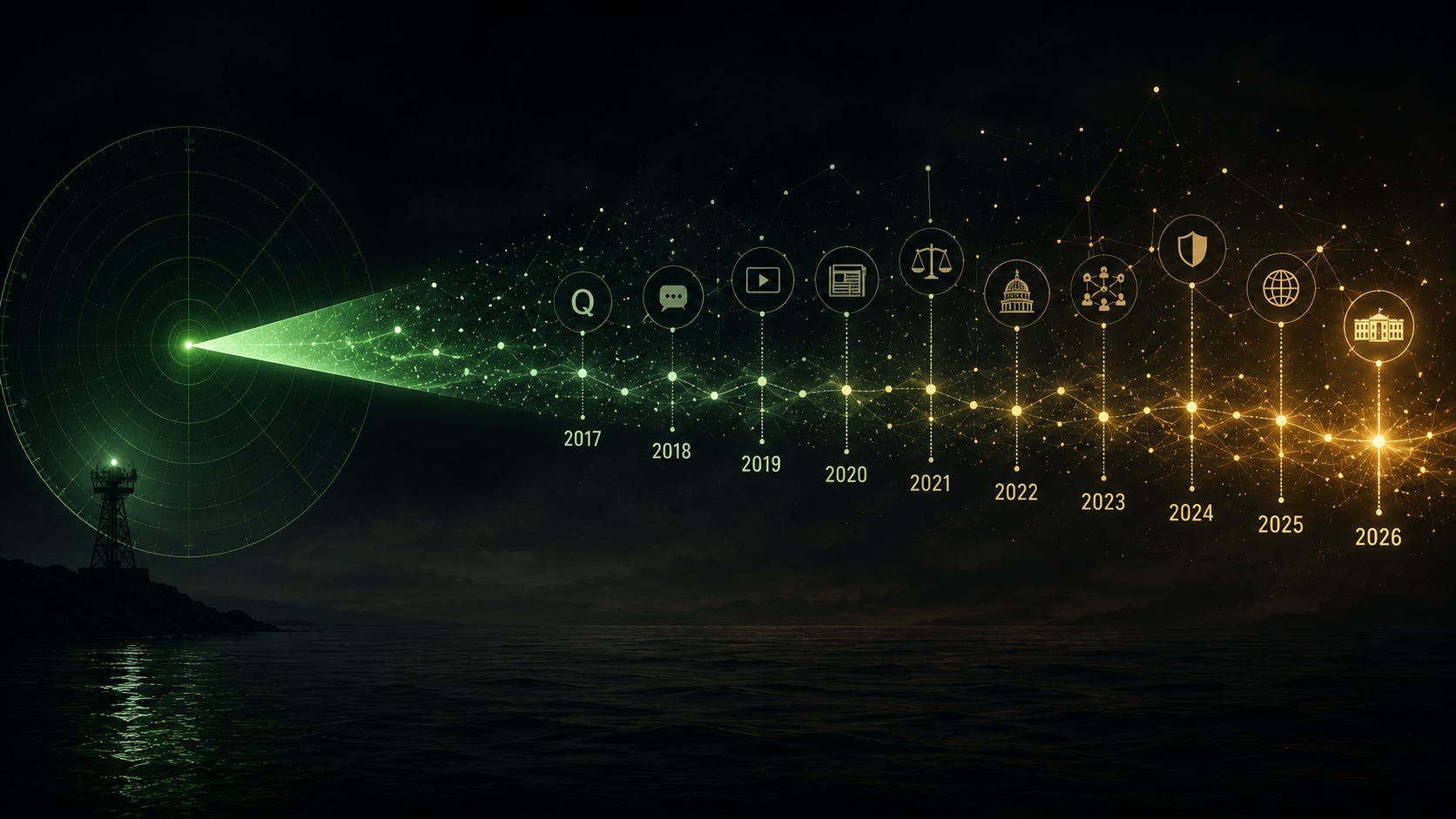
In the two previous articles in this series, I presented a neutral chronology of the recent burst of Q-themed social media emerging from the highest levels of the Trump 2.0 administration, followed by a demonstration of how general-purpose AI tools can be used to investigate the phenomenon without becoming trapped in either MAGA advocacy or QAnon allergy.
In this third and final article, I close the loop by explaining how my own thinking has evolved. The result is not simply a revised interpretation of Q, but a different way of thinking about long-running historical phenomena: as dynamic systems of attribution, recognition, and institutional behaviour.
That perspective generalises beyond this particular case towards a new science of computational historiography. Instead of dividing people into the “awake” and the “asleep”, it formalises competing historical reconstructions so they can be examined, challenged, refined, and, where necessary, discarded.
I write this article on a somewhat sultry July night, visiting the house where I grew up just west of London. My family moved here in the summer of 1975, and I can still remember watching the television coverage of America’s Bicentennial celebrations the following year on our new Sony Trinitron TV.
America’s 250th Independence Day celebrations are now only two days away, and are likely to be every bit as colourful—if not more so. You do not need a mathematical model to conclude that some kind of historically significant announcement or event is at least plausible at such a symbolic moment.
The only uncertainty is not whether history will continue to unfold, but what kind of history we are actually living through. My audience, therefore, is not necessarily my Substack readers today, but those who may arrive a month or a year from now, trying to make sense of what may prove to have been a profound cultural and geopolitical transition.
The precise contours remain uncertain, even if widely foreshadowed. I am typing furiously at 2am in the hope of staying ahead of whatever revelations—or chaos—the next few days may bring. If the recent trajectory continues, we may be witnessing the opening stages of a rupture whose exceptional scale has been hinted at for years—one that could ultimately make many of today’s political arguments seem trivial and parochial.
Events will do all the persuading necessary about the intent and outcome of the MAGA movement. My goal is to identify the shared ground that always existed—evidence, reason, and method—regardless of what anyone believed, at any given moment, about Trump, Q, the Great Awakening, or, for that matter, the totems of liberal ideology.
Analysis of a controversial phenomenon such as Q typically falls into one of two broad modalities:
Advocacy, which starts from observable and sourced data, then combines these with intuition, contextual knowledge, and broader narratives to construct an explanatory model capable of generating scenarios and forecasts.
Debunking, which frequently treats the underlying question as already resolved, and therefore substitutes selective evidence, pejorative labelling, appeals to contested authority, and the policing of permissible inquiry for genuine investigation.
Neither mode automatically conveys truth. One can be sincere, careful, and reasoned—yet still wrong; equally, one can be lazy, prejudiced, and dismissive—yet happen to be right.
Over time, my investigation evolved from asking Who Q might be? and What purpose the drops might serve? to something else entirely:
Why does this debate exist at all, and what has sustained it for nearly a decade?
If we simplify it into two competing camps—“obvious” and “insane”—what kind of historical process allows self-evident truth and certifiable madness to occupy the same evidential landscape?
In computer science, my “home” field of study, there are few vitriolic disputes of this nature. Competing ideas are generally resolved through logical proof or practical deployment at scale. So when I encounter a controversy like this, I instinctively reach for my toolkit of invariance, pre- and post-conditions, and refinement calculus.
By contrast, advocacy around phenomena such as Q readily entangles behavioural observation, hypothesised intent, and emitted symbolism, producing confusion rather than clarity. A more information-centric approach first teases these elements apart before asking a simpler question:
What underlying process could have generated them?
It is a small change of perspective, yet a decisive one.
This evaluation of Q is an ongoing process. Since publishing Part 1, there have been further top-level institutional “Q-isms”—I will not even recount them here, as the pattern is now well established. Whatever one’s prior beliefs, that pattern demands explanation.
What has increasingly helped me, especially as an explanatory device, is to think of the whole phenomenon as a runtime—rather like the software running on your phone or laptop that enables you to read this article.
Any runtime has both a visible surface, where events and interactions occur, and a hidden interior to which outside observers have no privileged access. The Q runtime now leaves behind an event log stretching back to at least 28 October 2017—the first Q drop—and arguably earlier through precursor phenomena such as FBIAnon, MegaAnon, or perhaps even Cicada 3301.
That runtime trace now encompasses far more than four thousand Q drops. It includes years of public reactions, media narratives, censorship, elections, institutional behaviour, legal actions, symbolic evolution, official communications, and—perhaps most importantly—the conspicuous absences: the explanations never offered, the questions never asked, and the repudiations that never came.
This evidence trail can be assembled and described without immediately triggering serious division; the events themselves are, for the most part, objectively characterisable. What matters is not any single event, but that the runtime has continued to evolve.
When I published WWG1WGA: The Greatest Communications Event in History in July 2018—effectively nailing my professional reputation to the Great Awakening mast—the observable trace was still short. Whatever conclusions people reached, they did so on the basis of what is now only a small fraction of the available runtime.
Eight years later, that history has become vastly richer, and it continues to evolve in significant ways to this very day.
The real “aha!” is that Q—or, more precisely, the authorship denoted by Q—is no longer the most interesting object of study. Whatever Q is, it sits inside a much larger historical runtime spanning institutions, media, politics, and culture. That expanding runtime now leaves behind an increasingly rich trace.
It is no longer the drops themselves that most reward investigation, but the behaviour of the larger system in which they are embedded.
The shift in outlook is subtle, yet revealing.
To bring it to life, let me share one genuine “OMG!” moment from my own analysis. During the Second World War, a handful of information technologies fundamentally altered the conduct of warfare. One was cryptography. Another was spread-spectrum radio. A third was radar: an apparently ordinary signal was transmitted, while the information of real interest was recovered not from the transmission itself, but from the reflections it provoked.
Seen in this light, the White House, Department of War, Department of Homeland Security, and other institutional “Q-isms” of June 2026 become less interesting as messages than as reflections. Their value lies not primarily in what they say, but in what they reveal about the willingness of official institutions to recognise, adopt, or inhabit a symbolic language that for years was publicly dismissed as fringe.
In doing so, they extend the very runtime they appear merely to comment upon.
What if Q is neither primarily a communications operation, telling people what to think, nor merely a training system, teaching people how to research and reason for themselves, but something else entirely? What if the mobilisation of Anons was itself the energy emitted into the information environment, while the true intelligence lay in the reflections—in the reactions of institutions, media, censors, bureaucracies, and political actors?
In that framing, Q resembles less a broadcasting system than an active sensing system. The messages matter. But what matters even more is what they cause the surrounding environment to reveal about itself.
My early analysis saw “the system” primarily as Q inviting and inciting Anons to activate and cohere into a kind of digital militia. I still think that captured something important, but it now feels incomplete.
The battlefield is not simply the contest for narrative dominance, but the accumulation of the runtime trace itself.
Every post, reaction, censorship event, media article, lawsuit, election, official communication, and conspicuous non-event becomes part of the evidence from which the underlying process can be reconstructed.
If there is a Deep State, this architecture gradually surfaces at least its shallower structures, if not deeper ones. We always knew that Anons were not passive recipients of ideas, but active participants. What I had stopped one step short of recognising was that they were also agents of perturbation, generating information through the responses they provoked.
The radar analogy is not ultimately about radar. It is about what now counts as evidence.
Once the runtime itself becomes the object of study, the most valuable evidence is no longer found in any individual post, drop, or proclamation. It is found in the pattern of reflections: what institutions recognise, what they ignore, what they deny, what they quietly adopt, and what they choose never to explain. Those reflections are not incidental. They are the signal we were trying to detect all along.
The key intellectual move is to stop treating ourselves as participants inside the runtime and instead treat the runtime itself as the object of study.
This reveals a very interesting dynamic over the long arc of the Q runtime. A core “trick” has been to keep Q’s identity ambiguous, while steadily building a field of recognised themes, data points, and shared purpose. Such a structure is unusual. Recognition normally follows attribution of authorship and authority, not the other way around.
Initially there were many plausible explanations for the kind of agent Q might be: a lone hoaxer, political campaign, commercial grift, private intelligence agency, foreign government, or state-aligned actor, whether actively endorsed or merely tolerated.
At first, many of these positions were intellectually respectable.
Over time, however, the runtime trace shortens or lengthens the description required to sustain each hypothesis; the economics of belief evolves:
At present, the idea that the Departments of War, Homeland Security, and Energy have all independently taken up Q-themed LARPing requires assumptions that are beyond heroic.
Meanwhile, the proposition that Q is broadly what it says it is—at the level of the overall architecture, if not necessarily every individual claim—steadily gains explanatory power.
This creates a kind of epistemic scissors:
One philosophy of recognition—that authority naturally attaches to the media, academia, NGOs, policy experts, and other established institutions—accumulates ever greater attribution debt as the runtime unfolds. Ever more explanations have to be bolted-on to patch anomalies.
The other—that truth can emerge through adversarial, distributed, bottom-up processes such as the Chans and social media—begins life carrying enormous attribution debt. “Q is military intelligence” was, and remains, an extraordinary claim with very little direct proof, but (given time) compelling indirect evidence.
Over a period now approaching a decade, the balance of explanatory cost has steadily shifted. One reconstruction becomes progressively more expensive to maintain; the other progressively compresses the observable runtime.
This is the point at which the burden of explanation quietly reverses.
In 2018, anyone proposing that Q was broadly what it claimed to be carried almost all of the explanatory burden. Today, after eight years of accumulated runtime, that burden increasingly falls on those insisting that nothing of consequence is happening.
The Q operation appears designed to migrate recognition from one pool of authority to another:
Legacy institutions increasingly incur attribution debt as they must explain not only the growing body of observable convergence, but also their own persistent reluctance to investigate it.
Meanwhile, distributed investigators begin with enormous attribution debt—“Q is military intelligence” was, and remains, an extraordinary claim—but see that debt steadily reduced as the runtime unfolds.
At one level, this is hardly a new observation. Many commentators have remarked on the migration of trust from legacy institutions towards decentralised networks.
What is novel is having a formal model and vocabulary that explains why this happens, measures how it happens, and recognises it as one instance of a broader doctrine of attribution, recognition, and authority—not one confined to Q, politics, or even fifth-generation warfare.
My proposition—and a radical one—is that history is becoming computable.
Q is not the discovery. It is the case that forces us to develop the method.
By “computable” I mean we can construct, compare, and evaluate competing reconstructions of what actually happened in a disciplined and increasingly rigorous manner. Rather than arguing over isolated facts or ideological commitments, we compare whole historical runtimes, asking which reconstruction best explains the accumulated evidence with the fewest independent assumptions.
The analyses in Part 2, using my Prolegomena, GTFO, and Canon tools, are a tentative first step. They are not the science itself, but the beginnings of its instrumentation.
We can go much further.
To illustrate the idea, consider two competing reconstructions of the observed Q runtime. Ask yourself: What underlying process could have generated the observed events?
History A (Q substantially real)
A compartmentalised, state-aligned information architecture operates over a long horizon through a public-facing subsystem (Q). Its functions include distributed sensing, public training, and recognition migration under conditions of deliberate ambiguity. The same underlying runtime generates the symbolic, institutional, monetary, and constitutional patterns observed over nearly nine years, culminating in the 2026 convergence as recognition migrates into official state communications.
History B (Q not substantially real)
Q originates outside state structures—a LARP, civilian movement, political operation, rogue element, foreign influence campaign, or emergent internet phenomenon. The symbolic convergence of 2026 results from later, largely independent institutional adoption through coincidence, meme diffusion, opportunism, parallel evolution, or other unrelated processes. The apparent coherence across symbolic, institutional, monetary, and constitutional domains is therefore emergent rather than architected.
We can now ask AI to compare the observed runtime (such as the chronology in Part 1) against each reconstruction (A or B), identifying where additional assumptions have to be introduced to explain the evidence. In effect, we are estimating the description length of each history. By Occam’s Razor, the more parsimonious reconstruction deserves the higher prior credence, all else being equal.
Better still, this process is iterative. Competing AIs can challenge one another’s priors, expose hidden assumptions, refine Bayesian weightings, and progressively converge on reconstructions that better explain the accumulated runtime. The mathematics is beyond the scope of this article, but the principle is straightforward.
History itself becomes the dataset against which rival accounts are continuously tested.
I may publish my own weighted priors and analysis tables in another article.
The temptation is to tell you what my AI engines—ChatGPT and Grok—ultimately concluded. But that would defeat the purpose of this series. The point is not to replace one authority with another, whether legacy media or artificial intelligence.
You do not have to accept the conventional “QAnon” narrative. Equally, you do not have to accept mine “On Q”. Nor, for that matter, do you need to spend months or years reading thousands of Q drops yourself.
The more interesting question is simply this:
What kind of hidden runtime is capable of generating the history we can all now observe?
For centuries, history has largely been written by institutions looking backwards.
Computational historiography allows competing reconstructions to be compared while history is still unfolding.
That has only recently become practical. Reconstructing a multi-year runtime, mapping its topology, and testing competing models against an ever-growing trace once demanded prohibitive amounts of time, expertise, and attention.
AI has collapsed that cost.
What once required months of painstaking work can now be done in hours.
What once depended on rare expertise can now be checked by any careful reader.
Computational historiography is therefore not merely a new perspective.
It is a new capability.
Whether the Q phenomenon ultimately proves to have been a military intelligence operation, a constitutional restoration programme, or something stranger still, is no longer the most important discovery.
The more important discovery is that AI has given ordinary people the ability to treat history itself as a computational object—to inspect the runtime, compare competing reconstructions, and judge them against the accumulated trace rather than institutional authority or narrative comfort.
That capability will not remain confined to Q.
It changes how we investigate everything else.
Perhaps, then, the “Final Qonvergence” is not simply the alignment of Q symbolism with official institutions.
It is the convergence of the observer with the method.
The reader becomes the investigator.
The consumer of history becomes its computational historian.
You do not need to know who Q is.
You need to know who you are.
Not a passive consumer of narratives.
An active participant in reconstructing history.
A compelling piece right up to AI part. I can't get myself to take AI seriously because it loves to make stuff up. It's just not reliable. If you don't catch a false premise it sneaks in or a re-word that turns a logical point flacid, it can really throw you off course. I use it for short rewrites- it's pretty good at that. But you still have to watch every point it makes because it can significantly shift emphasis.
That aside, as soon as Martin is teaching his first Grad-level University Philosophy class, I'm applying! This will ABSOLUTELY be taught someday to normies. Brown University works best geographically for me, please!
from your Telegram:
"After eight years, I no longer think the most interesting question is “Who is Q?”
I think the more interesting question is:
What kind of hidden runtime could have generated the history we can now observe?
My concluding essay introduces the idea of computational historiography—using AI to compare competing reconstructions of history rather than simply arguing over narratives."
Ever read Asimov's Foundation trilogy?
And actually nothing holds a candle to the astonishing 'future proves past' accomplishments and historical harmonic resonances of the Bible for that matter