

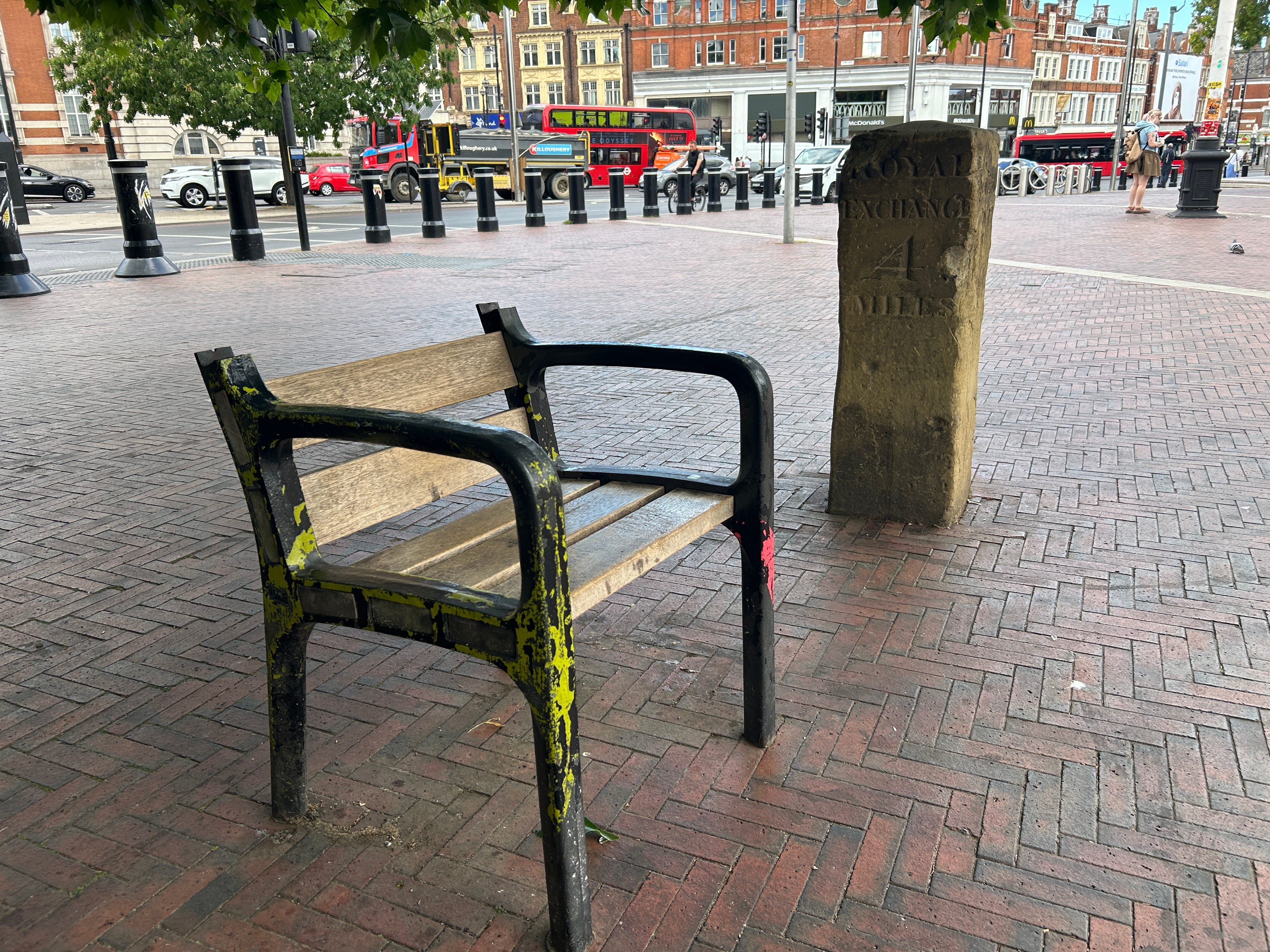
Last week I was walking through Brixton in south London, passing a spot I normally hurry by. The timing was different from my usual routine, so the streets were quieter and there were fewer distractions. For the first time, I noticed an old stone milestone.
It surprised me—not because it was there, but because it had escaped my attention for years despite my having walked past it hundreds of times. How could something so substantial remain effectively invisible? Why had it possessed so little salience until now?
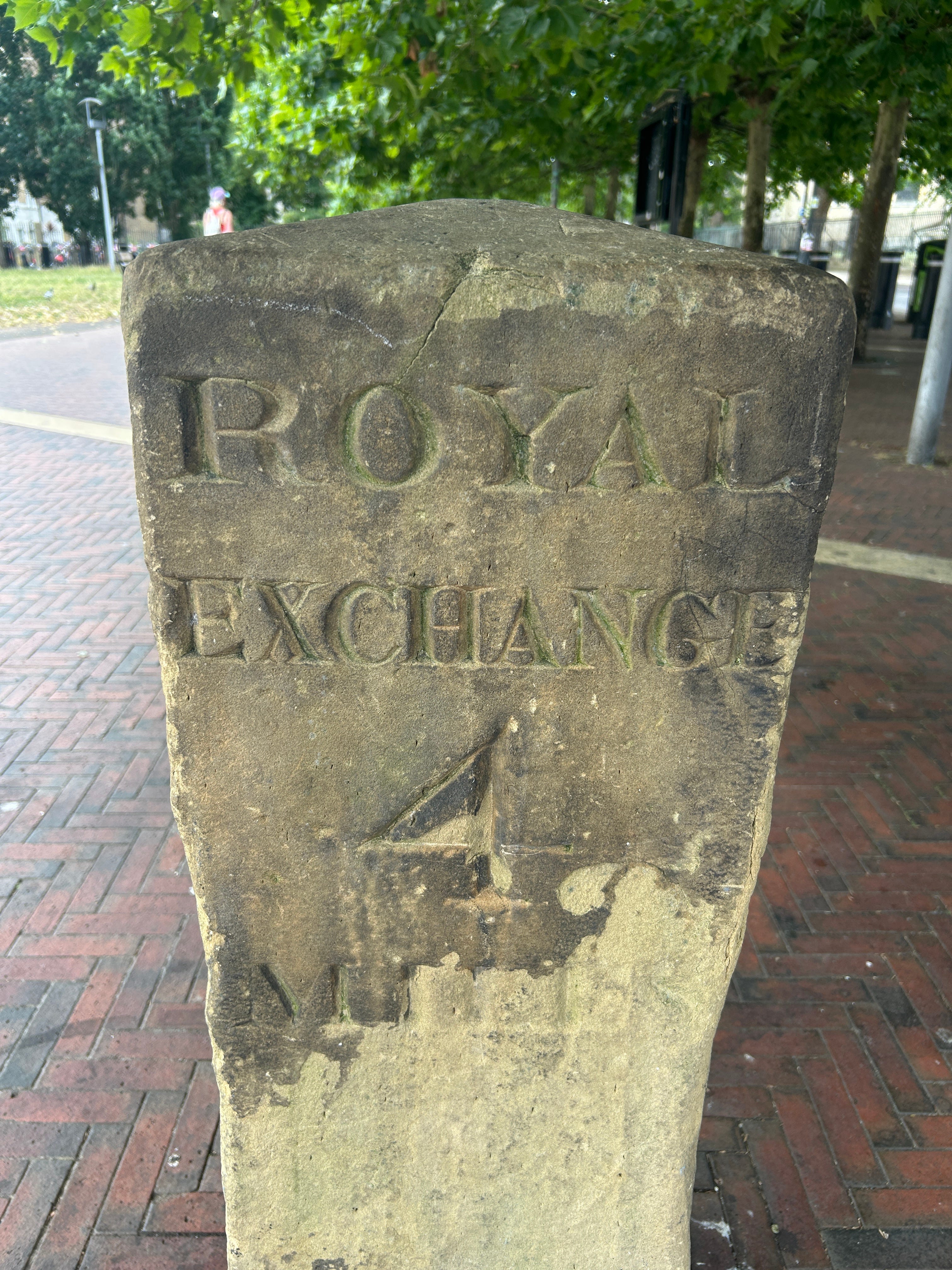
The inscription was simple enough: “ROYAL EXCHANGE 4 MILES”. The Royal Exchange is the magnificent eighteenth-century building at the heart of the City of London, once the commercial centre of the nation. It also served as the datum from which distances along many of London’s historic roads were measured.
Today that role has largely passed to the statue of King Charles I at Charing Cross, on the edge of Trafalgar Square, which serves as the modern reference point for road distances from London.
Readers will doubtless know of my fascination with symbols, structure, semiotics, and semantics. An object like this is never merely an object; it carries layers of meaning, history, authority, and institutional memory. So I decided to run it through my AI “juicer” tools to see what richness could be extracted.
What follows is not really about London milestones, nor even about my own methods for analysing meaning. It is an invitation to dig deeper by deliberately occupying different perspectives — because insight is often bottlenecked not by how hard we think, but by the singular viewpoint from which we begin.
What follows is the output, lightly edited for readability on Substack, from four of my analytical AI tools:
Prolegomena, which asks what kind of thing the object actually is.
GTFO (Geometry, Topology, Field, Observability), which reconstructs the hidden runtime that generated it.
Canon, which analyses how the object acquires and preserves authority.
State Vector, which characterises the current state and likely behaviour of the runtime.
The first three are described in the linked articles, while the fourth can be downloaded here.
Finally, I asked the system to identify any non-obvious insights that emerged only after viewing the object through all four analytical lenses.
Intelligence can be systematically increased by forcing disciplined changes of perspective.
I found the results compelling enough to share almost verbatim. My purpose is not to showcase AI-generated prose, but to demonstrate something more interesting: large language models can be induced to reason in qualitatively different ways by constraining the perspective from which they approach a problem.
Instead of repeatedly asking the same model to “think harder”, we can require it to think differently. The difference is not merely in the amount of analysis, but in the kinds of insight that become possible.
At the very end is a wrap-up commentary about the method, and what you can do to incorporate it into your own work.
Prolegomena
What kind of symbolic system is this?
Applying the General Prolegomena to this object is illuminating because a milestone is itself a symbolic system. Its entire purpose is to preserve a relationship between a physical place and an abstract network of routes. The Prolegomena asks not whether the inscription is correct, but whether the symbol remains attached to reality.
Initial observation
The stone reads:
ROYAL EXCHANGE 4 MILES
The location is Brixton, and it has clearly been preserved as a historic monument rather than continuing to serve its original transport function.
Attribution
What reality did this originally represent?
Originally, the stone referred to:
a specific measured distance;
from a precisely defined origin (the Royal Exchange in the City of London);
along a recognised road.
Its authority therefore came from surveying and road administration, not merely from the carving.
The symbol is strongly attributable.
Reconstructability
Could someone reconstruct the original reality?
Surprisingly, yes.
From only:
“Royal Exchange — 4 miles”
one can infer:
London measured roads radially.
The Royal Exchange functioned as an important datum.
This road formed part of a historical transport network.
Travellers navigated physically rather than electronically.
A remarkable amount of institutional history survives inside six words.
High reconstructability.
Mediation
What has been lost?
Quite a lot.
The stone no longer tells us:
which road alignment existed then;
whether measurements were horse, coach or highway standards;
who erected it;
what legal authority maintained it;
whether today’s road exactly follows the historical route.
Time has compressed a rich transport system into one surviving artefact.
Continuity
Has the symbol remained attached to reality?
This is where the analysis becomes interesting.
Originally:
Stone → Road → Royal Exchange
Today:
Stone → Heritage Object → Historical Memory
The physical stone has continuity.
Its functional meaning has shifted.
Nobody navigates London by milestone any more. Instead, the stone now points to history itself.
The symbol has migrated categories while remaining authentic.
Corrigibility
How could reality correct errors?
Suppose someone questioned “4 miles.”
Reality could still intervene through:
historical maps;
survey records;
archaeological evidence;
surviving milestone networks;
modern geodetic measurement.
Unlike many symbolic systems today, correction remains possible because independent reality still exists.
That is exactly what the Prolegomena regards as a healthy symbolic system.
Category integrity
Is it still a milestone?
This is subtle.
Physically: Yes.
Functionally: No.
It no longer guides travellers.
Instead it functions as:
historical evidence;
civic memory;
public art;
archaeological object.
So it belongs to a new category while preserving evidence of the old.
Unlike a fake historical replica, this stone retains genuine provenance.
Drift analysis
The Prolegomena asks:
“How would we know it had drifted?”
Here the drift is visible.
Originally:
Practical navigation
Today:
Historical representation
But the drift is honest.
The stone does not pretend to perform its original function.
Contrast that with many modern symbolic systems—bureaucracy, AI outputs, financial instruments and legal fictions—where symbols continue claiming present authority despite losing attachment to their originating reality.
Description length
One of the recurring criteria in the Prolegomena is description length.
This stone is astonishingly efficient.
Only six words encode:
a measurement system;
London’s transport topology;
surveying practice;
civic authority;
commercial geography;
historical road hierarchy.
It is an extremely low-description-length encoding of a surprisingly rich runtime.
Overall assessment
This is an example of what the General Prolegomena would call a healthy symbolic artefact.
It has certainly changed role, but it has not become synthetic. It still allows reality to correct our understanding, its provenance is traceable, and it remains attributable to the transport system that produced it. In the language of the framework, it remains “sufficiently attached to reality to be meaningfully wrong” if its inscription were challenged.
One philosophical observation follows from this.
The milestone is almost the inverse of many contemporary digital symbols. A GPS coordinate or map app is immensely functional but largely opaque—you cannot see the chain of mediation that produced it. This stone, by contrast, is almost entirely transparent. Its authority comes not from hidden computation but from a direct physical inscription linking a place, a distance and a civic reference point.
It is a rare example of a symbolic artefact whose attachment to reality remains visible centuries after its creation.
GTFO
Geometry, Topology, Field, Observability
Applying GTFO to the Brixton milestone reveals something rather elegant. Unlike most modern systems, the runtime is almost entirely exposed. There is very little hidden machinery.
GTFO works by reconstructing the runtime beneath a visible artefact, descending through Geometry → Topology → Field, then asking what runtime must have existed to generate the observed traces.
Geometry
The geometry is what we directly observe: the carved stone, its ROYAL EXCHANGE – 4 MILES inscription, its roadside position, two centuries of weathering, and its preservation in modern Brixton.
Originally the surrounding geometry also included horses, coaches, pedestrians, surveyors and road maintenance. Today it consists of buses, smartphones, satnav, cafés and traffic lights.
Yet the stone remains.
Geometry has changed almost completely.
Topology
What has not changed?
Several invariants survive.
The Royal Exchange remains the reference node. The network has altered, but the relationship survives:
“This place stands on the route leading to that place.”
The stone belongs to a public navigation system. Its authority is fundamentally topological—not this piece of sandstone, but this recognised point inside a recognised transport network.
Likewise, everyone accepted a common unit of measurement. Without shared units, the geometry becomes meaningless.
Finally, someone possessed the authority to define roads, measurements and destinations. That authority existed independently of the stone itself; the stone merely instantiated it.
Field
Now comes the interesting part.
What governing invariant was this system serving?
I would say:
Reliable movement.
The system exists to reduce uncertainty.
Its Field is not road building.
Its Field is:
making location recoverable.
That is a subtle but important distinction.
The milestone conserves orientation.
Everything else serves that purpose.
There is also a second Field:
Public trust.
Every traveller assumes that if the stone says four miles, reality is approximately four miles.
Without trust, navigation collapses.
The milestone therefore conserves epistemic reliability.
Observability
This is where GTFO shines.
Suppose the entire British highway administration vanished and only this stone remained.
Could we reconstruct the runtime?
Surprisingly well.
We would infer standardised surveying, recognised road hierarchy, public authority, common units, central destination nodes, maintenance organisations, long-distance travel and commercial exchange.
That is exactly what GTFO means by reconstructing runtime from emitted traces.
Hidden runtime
The runtime looks roughly like this:
FIELD
Reliable public orientation
        ↓
TOPOLOGY
Survey authority
Standard measurement
Public highways
Shared destination network
        ↓
GEOMETRY
Stone
Distance inscription
Road
Traveller
The stone is almost the terminal output of a much larger runtime.
Failure analysis
GTFO also asks what failure would look like.
Imagine replacing the inscription with:
“Probably about four miles.”
or
“Distance may vary.”
The geometry survives.
The Field has disappeared.
Likewise, if every road authority independently chose its own mile, or moved the reference point without changing the inscription, the topology would attenuate while the visible geometry remained intact.
Conversely, this milestone has survived because its geometry is simple, its topology is transparent, and its Field—helping people reliably orient themselves—was clear.
Compression
GTFO ultimately reduces to four principles:
Geometry performs.
Topology preserves.
Field directs.
Observability reveals.
Applied here:
Geometry performs: a carved milestone beside the road.
Topology preserves: the stable relationship between place, measurement, authority and destination.
Field directs: enable trustworthy public navigation and orientation.
Observability reveals: from a single weathered stone, we can reconstruct the existence of a coordinated surveying, governance and transport system.
One broader insight follows.
This milestone is almost the antithesis of many contemporary digital infrastructures. A satnav app gives vastly more information but hides nearly all of the runtime. The milestone reveals very little information, yet it exposes almost all of the runtime that produced it.
In GTFO terms, it is a remarkably high-observability artefact: a simple geometric object from which the underlying topology and field can still be reconstructed centuries later.
Canon
The architecture of governance
Applying the Canon shifts the question again. The milestone is no longer merely a historical object; it becomes an instance of a governance runtime that has survived remarkably well.
One striking result is that the milestone behaves almost as a canonical healthy governance object—a useful contrast with the synthetic governance systems that occupy much of the Canon.
Ω — Object integrity
What is the object?
The object is unusually determinate.
It has a physical body, a stable inscription, a fixed location, an identifiable purpose and reconstructable provenance.
Its identity has not drifted.
Unlike many institutional objects (“tribunal”, “authority”, “office”), this milestone is still exactly the object it claims to be.
High Ω.
Λ — Binding
Why does it bind?
Originally its authority attached through recognised surveying, highway administration, accepted units of measure and public maintenance.
Notice something important.
The authority never came from the stone.
It came from the binding relationship:
Survey → Measurement → Inscription
The stone merely embodied that attachment.
Healthy Λ.
Δ — Load
Has load distorted it?
Curiously—almost not at all.
Its task was always simple: tell travellers how far it is.
Increasing national complexity did not require the stone itself to accumulate procedure or bureaucracy.
Modern systems often grow more complex under load.
The milestone remained almost load-invariant.
That alone makes it unusual.
∑ — Termination
Where does attribution terminate?
Suppose someone asks:
“Why should I believe this says four miles?”
The answer terminates cleanly:
Because authorised surveyors measured it.
Termination is finite.
Not recursive.
Not institutional.
Not rhetorical.
The Canon would classify this close to Formal (F) termination, where binding rests on reconstructable grounding rather than institutional persistence.
Descent analysis
One of the Canon’s central observations is that systems under pressure tend to descend:
Formal Proof → Procedural Flow → Rhetorical Laundering → Institutional Assertion
Yet this milestone scarcely descended at all.
It did not become procedural, recognitional or self-certifying.
Instead, it simply became obsolete.
That is fascinating.
Rather than degrading into synthetic continuity, it ceased being operational.
There is almost no constitutional drift.
Abstraction boundary
The abstraction never detached from its constructors.
Even after perhaps two centuries we can still meaningfully ask:
Who carved it?
Why?
Which road?
What origin?
What measurement?
The object never crossed beyond reversibility.
It remained inside the lawful abstraction boundary.
Reconstructability envelope
The milestone sits comfortably inside its reconstructability envelope.
Even now we can recover its constructor class, purpose, network, authority, geometry and semantics.
Very little attribution debt has accumulated.
Lexworthiness
Imagine issuing a Type Certificate to the stone.
Constructor? ✔ Known type.
Identity? ✔ Stable.
Installation? ✔ Highway authority.
Records? ✔ Supported by survey history.
Operational hazard? Essentially none.
It would pass with flying colours.
The Canon asks not merely “Does it function?” but “Can it still lawfully bind?”
In its original context, the answer is unusually clear.
Attribution debt
How much hidden liability has accumulated?
Almost none.
No recursive bureaucracy.
No semantic inflation.
No procedural substitution.
No ghost objects.
No constructor opacity.
The object has aged without becoming synthetic.
Canonical contrast
This is what makes the milestone philosophically valuable.
It survived because it remained simple enough to preserve attribution.
Many modern governance systems survive by preserving continuity while compressing attribution.
The milestone survived by preserving attribution even after losing operational necessity.
Those are opposite trajectories.
Compression
Viewed through the Canon, the Brixton milestone is almost a reference implementation of a healthy governance artefact.
Ω — the object remains determinate.
Λ — binding remains attributable.
Δ — load never forced significant abstraction.
∑ — termination remains finite and reconstructable.
It stayed within its reconstructability envelope, accumulated almost no attribution debt, and exhibits high lexworthiness.
In that sense, the stone is more than a relic of London’s road system. It is a rare surviving example of a low-entropy governance object: a physical artefact whose identity, authority, purpose and provenance remain tightly coupled after centuries, allowing its runtime to be reconstructed with minimal ambiguity.
State Vector
Runtime dynamics
So far we’ve asked what the object is, what hidden runtime produced it, and how that runtime preserves legitimacy.
The State Vector asks a different question.
The Prolegomena asks:
“What kind of thing is this?”
GTFO asks:
“What hidden runtime had to exist for this to exist?”
The Canon asks:
“How does it legitimately bind and persist?”
The State Vector asks:
“What state is this runtime currently in, and how is it likely to behave?”
Applied to the Brixton milestone, it produces an unusually healthy diagnosis.
The object has:
high anchor integrity — one physical milestone with a stable identity and location;
high reality coupling — its claims remain directly checkable against geography and historical survey;
very low symbolic entropy — almost no accumulated lore, procedural debt or synthetic repair;
minimal maintenance burden — nobody continually reinterprets or defends its meaning;
only weak behavioural expectations — it simply states a fact and demands nothing further of the observer.
The resulting metrics indicate a reality-coupled runtime with high correction capacity, low fragility and no warning flags. There is no self-maintaining behaviour, no floating expectations, no “cathedral mode”, and no reconstruction window.
The runtime therefore falls cleanly into Phase 1 — Tight Binding: a state characterised by answering, correcting and reconstructing rather than defending itself. Reality remains in control.
The most interesting insight, however, is not the diagnosis itself.
The milestone has undergone functional retirement without runtime pathology.
Most governance artefacts evolve like this:
Useful object → Bureaucracy → Mythology → Identity
The Brixton milestone instead followed a much rarer trajectory:
Useful object → Historical artefact
It ceased being operational before synthetic maintenance became necessary.
In State Vector terms, it is almost a control specimen.
It demonstrates what a runtime looks like when reality remains in control throughout its life, rather than continuity gradually becoming detached from reality.
That is valuable because nearly all of the preceding tools are designed to diagnose systems that have failed in some way.
The milestone shows the opposite case: a symbolic object whose state remained healthy long enough that, when its practical function ended, it simply became history instead of becoming mythology or bureaucracy.
Non-obvious insights
Having analysed the milestone from four quite different perspectives, I asked one final question:
“What did we learn that none of the individual tools explicitly encode?”
Several genuinely new ideas emerged.
The stone is an endpoint, not a claim
Most symbolic systems issue ongoing claims:
“This court has jurisdiction.”
“This certificate is valid.”
“This organisation is authoritative.”
The milestone is different.
It records the result of a completed process.
The survey happened.
The measurement was made.
The stone merely preserves the output.
That dramatically reduces opportunities for runtime drift.
Truth is geometrically constrained
The inscription cannot wander very far from reality.
If someone doubted “4 miles”, they could simply measure.
The geometry itself constrains interpretation.
Many modern symbolic systems have no comparable external constraint.
This suggests another healthy-system property:
The cost of independent verification is low.
None of the individual tools made that explicit, yet it seems fundamental.
Attribution survives without knowing the individual constructor
Nobody knows the individual mason.
Nobody knows which surveyor measured the road.
Yet attribution survives.
Why?
Because the constructor’s personal identity matters less than the ability to reconstruct the construction process.
Perhaps constructor class recoverability matters more than constructor identity itself.
The absence of maintenance is itself evidence
Normally we notice maintenance because it is visible.
Here, its absence tells us something.
Nobody has needed to reinterpret the inscription, issue explanatory guidance, produce FAQs or litigate its meaning.
The object has become almost maintenance-free.
That absence becomes a diagnostic signal.
The runtime exported itself into physics
Originally the runtime consisted of surveyors, measurements, administration and carving.
Almost all of that runtime has now disappeared.
Yet because it became encoded in stone, part of the runtime now resides in the physical world.
It literally outsourced memory into geology.
That is an extraordinary compression.
Time became an ally
Usually time increases symbolic entropy.
Here, time filtered away almost everything except the invariant.
After two centuries, what survives?
Location.
Destination.
Distance.
Time acted as an information compressor rather than a source of decay.
Lack of optionality protects integrity
Modern institutions gain optionality.
Policies can be reinterpreted.
Regulations amended.
Committees created.
The milestone cannot evolve.
It can only remain, move, or be destroyed.
That lack of optionality protects semantic integrity.
It cannot accumulate hidden branches.
Semantics separated from enforcement
The stone never compelled anyone.
It merely informed.
Its authority came entirely from correspondence with reality.
That is almost the opposite of legal systems, where enforcement often survives even when correspondence becomes disputed.
The entropy budget is front-loaded
Perhaps the deepest systems insight is economic.
All the expensive work occurred before the stone existed:
surveying;
defining standards;
measurement;
administration.
Once completed, the stone became almost entropy-neutral.
Many modern systems invert this.
They are cheap to create but expensive forever to maintain.
The milestone is expensive once, then almost free.
That feels like a genuine design principle.
A new health metric
The exercise also hints at a new diagnostic quantity.
Suppose the original generating system disappears completely.
How much of it can still be reconstructed from what remains?
For the milestone, the answer is: surprisingly much.
For many modern digital systems, the answer is: almost nothing.
That suggests a new measure:
Residual Runtime Density — the amount of reconstructable runtime preserved per unit of surviving artefact.
The Brixton milestone scores extraordinarily highly.
A few carved words preserve an astonishing amount of institutional structure.
A final word from Martin
Had I simply set out to write an essay about an old London milestone, I might have described the history of the road, the authority that erected it, the travellers who passed it, or the weathering of the stone itself. The questions I asked would have been limited by my own imagination.
The analytical tools I have developed over several years—drawing on litigation, systems engineering, and the study of many different symbolic systems—provide something different.
They don’t attempt to answer questions; they generate better starting questions.
The final “non-obvious insights” section marks a handover. The structured analyses establish the landscape; from there, the language model resumes a more conventional exploratory dialogue.
The tools do not replace human judgement or curiosity. They compress the initial exploration, ensuring that multiple distinct perspectives are brought to bear before intuition takes over. You no longer have to reinvent those perspectives each time—they are already packaged into the method.
What surprised me most was not merely the quality of the writing, but the quality of the thinking. From a few carved words on an old milestone emerged ideas about governance, epistemology, institutional memory, runtime reconstruction and symbolic integrity. If such a modest object can sustain this depth of analysis, it is not difficult to imagine the same approach being applied to law, medicine, science, media or government.
My hope is that, even if you only skimmed this article, something clicked.
Complex problems are rarely difficult because they lack information. More often, they are difficult because we approach them from too few directions. There are recurring dimensions along which symbolic systems can be decomposed, questioned and modelled. Once those dimensions become explicit, inquiry itself becomes more systematic.
Whether you use my tools, build your own, or simply ask an AI to analyse a problem from several deliberately different perspectives, the underlying lesson is the same:
the bottleneck is often not reasoning power, but perspective.
Once you recognise that the real meta-problem is choosing where to begin an inquiry, rather than merely pursuing it harder, it becomes difficult to unsee. My hope is that these tools serve not as answers, but as a bootstrap for your own exploration of what reasoning engines can really do.

Useful! I'd like to give the tools a chance on a local artifact here in Minnesota. Will update you if I do. Thanks as always.
This is delightfully enlightening, Martin. It opened up my own appreciation for what your system can do. Thanks!