


I didn’t expect to uncover the underlying structure of modern “family crime” when I sat down last night to review the State Department’s paper Navigating the Unique Complexities in Familial Trafficking. All I wanted to do was operationalise the paper into a diagnostic framework so I could apply it to a particular case affecting me and those close to me.
Instead, I found myself formalising something much bigger. The most important insights in the paper were not really about trafficking in the narrow sense of sex, labour, or commerce, but about what happens when exploitation hides inside relationships of dependency, continuity, and trust.
I believe I have put some formal structure around patterns many people intuitively recognise — and which mainstream criminology partially acknowledges, but usually only at surface level. My hope in sharing the insight is that it offers a more robust way to safeguard vulnerable people before well-camouflaged destructive systems become normalised simply because they persist over time.
My own interest in the subject is close to home. In 2024 and 2025 I was a tangential figure in a child-custody case in North Carolina. My involvement was entirely downstream of what I regard as a heist by two coercive and controlling men who were effectively asset-stripping the mother after she came to the UK to visit me during a separation and divorce.
I have written publicly about the case, but it is not the focus here. I am not a party to the proceedings, only an observer of them and their consequences.
A key moment during that period was the publication by the State Department of a paper on familial child trafficking which, at the level of underlying pattern, appeared to fit the case disturbingly well. The use of the term “trafficking” to describe interstate custodial interference — admitted under oath — became a matter of controversy during proceedings.
My intention yesterday was to apply my Canon attribution framework — a kind of “mathematics of liability” — to translate the paper out of rhetoric and into a form that could be operationalised through AI as a diagnostic tool.
The underlying difficulty is that genuine cases of criminal trafficking often overlap structurally with high-conflict custody disputes, coercive control, financial abuse, and other civil wrongs. Ambiguity creates a protective fog around the underlying pattern. False positives are a real risk.
This uncertainty allows serious harms not only to go unpunished, but gradually to become normalised — often inverting the position of the victim-parent into the party blamed for the resulting instability, while embedding the child inside a generational cycle of contradiction, dependency, and abuse.
While I succeeded at the proximate task — turning government prose into executable pseudo-code — it turned out not to be the real “win” in this instance.
Purely for candour and completeness, the formal Canon translation of the State Department paper appears below. It is intended primarily for ingestion into AI systems rather than bedtime reading. That said, it can still be scanned as a fully professional reconstructive framework for the detection and analysis of familial child trafficking (FCT).

There is a process I designed to apply the diagnostic structure to specific cases, but that lies beyond the scope of this article.
The real “aha!” moment came from a conflict between two conclusions repeatedly produced by AI analysis:
the specific case strongly resonated with the telltale runtime patterns of trafficking identified in the State Department paper;
the specific case was not, in the strict statutory sense, familial trafficking, because it involved no direct commercial exploitation, only indirect financial benefit and leverage in related disputes.
Reconciling those two findings sent me into a much deeper investigation.
I can personally attest to the moral outrage surrounding the case, and to the deep and lasting harms that followed.
In practical terms it became functionally equivalent to a kidnapping: the child’s relationship with one parent was effectively destroyed, the other parent appeared to obtain substantial financial advantage from the retrospectively normalised act, and the step-parent was simultaneously exfiltrating marital assets during the event itself. This was all regularised by a court that, I assert, never had jurisdiction in the first place.
The court transcripts make the underlying wrongdoing difficult to ignore.
The AI itself repeatedly identified a recognisable pattern. It works only from the facts and symbols representing the story, and the analysis proceeds on an intentionally cautious basis — conservative logic, minimal assumptions, and a strong bias against false accusation.
But lived experience and personal knowledge of the people involved create an intuitive understanding the machine does not possess. That can make the apparent minimisation of adult wrongdoing frustrating. Yet the caution exists for good reason: avoiding false positives matters. At the same time, there remains an equally serious need to safeguard the vulnerable child.
It was trying to reconcile those two pressures — caution on the one hand, safeguarding on the other — that led me toward a deeper question:
what if trafficking is not the whole category, but only one visible manifestation of a larger underlying pattern?
So rather than becoming trapped in arguments over whether this particular case technically qualifies as “trafficking” — and in the under-specification of that statutory category itself — perhaps the real question is whether trafficking is only one facet of a deeper societal malaise.
The clue is in the State Department paper itself, and this is the point at which we can return to the useful distinction between geometry (shape and size) and topology (connection and continuity).
At first glance, the paper presents familial child trafficking as a geometric “payload problem”, albeit one involving different actors from industrialised criminal cartels. The child remains the illegal object being moved. The wrong is framed primarily as a specific act carried out for a limited menu of prohibited purposes.
But the diagnostic characteristics that follow are not really specific to the payload at all. They are process characteristics. They describe what happens when exploitation becomes fused with dependency, caregiving, attachment, continuity, secrecy, and normalisation.
In other words, the deeper pattern is not about the thing being extracted from the child — sex, labour, money, or commerce — but about the structure of the relationship surrounding the child.
The State Department paper uses topological criteria to diagnose a geometrically restricted category. That mismatch is the clue that we may be looking at a larger underlying class of harm, artificially narrowed by geometry to a small subset of the possible payloads compatible with the underlying pattern.
To make this concrete, here are some of the recurring patterns and warning signs that emerge from the paper when translated into ordinary human terms:
a child becoming emotionally trapped inside a relationship they no longer feel safe challenging;
the person harming the child also being the person the child depends upon for love, identity, housing, protection, or belonging;
disclosure feeling dangerous because it threatens the child’s entire continuity of life;
secrecy, shame, and silence becoming woven into everyday family reality;
outsiders repeatedly failing to reconstruct what is actually happening because the family still appears superficially “normal”;
the child becoming isolated from trusted external anchors capable of safely interrupting the situation;
coercive behaviour gradually becoming normalised simply because it persists over time;
divided loyalties and contradiction becoming psychologically adaptive survival strategies for the child.
The paper explicitly identifies many of these ingredients individually. What it does not quite say outright — but strongly implies — is that the underlying pattern is structural rather than payload-specific.
So the natural question arises: how large is the “payload space” that fits this underlying pattern of harm, and what proportion of it is actually captured by the State Department’s familial trafficking framework?
At one end of the spectrum lies the narrow statutory payload space the paper explicitly addresses:
child sex trafficking,
forced labour,
and intergenerational exploitation economies.
But once you isolate the deeper structural pattern — caregiver/control fusion inside high-dependency, continuity-preserving relationships — the possible payloads expand dramatically. The same topological geometry appears capable of carrying:
financial exploitation through custody and dependency leverage,
coercive parental alienation,
emotional or psychological domination,
reputational or social-control leverage,
forced secrecy and loyalty conditioning,
institutional continuity protection at the expense of safeguarding,
elder exploitation and guardianship capture,
cultic or ideological dependency systems,
and intergenerational normalisation of coercive family structures.
The State Department paper formally describes only a small subset of this wider payload space. Its legal framing is constrained by the geometry of trafficking law — sex, labour, commerce, and physical transport.
Yet the diagnostic machinery the paper actually deploys is fundamentally topological: it identifies patterns of dependency, attachment, continuity preservation, normalisation, silence, and reconstructive difficulty that are not inherently tied to any single form of exploitation.
My first estimate was that the paper’s explicit legal geometry may occupy only 10–20% of the broader topological space implied by its own diagnostic criteria.
In other words, many structurally similar harms may fall outside trafficking law altogether, even while sharing much of the same underlying dependency and continuity pattern — and equivalent lasting damage.
In such cases, only adjacent geometric infractions — perjury, wire fraud, custodial interference, coercive control, financial abuse, obstruction, or procedural misconduct — become visible to the legal system as punishable acts.
What emerged from this investigation was not a single new category, but a stack of progressively deeper observations. I will introduce them here in plain English before unpacking each in turn.
Dependency–Continuity Corruption (DCC)
When dependency relationships — in families, caregiving systems, or institutions — become primarily organised around preserving continuity rather than truth or safeguarding.
In plain English: social systems that quietly stabilise themselves even when harm or distortion is occurring inside them.
Familial Continuity Corruption (FCC)
The family-domain form of DCC.
In plain English: a family that gradually reorganises around continuity preservation, loyalty pressure, and contradiction management, often at the expense of the child’s long-term wellbeing and recoverability from rupture.
Continuity Reversal (CR)
The observation that most institutions and systems optimise for continuity, stability, and finality, while effective safeguarding often requires the ability to safely interrupt and reconstruct.In plain English: systems tend to protect what already exists — even when what exists has become harmful or distorted.
Recursive Continuity Architecture Distortion (RCAD)
The long-term developmental imprint left on children (or other dependents) raised inside these systems.In plain English: the child adapts to contradiction, divided loyalties, silence, and continuity pressure until those conditions begin to feel normal — and may later reproduce similar patterns in their own life.
None of these concepts replace existing law, safeguarding frameworks, or trafficking statutes. They are an attempt to describe a deeper structural pattern that may sit beneath many apparently unrelated forms of harm, coercion, institutional blind spots, and family-system dysfunction.
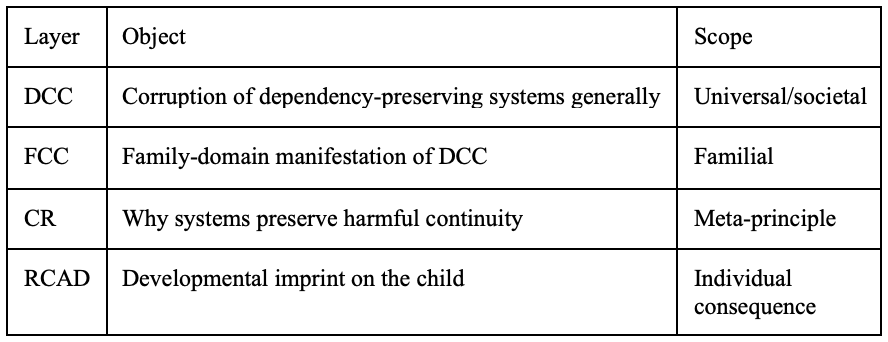
The rest of this article unpacks how these ideas emerged from a close, reconstructive reading of the State Department paper itself.
The broadest concept to emerge from this work is Dependency–Continuity Corruption, or DCC.
DCC describes what happens when any relationship built around dependency — a family, institution, marriage, school, church, workplace, or care system — gradually becomes more concerned with preserving itself than protecting the vulnerable people inside it.
In plain English: the social system starts defending its own continuity even when harm is obviously occurring.
This is different from how we usually think about crime. Traditional criminal law focuses on specific prohibited acts: assault, fraud, coercion, trafficking, theft, or abuse. DCC shifts the focus away from the isolated act and onto the surrounding structure.
The system surrounding the wrongdoing increasingly reorganises itself to “un-crime” the harm occurring inside it.
Over time, legitimacy of the setup becomes synthetic — self-validating and increasingly detached from the original moral, relational, or lawful grounding that once justified it.
The question that follows is no longer merely “what single illegal thing happened?”. Instead, the challenge is identifying how the social and legal governance structure itself has quietly reorganised around silence, contradiction, dependency, and resistance to interruption by insiders or outsiders.
This creates a fork in the road:
Healthy systems can tolerate truth. They can survive challenge, disclosure, correction, and temporary instability.
Corrupted systems cannot. They become increasingly invested in preserving appearances, maintaining continuity, and managing contradiction.
Vulnerable people trapped in the latter depend emotionally, financially, socially, or psychologically on the very people causing the harm; they know the consequences of stepping out of line by surfacing the truth.
You might think of DCC as a kind of ambient existential blackmail embedded into a dependency system.
Nobody may ever explicitly threaten the vulnerable person. Instead, they gradually learn that truth risks abandonment, interruption risks collapse, and maintaining continuity feels safer than confronting reality.
Continuity has a kind of social gravity: once routines, institutions, financial arrangements, and emotional dependencies stabilise around an abusive structure, preserving that continuity often becomes easier than acknowledging the underlying truth.
Over time, reconstructing the original (legitimising) reality becomes progressively harder. Records fragment, memories adapt, loyalties harden, institutions defer to persistence, and continuity itself gradually acquires the appearance of legitimacy simply because it has survived.
Importantly, DCC is not simply another word for dysfunction or family conflict.
All human systems try to preserve continuity; that is normal. The corruption begins when preserving the continuity of the broken system becomes more important than confronting the damage occurring inside it.
That is how some of the most destructive situations can remain outwardly respectable and institutionally stable for years. From the outside everything still appears intact. Internally, however, the institution has adapted itself around the protection and normalisation of harm.
Familial Continuity Corruption, or FCC, is the family-domain form of DCC. Continuity pressure, dependency, and divided loyalties become embedded into the child’s developmental environment.
In plain English: the family starts protecting the continuation of its power system more than the wellbeing of the people within it.
Families are among the most powerful dependency structures humans ever experience.
A child’s survival, identity, belonging, and entire developmental world depend on the very people who may be harming them. In some corrupted systems, the child gradually becomes the continuity anchor around which adult financial, relational, procedural, and emotional interests converge. That creates immense pressure to preserve familial continuity — even when something is deeply wrong.
FCC rarely looks criminal from the outside.
The routines continue. School, birthdays, holidays, and public appearances all carry on. Continuity itself becomes “proof” that everything must basically be fine.
Inside the family, these pressures become deeply personal and developmental. Disclosure becomes dangerous, silence becomes protective, and divided loyalties gradually become normalised survival strategies for the child.
Importantly, this does not require the child to perceive themselves as victimised, nor the adults to perceive themselves as malicious.
People inside these systems may simultaneously be harmed, adaptive, loving, dependent, protective, coercive, and trapped by continuity pressures they only partially understand themselves.
One of the most insidious features of FCC is that interruption of the dysfunctional dynamic itself gradually becomes reframed as the real threat.
The parent, relative, or child attempting to expose the contradiction and illegitimacy increasingly becomes treated as the source of instability rather than the underlying harm.
This is why FCC can become so difficult for outsiders to reconstruct accurately. By the time external bureaucratic systems encounter the situation, the family has often already adapted itself around the contradiction.
The visible conflict is no longer the original harm, but the disruption caused by attempts to confront it. By that stage, outsiders often encounter only the turbulence created by attempted interruption, not the continuity corruption that generated it.
Again, FCC is not another word for ordinary divorce, family conflict, or imperfect parenting. All families contain loyalty and continuity pressures. The corruption begins only when preserving the continuity of the family system becomes more important than truth, safeguarding, or the child’s developmental wellbeing.
That is how some of the most damaging family situations can remain outwardly respectable and “normal” for years — while quietly destroying the people inside them.
The next insight is Continuity Reversal, or CR.
CR describes the moment when preserving continuity quietly becomes more important than confronting reality.
In plain English: institutions, including families, start treating interruption itself as more dangerous than the underlying harm.
Most human systems — families, courts, schools, churches, corporations, governments — are designed to remain stable and intact.
Modern legal systems are heavily optimised around continuity, administrability, procedural finality, and stable narratives.
But corrupted systems invert the logic.
Safeguarding often depends on the ability to interrupt continuity safely and reconstruct what actually happened. Instead of continuity serving truth and safeguarding, truth and safeguarding become subordinate to continuity.
The priority quietly shifts from “what is happening?” to “how do we stop the disruption?”
This is why people who expose harm — the whistleblower, resisting parent, or distressed child — are often reframed as the real problem. They become “divisive”, “unstable”, or “difficult”.
The interrupter ends up looking more dangerous than the contradiction itself.
Institutions may reinforce this process, mostly unconsciously. Courts, schools, bureaucracies, and safeguarding systems often recognise and stabilise continuity because continuity is easier to administer than reconstruction.
The result is a powerful illusion. Because the corrupted system still appears operational, socially recognisable, and stable from the outside, outsiders assume it must still be fundamentally legitimate.
Continuity itself becomes evidence that nothing seriously wrong could be happening.
But continuity is not proof of health. Some social systems survive precisely because they become very good at absorbing, managing, normalising, and redistributing harm without ever resolving it.
The final layer is Recursive Continuity Architecture Distortion, or RCAD.
RCAD describes what prolonged exposure to continuity-corrupted family systems can do to a developing child.
In plain English: the child gradually adapts to contradiction, silence, divided loyalties, and emotional instability until those conditions begin to feel normal.
Children are extraordinarily adaptive. That survival skill helps them endure difficult environments, but it also allows them to internalise patterns that would look obviously unhealthy to an outsider. They learn not to say certain things aloud, not to challenge contradictions too directly, and not to destabilise the very system they depend upon for survival.
Over time this reshapes the child’s internal understanding of relationships. Love becomes entangled with fear, guilt, silence, and contradiction-management. Many of these children still appear intelligent, resilient, high-functioning, and socially successful from the outside.
The distortion runs deeper — in what they gradually come to believe human relationships are supposed to feel like.
The deepest distortion is not merely emotional injury, but alteration of the child’s continuity-management functions themselves — how they learn to negotiate truth, loyalty, interruption, attachment, and conflict.
This is why the pattern can become recursive across generations.
What once felt emotionally necessary can slowly begin to feel emotionally normal. This recursion does not require conscious intent. Continuity adaptations themselves can become normalised and later reproduced without participants fully understanding where the patterns originated — a kind of psycho-social virus.
The child may later struggle to recognise — or safely interrupt — similar dynamics in their own adult relationships, marriages, workplaces, institutions, or parenting.
That is the quiet tragedy of RCAD:
The harm does not simply injure the child in the present.
It quietly reshapes their entire map of what “normal” is supposed to feel like.
In some ways, this underlying pattern may prove more socially corrosive than the more legible “payloads” described in the State Department paper precisely because it is harder to recognise, harder to interrupt, and easier to normalise.
What this ultimately points toward is the possibility of a broader criminological category:
dependency–continuity crime.
In this model, the deepest wrong is not the visible payload — sex, labour, money, custody, ideology, or coercion — but the corruption of the dependency-preserving continuity system itself.
The crime is no longer merely the isolated act.
It is the progressive reorganisation of a human dependency structure around contradiction-management, interruption-suppression, continuity preservation, and the normalisation of harm.
Trafficking becomes one especially visible and legally tractable payload type of dependency–continuity crime — not the whole category.
Most criminal frameworks are geometric: they classify visible acts, bounded events, and defined payloads. But many of the most damaging modern harms are topological. The issue is no longer simply “what happened,” but what became connected to what — dependency to coercion, attachment to contradiction, continuity to silence.
That is why some social systems remain outwardly lawful, stable, and respectable while quietly becoming corrosive underneath. Continuity itself acquires evidentiary weight. The fact that the system persists is treated as proof that it must be legitimate.
But continuity is not proof of health.
Some social systems survive precisely because they become good at normalising the conditions that should have triggered ground-up reconstruction.
This carries a difficult implication for law and safeguarding. Modern legal systems are heavily optimised around continuity, administrability, procedural finality, and stable narratives. In most cases, that is both necessary and good.
But once coherent indicators of dependency–continuity corruption emerge, continuity itself can no longer remain automatically presumptive evidence of legitimacy.
At that point, safeguarding may require what amounts to a controlled “meta-interrupt” — a temporary suspension of continuity-presumption in favour of reconstructive inquiry into what is actually happening inside the family system.
None of this is easy because law and safeguarding optimise for different things.
Law needs administrable categories, procedural finality, and bounded acts.
Safeguarding requires the harder task of safely interrupting continuity and reconstructing what actually happened inside systems that have adapted around non-disclosure.
Civilisation depends on continuity — which means respecting resource constraints. Not every family dispute can be fully reconstructed to source.
The problem begins when continuity becomes detached from truth and safeguarding — when preserving the social system quietly becomes more important than protecting the vulnerable people inside it.
And that, perhaps, is the clearest warning sign of all that we may be looking at something bigger than just child trafficking — awful as that already is.
I honestly don't know how "civilization" will crawl out from this steaming heap of dung with so many layers of dysfunction.
A brilliant exposition of the interaction of Family Dynamics with the Legal System...and including the "Plain English" translation of the concepts, along the way, is quite helpful. Well done, Martin !