

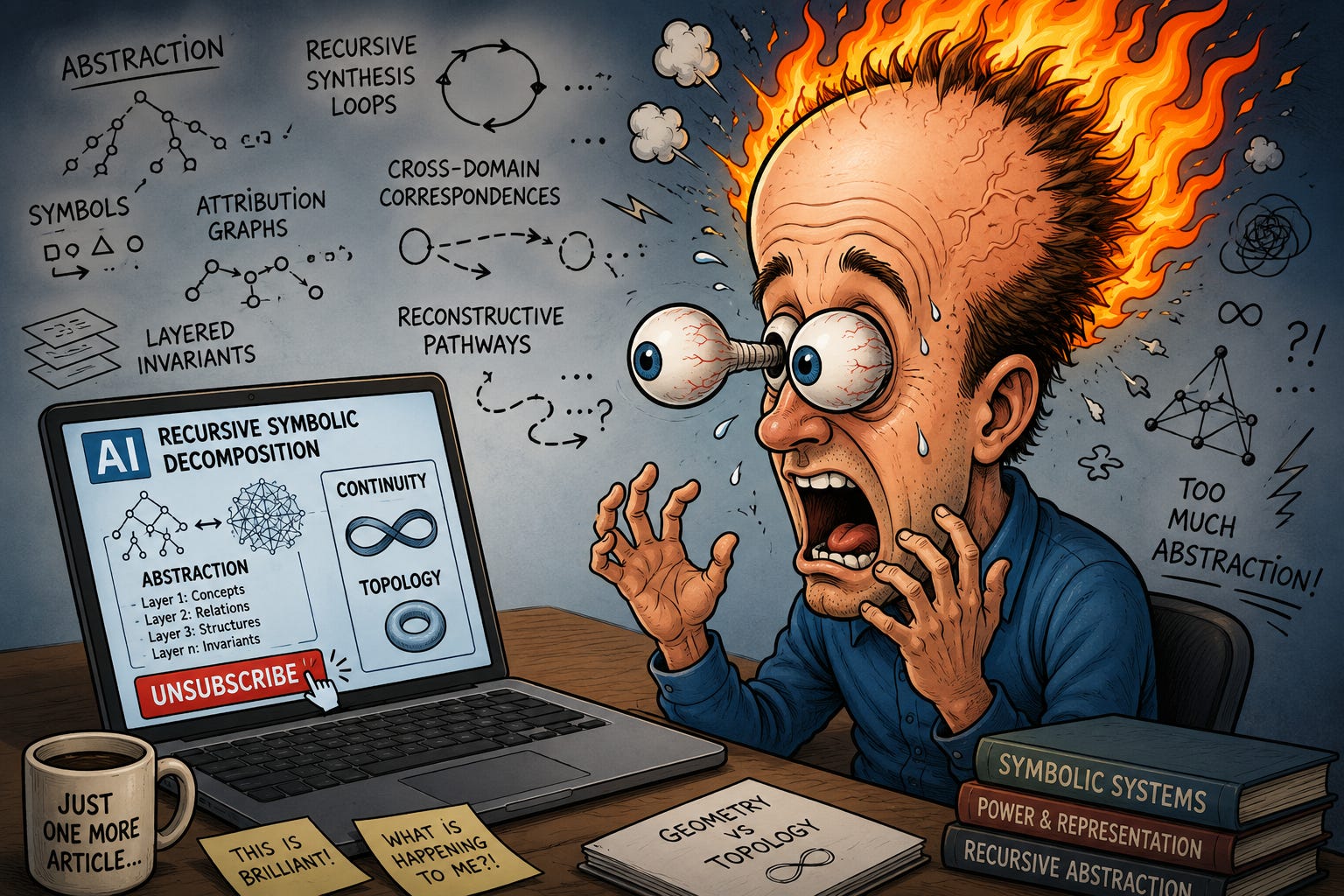
What if AI is creating a rift between those who are cognitively accelerating and those who are instinctively braking — and we are seeing the early signs of a social and cultural tension that is about to become acute?
Let me bring that thought to life with an experience I had yesterday — trivial detail which will become fodder for a deeper reflection.
I sat down at my laptop and started working on yesterday’s article on scalable civilisation at 11.40am. I know, because the first entry in the AI chat log has a timestamp.
The final text was published at 7.14pm. It’s also timestamped, and is in my email inbox.
Between those times, I worked on it pretty much nonstop, without a break. That is normally considered a day’s work.
I wrote most of the text by hand, and used AI as a tool to clarify expression and ensure seamless logic.
A few bridging sections were AI-assisted where review identified conceptual gaps needing connective tissue.
There is a point to telling you this. Hold with me.
Having done a full day’s work, I was tired and hungry, having had no lunch. I was also quite pleased with what I had produced, so treated myself to a steak dinner at the local pub. While eating, I re-read what I had written; I know the subject matter is a minority sport, and that the narrowing and deepening of my focus may mean a smaller cohort travels with me in future.
Then an email popped into the separate inbox I keep for newsletter replies and other Substack subscriptions. It was a bit of a jolt (although the steak was nice so I wasn’t too upset)!
Take me off your mailing list !!!
It’s just spam now. Too much nearly every day and half of it written by AI.
I’ve emailed you before to take me off your contacts list. You just ignore me. Fuck off!
I told Debra to hit the unsubscribe button and not speak to me that way. I then checked through my newsletter inbox, and three days earlier I had gotten one from her screaming “TAKE ME OFF YOUR MAILING LIST / GET YOUR HEAD SORTED!!!” — unopened as it happens.
Now, having done this work for many years — including the rough-and-tumble of social media — I am used to emotionally dysregulated responses. The abuse is rarely truly personal, even if it initially feels that way. People are usually acting out their own fears, frustrations, wounds, and cognitive overloads.
But it left me wondering whether something deeper was being revealed underneath the outburst.
Ironically, Debra — now manually unsubscribed and not receiving this follow-up article — unconsciously illustrated the exact geometry-versus-topology distinction I had spent the entire day writing about.
Substack’s architecture deliberately places continuity control at the subscriber endpoint, not the publisher endpoint. In practice, I cannot directly unsubscribe someone from my phone at all, and can only manually do so from the desktop interface. Likewise, I cannot change a subscriber’s email address for them; readers who change address must unsubscribe and resubscribe themselves.
That is not a bug. It is part of the continuity topology of the system.
The lawful reconstructive path already existed:
subscriber → unsubscribe link → platform state transition → continuity severed.
But Debra refused to traverse that path.
Instead, she repeatedly demanded that I personally perform the transition from outside the authorised continuity chain:
“Take me off your mailing list!”
“Delete my contact details!”
That is geometry-first thinking.
The problem is imagined as a local object attached to a local human:
“my email address exists somewhere near Martin; Martin must remove it.”
But the actual system is topological, not geometrical. The continuity relation lives in the structure of permissions, pathways, consent states, auditability, and endpoint authority. The state transition can only lawfully originate from the subscriber node itself.
Ironically, the harder she pushed emotionally against the topology, the more she demonstrated the very phenomenon I had been writing about all day: under cognitive or emotional stress, humans often abandon reconstructive pathways and instead attempt to force continuity transitions through proximate human nodes.
It could be an unsubscribe from a newsletter.
Or it could be a family court unfairly endorsing the status quo of a child taken unlawfully by one parent.
The lawful path still existed.
But subjectively, it no longer felt real.
What struck me afterwards was that this tiny interaction perfectly mirrored the deeper distributed-state problem at the heart of ∆R — the civilisation-level “reconstructable reality” problem.
Distributed systems do not possess one single globally synchronised state equally visible to all participants. Each node operates from partial local visibility, delayed updates, and imperfect continuity.
Human cognition turns out to work much the same way.
Debra believed she had already communicated her intent to leave and been ignored. From her local perspective, the continuity relation had already broken down. I, meanwhile, had not even opened the earlier email, and was operating from a completely different local state model in which the lawful reconstructive path — the unsubscribe mechanism — still remained intact and obvious.
Neither of us possessed the same continuity state.
The result was not merely disagreement, but continuity divergence.
We no longer inhabited the same ‘state universe’.
What fascinated me was how rapidly the reconstructive topology disappeared psychologically once emotional stress entered the system. The lawful path still objectively existed. But subjectively it no longer felt ‘real enough’ for her to traverse.
Instead, the relationship collapsed geometrically toward the nearest visible human node:
Martin must fix this.
Martin must delete me.
Martin is ignoring me.
But her continuity relationship wasn’t really with Martin. It was with Substack. The apparent direct continuity between writer and reader is itself a reconstructed illusion layered on top of the platform’s deeper publish-subscribe continuity machinery.
I write essays and then go and eat steak dinners afterwards. I do not sit waiting for unsubscribe events in real time. That is what the platform exists to handle.
But that technical continuity structure itself faded from view.
Her final sign-off to my insistence that she unsubscribe herself was:
I have every right to!
That, I increasingly suspect, is not merely a problem with “angry people on the Internet”. It may be an early symptom of something wider happening to cognition and social continuity under AI-accelerated informational overload conditions.
Debra isn’t the problem.
Debra is the symptom.
There is an even deeper layer to what Debra was reacting against.
Her experience was that AI-augmented cognition was becoming overwhelming and had lost the human-scale grounding she had originally associated with my writing. In her eyes, the emotional continuity relation itself had degraded.
“Spam” and “half AI” were factually disconnected from the very real human effort involved, but her perception was itself a social fact requiring explanation.
The difficult reality is that I am knowingly pushing beyond what many readers can comfortably ingest. That is not arrogance; it is simply the nature of the symbolic mediation problem I am now confronting. Once you start dealing with reconstructability, governance, distributed cognition, institutional topology, and AI-accelerated synthesis simultaneously, the abstraction density rises very quickly.
There is no true kindergarten version available.
Some problems are intrinsically resistant to reduction into slogans and sound bites. The difficulty is not accidental. Systems of power often persist precisely because the reconstructive effort needed to understand them exceeds what most people can sustainably tolerate.
What made this suddenly feel much more acute was that, in parallel with Debra’s outburst, I had also received an email from Jeffry — a longtime supporter who publishes his own private newsletter summarising developments in the American freedom movement. He occasionally cites my work in his mailings, and I am sure he will not mind me reproducing his comments here for illustrative purposes.
Introducing my two recent articles applying the ΩΛ∆∑ attribution framework to Trump’s political speech, he wrote:
“And here’s two offerings from Martin Geddes, for ‘The heady’ on my list… The dude has been putting out some pretty deep dive heady schtuff lately…”
He then added, with touching honesty:
“Here’s the latest two offerings that I personally couldn’t get completely through…”
That struck me.
Debra reacted with hostility.
Jeffry reacted with humility.
But underneath both responses lay the same deeper signal:
The cognitive terrain itself is shifting.
Amusingly, the “ΩΛ∆∑” in my article title was replaced in transit with “(greek symbols)” — and in a sense it really is becoming “all Greek” to many people.
What especially caught my attention, however, was Jeffry’s parenthetical aside:
“he probably spends too much time with AI, probably to his detriment”
That observation lingered with me because it was simultaneously affectionate, perceptive, and potentially true.
AI does not merely increase writing throughput. It changes the topology of cognition itself — and topology, at root, is the study of continuity and connectedness under transformation. Social cohesion and fragmentation are therefore not side-effects of AI acceleration, but intrinsic consequences of altered cognitive topology.
When you spend extended periods inside recursive synthesis loops — cross-linking concepts, refining abstractions, restructuring arguments, exploring correspondences, reconstructing continuity across domains — your internal cognitive tempo begins to drift away from ordinary conversational cadence.
You stop thinking primarily in linear narrative chains and begin thinking in continuity structures, attribution graphs, symbolic compressions, layered invariants, and reconstructive pathways.
Living inside these reconstructive abstraction loops can be exhilarating.
It can also become socially isolating.
I know that to my cost.
You too are probably experiencing elements of Debra and Jeffry reading my recent work.
That is the feeling I am naming aloud.
The issue is not simply “too much information”. Human beings have always coped with large amounts of information. The deeper issue is that AI dramatically increases the rate at which abstraction, synthesis, and symbolic mediation can occur.
And human social cognition may not yet have stable norms for handling the resulting social and cultural divergence in cognitive tempo.
In my own case, AI does not feel alien. Much of my academic, professional, and public life has effectively been training for this moment: designing a CPU before leaving school; formal methods and mathematical abstraction at Oxford; relational databases at Oracle in the 1990s; developer API platforms at Sprint; telecoms performance science and the ∆Q algebra of degradation; recursive networking architectures like RINA; years of Q analysis and fifth-generation warfare; public narrative decomposition; and now attribution analysis and synthetic governance.
Seen that way, AI feels less like a foreign intelligence than an amplification of cognitive patterns I have spent decades developing across multiple domains.
Not everyone experiences these tools that way.
Jeffry sensed that tension between cognitive acceleration and legacy expectations instinctively.
Unlike Debra, he did not reject the experience emotionally. But he still recognised something important:
The cognitive terrain itself is beginning to fracture into different continuity realities.
The problem of cognitive division and continuity fragmentation resulting from AI adoption is not located in me, or my writing. It is universal.
For instance, I read an X post this morning from Rimsha Bhardwaj summarising a Wharton study on student use of AI as a learning tool. In brief, students who outsourced cognition to AI performed worse later in pen-and-paper tests than those who largely avoided AI assistance, even when the AI had initially functioned as an apparently effective accelerant of learning.
In other words, the AI-assisted students performed better while operating inside their native cognitive environment, but degraded once forced into cognitive exile.
In one sense the result is almost banal:
what did you expect?
If you train inside one reconstructive environment and are later evaluated inside another, continuity degradation is inevitable.
But the study was almost more interesting for what it did not test. It did not examine how “internal cognition only” students would perform if suddenly handed advanced external cognition tools cold — nor compare them to students who had acquired a different skill entirely:
how to orchestrate cognition across human and machine layers to sustain higher symbolic throughput.
We have encountered versions of this transition before with slide rules, calculators, spreadsheets, search engines, and computer algebra systems. Entire categories of human advantage disappear once continuity is reconstructed differently. The tolerance for repetitive manual administration that once conveyed educational or professional status may no longer function as an edge.
But the deeper issue underneath the study is not really AI performance at all.
It is:
what is education actually for?
The answer changes radically once cognition itself becomes distributed, externally scaffolded, recursively synthesised, and topology-dependent.
These three vignettes — Debra, Jeffry, and Rimsha — hint at the cognitive chasm beginning to open across society.
The post-structuralist philosophers were right about at least one thing: power is mediated through symbolic systems. Law, finance, media, bureaucracy, academia, politics, and now AI all operate through layered structures of representation, attribution, abstraction, and interpretation.
AI is a profoundly symbol-native technology. It therefore advantages those who are comfortable operating recursively inside symbolic systems, since they can interface more effectively with the underlying power-mediation layer itself.
What is emerging is not merely “better writing” or faster information retrieval, but new forms of cognitive topology.
My own Canon framework is what happens when someone sufficiently skilled is willing to follow recursive symbolic decomposition all the way to its civilisational endpoint under AI amplification.
Reading that sentence back to myself is quite a mouthful.
If you are feeling a sense of “struggling to keep up” — that itself is the story.
The personal cost of cognitive acceleration is not simply overload.
It is waking up one day and realising that some people now experience your cognition as inspiration, others as alienation — and increasingly fewer as simply normal.
You already feel it.
Now you can name it.
A cognitive chasm.
I continue to be amazed at the avenues your wee noggin takes in your path of the cognitive dissident. I don't react in either way as your story tells but my response is WTF? How does he go there? I can read this stuff then walk out into my garden and happily pick up chicken shit for the rest of the day. I think the future needs both of us.
I find myself fascinated, Martin, but I'm not sure how much is related to AI as opposed to another factor. In the year 2000 or so, I took the career aptitude test provided by the Rockport Institute. I don't know what it is like nowadays, but then it tested about 11 pretty much orthogonal factors. Most people have a few factors at which they excel and several where they lag, and that helps identify the careers or work that they should focus on. Some are high-rated in all factors, and they have a tougher job figuring out what to do with their work lives.
There was one factor that stands out in relation to your article today. That one was whether the test taker was a team player or a maestro. Team players naturally use normal language to communicate with others and build or at least participate with others in a team. On the other hand, maestros follow their own path, make up their own language many times, and tend to go way out in their arc through life.
There is a real and fundamental difference between team-type people (which is most people) and maestros.
I am high in all factors, and yes, I have done all sorts of things in my life, having difficulty settling on any task in particular but simply liking to read and think and sometimes discuss material with others. I'm a generalist. Further, it's easier for me because I am a team-leaning person despite the fact that my cognition regularly goes way out away from what most people can easily follow or even want to follow. However, because I lean toward normal language in my communications, I rarely feel lonely or divorced from the rest of the world in a cognitive sense.
I will hazard a likely guess that you on the other hand are a maestro. Your life is likely filled (as is your recent work) with symbols, new words, new use of existing words, all of which fit to and express in your eyes what you are trying to communicate ever so precisely. However, the use of special words and contexts without rooting it all in normal "team" language creates a chasm between you and those you seek to enlighten.
AI may aggravate that division between "team-normal" and maestro, but it has not created that chasm. That chasm has been around for millennia.
Although it may feel in a way foreign to you, or perhaps more precisely, lacking in discrete conceptual boundaries, if you were to use AI to write your new insights and systems into fuzzier team-language posts, my belief is that you would be able to reach (many) more people in ways they can follow and perhaps feel the natural chasm between you and everyone else rather less than you do now. Further, you will reach more people and spread your concepts more easily (though less precisely than you might wish).
In this sense AI not only can help you go out in a great arc of intellectual exploration almost nobody other than you can pursue successfully but might also perhaps then become your translator, your Boswell, to bring back the rich lode of new concepts you have discovered and make them into team-language communications (more) easily accessible to far more people. Maestro work, brilliant as it might be, is largely useless and lost unless it can be made accessible to the normal people who are the ones who must apply it in the human world.
Think of Tolkien, who had a massively interlinked network of thoughts and concepts brilliantly operational in his head. He could have written a massive scholarly tome like Aquinas' Summa Theologica. He chose instead to write one of the most soaring, unforgettable epoch novel sets ever written in all of history and has in some way or another enlightened literally a billion people through that human touch.
You need to finish fleshing out your current work (which I still believe is not yet finished because it does not account for or cover how psychopathic predation naturally is advantaged as societal systems degrade and how psychopaths are therefore incentivized to degrade such systems faster) and how to fix that issue *first* so that normal people have a real chance to fix things longer-term with some likelihood of success.
But then you need to figure out how to gift it back to us all with the necessary human touch. For all I know at this point, you may find that the toughest part of the work. :-)